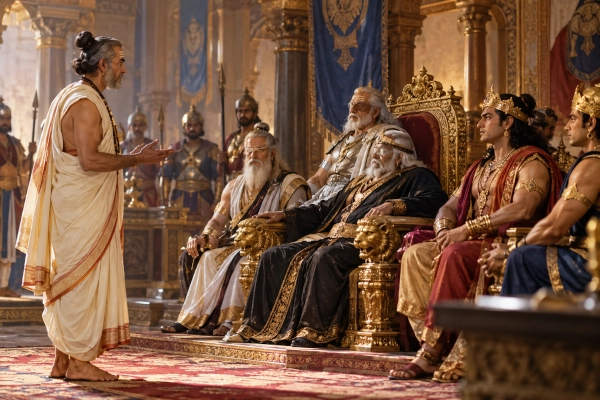
Before the armies gathered at Kurukshetra, before Krishna undertook his celebrated peace mission, and before the final choices of war were made, the Mahabharata records an earlier formal diplomatic effort by the Pandava alliance. After the Pandavas completed their exile and emerged from the conditions imposed upon them, King Drupada of Panchala sent his learned priest to Hastinapura to present their case before the Kuru court.
The mission was not conceived as an ultimatum. Drupada’s priest was expected to argue that the Pandavas had fulfilled the terms imposed upon them and should therefore receive their legitimate share of the kingdom. His task was to persuade Dhritarashtra, but his words were also directed towards influential elders such as Bhishma and Drona, men whose moral authority could potentially shape the decision of the court.
This makes the episode one of the Mahabharata’s clearest studies in multi-level diplomacy. The envoy was addressing the king formally, but the success of his mission depended equally upon whether respected figures within the Kuru establishment could be persuaded to support conciliation.
The Political Situation After the Pandavas’ Exile
The diplomatic mission took place after the Pandavas had completed the long period of exile that followed the disastrous dice game at Hastinapura. The terms imposed upon them required twelve years in the forest followed by a thirteenth year spent in concealment. Having endured both stages, the Pandavas considered the conditions fulfilled and expected restoration of their political rights.
Their return, however, did not automatically produce a settlement. Duryodhana remained unwilling to surrender territory, while Dhritarashtra continued to occupy the throne at the centre of a court divided between dynastic loyalty, moral obligation and political fear.
The dispute was therefore no longer simply about whether the Pandavas had survived exile. It concerned whether an agreement solemnly imposed upon them would actually be honoured once they had complied with it.
That distinction gave the Pandava side considerable diplomatic strength. Their position could be presented not as a demand for new territory, but as a request for the restoration of rights that had already been recognised within the political framework of the Kuru kingdom.
Why Drupada Sent a Priest Rather Than a Warrior
King Drupada of Panchala, father of Draupadi and one of the Pandavas’ most important allies, chose a priest as his envoy rather than sending a military commander or prince.
That decision was politically intelligent. A priest carried moral and intellectual authority and could speak in terms of Dharma, justice, memory and obligation without appearing to threaten immediate military action. His presence made the mission visibly diplomatic rather than coercive.
The envoy’s role was therefore not simply to deliver a message. He had to construct an argument strong enough to make refusal politically uncomfortable.
Drupada understood that Hastinapura contained men who knew the history of the dispute and were aware of the injustices suffered by the Pandavas. The mission sought to activate that awareness.
The Pandavas’ Claim Was Framed as a Question of Justice
The priest’s argument rested upon a straightforward political principle: the Pandavas had complied with the conditions imposed upon them and should therefore receive what was due to them.
This framing was important because it placed the burden of justification on the Kaurava side. If the Pandavas had fulfilled their obligations, the question before the court became why the agreement should not now be honoured.
The envoy could therefore appeal simultaneously to law, custom, family obligation and royal reputation. A ruler who refused to honour an agreement risked more than conflict with relatives. He risked weakening the credibility of political promises themselves.
In the world of the Mahabharata, where alliances and royal agreements depended heavily on personal honour, such a charge carried serious weight.
The Real Audience Was Larger Than Dhritarashtra
Drupada’s priest formally addressed King Dhritarashtra, but the deeper strategy of the mission becomes visible when the composition of the Kuru court is considered.
Dhritarashtra was not the only person whose opinion mattered. Bhishma, Drona, Kripa, Vidura and other senior figures possessed differing degrees of moral and political influence. Several of them had complicated relationships with Duryodhana and did not necessarily share his determination to deny the Pandavas their inheritance.
The envoy’s task was therefore to place the issue openly before these men.
By presenting the Pandava claim as reasonable and lawful, he could strengthen those within the Kuru establishment who already favoured compromise. Even if he failed to change Duryodhana’s position, he could make continued refusal harder to defend before the elders of the dynasty.
This is one of the most sophisticated elements of the mission.
Diplomacy Directed at Moderates Inside the Opposing Court
Modern diplomacy often operates in exactly this way. An ambassador may formally address a government, but the message may be designed equally for ministers, legislators, military leaders, bureaucrats, allied political groups or public opinion.
Drupada’s priest was doing something comparable within the political structure of Hastinapura.
He did not need every member of the Kuru court to agree with him. He needed enough respected figures to recognise that the Pandava demand was legitimate and that Duryodhana’s refusal could lead the kingdom towards catastrophe.
The diplomatic objective was therefore broader than persuading a single ruler. It was an attempt to shift the internal balance of opinion within Hastinapura.
Bhishma Was Particularly Important
Among those present, Bhishma represented perhaps the most important potential audience.
He possessed enormous prestige within the Kuru dynasty and had devoted his life to preserving the throne of Hastinapura. His military reputation was unmatched, but his political importance came from something deeper: he embodied continuity between generations of Kuru rulers.
A public acknowledgement from Bhishma that the Pandavas deserved justice would carry considerable weight.
The envoy therefore had reason to frame his message in language that would appeal to Bhishma’s understanding of duty and dynastic responsibility. The question was not merely whether the Pandavas could fight successfully, but whether the Kuru house could preserve its legitimacy while denying them what they claimed as their rightful share.
Drona Was Another Audience That Could Not Be Ignored
Drona occupied a different but equally complicated position.
He had trained both the Pandavas and Kauravas in warfare and had deep personal relationships with members of both branches of the family. His political position at Hastinapura tied him to the Kuru establishment, but his past made the approaching conflict deeply personal.
Drupada’s own history with Drona was bitter, yet the priest’s diplomatic mission required that such personal hostility remain secondary to the larger political objective.
That itself demonstrates a fundamental principle of diplomacy: states and rulers often communicate through people with whom they have difficult histories when larger interests demand it.
The Pandava coalition could not afford to ignore Drona merely because Drupada had once been his enemy.
Persuasion Came Before Coercion
The priest’s mission is important because it occurred before the Pandava side exhausted peaceful alternatives.
The Pandavas and their allies were already capable of assembling considerable military strength. Drupada, Virata and other kings could provide troops, while Arjuna and Bhima alone represented formidable battlefield power.
Yet the first formal approach to Hastinapura was based on argument rather than intimidation.
That choice helped establish an important diplomatic record. Should war eventually come, the Pandavas could demonstrate that they had first sought a negotiated settlement.
Diplomacy therefore served both an immediate and a longer-term purpose. It attempted to prevent war, while also establishing responsibility should negotiations fail.
Negotiations Can Shape Legitimacy Even When They Fail
A diplomatic mission does not become meaningless simply because it fails to produce an agreement.
Drupada’s priest did not succeed in obtaining the restoration of the Pandavas’ kingdom, but the mission helped clarify the political positions of both sides.
The Pandavas had stated their claim through a formal envoy. Hastinapura had been given an opportunity to resolve the dispute without war. Senior Kuru figures had been confronted directly with the consequences of continued refusal.
This created a record of attempted conciliation before the conflict escalated.
In modern international relations, the same principle often applies. Negotiations can establish which party proposed compromise, which terms were considered and where the process broke down. Such a record can influence allies, neutral powers and later political narratives.
Drupada’s Priest Was Only the Beginning of the Diplomatic Sequence
The mission also forms the opening stage of a larger diplomatic chain in the Udyoga Parva, the section of the Mahabharata devoted heavily to preparations, alliances and negotiations before the war.
After the priest’s mission, further exchanges followed. Sanjaya was sent by Dhritarashtra to the Pandavas, and eventually Krishna himself travelled to Hastinapura in the most famous peace mission of the epic.
The progression is important. The Mahabharata does not move directly from exile to battle. It devotes substantial attention to attempts at negotiation.
Each mission also becomes progressively more consequential. Drupada’s priest opens the formal dialogue. Sanjaya carries messages in the opposite direction. Krishna’s mission represents the last major attempt to reach a political settlement before war becomes unavoidable.
The Mission Shows the Importance of Choosing the Right Messenger
Envoys are never neutral instruments. Their identity affects how a message is received.
Drupada’s choice of a learned priest gave the Pandava position a deliberately sober tone. The envoy could invoke Dharma and political responsibility without sounding like a battlefield commander delivering terms.
In diplomacy, credibility often depends upon the messenger as much as the message. A negotiator trusted for wisdom, restraint or integrity can say things that would sound threatening if spoken by a military leader.
The Mahabharata repeatedly demonstrates awareness of this principle. Krishna later becomes the supreme example, but Drupada’s priest represents an earlier and more restrained version of the same diplomatic calculation.
Diplomacy Often Operates on More Than One Level
The episode also illustrates the difference between the formal recipient of a diplomatic message and its actual audiences.
Dhritarashtra was the formal authority. Duryodhana was the central obstacle. Bhishma and Drona represented influential institutional voices. Vidura embodied another strand of political conscience within the court.
The priest’s speech therefore had multiple purposes at once. He had to address the king respectfully, challenge the logic of continued refusal, encourage moderate elders and demonstrate that the Pandavas were still willing to seek peace.
Modern diplomacy frequently operates in the same manner. A public statement to one government may simultaneously reassure allies, influence officials inside the other government and signal reasonableness to neutral observers.
The Limits of Moderate Voices
The mission also reveals a recurring weakness in diplomacy: influential moderates cannot always control the final decision.
Bhishma, Drona and other senior Kuru figures possessed enormous prestige, but prestige did not automatically translate into political control over Duryodhana.
The distinction between influence and decision-making authority is crucial. A government can contain respected figures who favour compromise while actual policy remains controlled by a narrower leadership group.
Drupada’s diplomatic strategy recognised the importance of internal opinion, but the episode also demonstrates the limits of relying upon it.
A Negotiator Must Understand the Political Structure Behind the Throne
Dhritarashtra was king, yet the politics of Hastinapura could not be understood simply by looking at the throne.
Duryodhana exercised powerful influence. Bhishma possessed moral authority. Drona commanded military respect. Vidura offered counsel rooted in prudence and Dharma. Karna strengthened Duryodhana’s determination and represented another major political and military force.
Any diplomatic mission that ignored these relationships would misunderstand how decisions were actually made.
Drupada’s priest therefore entered not merely a royal court but a complex political system containing competing loyalties and centres of influence.
That remains one of the most enduring lessons of the episode: effective diplomacy requires understanding who formally governs, who actually influences decisions and who might still be persuaded.
A Peace Mission That Prepared the Moral Ground for What Followed
The embassy of Drupada’s priest did not prevent the Kurukshetra War, but it occupies an important place in the diplomatic architecture of the Mahabharata.
It established that the Pandava side was willing to seek restoration through negotiation before resorting to force. It presented their claim before the entire Kuru establishment and forced influential elders to confront the consequences of continued refusal.
Most importantly, it showed that diplomacy in the Mahabharata was never merely an exchange between two rulers. It involved alliances, court factions, senior advisers, family loyalties and competing ideas of Dharma.
The mission failed to produce settlement, but it succeeded in exposing the political problem clearly. Hastinapura still possessed voices capable of recognising the justice of compromise, yet those voices were increasingly unable to redirect the course chosen by Duryodhana.
That failure would shape every diplomatic mission that followed.
The Diplomatic Lesson
Drupada’s priest was officially speaking to Dhritarashtra, but his real audience was the entire Kuru power structure. His mission illustrates a principle that remains central to diplomacy: negotiations often seek to influence not only the person across the table, but also the people around that person who may shape the final decision.
Diplomacy therefore operates simultaneously at several levels. A message may be addressed to a government while strengthening moderates inside it, reassuring allies outside it and establishing legitimacy before a wider political audience.
The first formal Pandava mission to Hastinapura demonstrates that this understanding of diplomacy was already deeply embedded in the Mahabharata’s account of the road to Kurukshetra.
References
Mahabharata, Udyoga Parva — passages describing the Pandava consultations after exile, Drupada’s proposal to send his priest and the priest’s embassy to Hastinapura.
Mahabharata, Udyoga Parva, Critical Edition — Bhandarkar Oriental Research Institute, Pune.
Kisari Mohan Ganguli Translation of the Mahabharata — Udyoga Parva, sections covering the mission of Drupada’s priest and subsequent diplomatic exchanges.
Bibek Debroy, The Mahabharata — Udyoga Parva translation based on the Critical Edition.
You may also like
-
One Voice – One Resolve – One India: Namami Bharatam Marks 150 Years of Vande Mataram Across the Nation
-
India and Finland Expand Technology Dialogue as New Delhi Deepens European Partnerships
-
India and Slovenia Explore Manufacturing, Energy and Digital Opportunities Around India-EU Trade Expansion
-
India-Pacific Islands Cooperation Gets Fresh Push at Second FIPIC Foreign Ministers’ Meeting
-
India and Netherlands Deepen Water Partnership With Two MoUs for Gujarat’s Kalpasar Project
