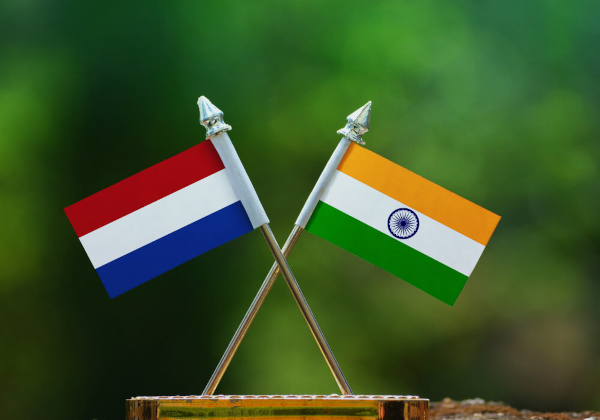
India and the Netherlands have expanded their long-standing cooperation in water management with the signing of two tripartite Memoranda of Understanding focused on technical cooperation and capacity building for Gujarat’s Kalpasar Project. The agreements were concluded on the sidelines of the 9th India International Water Week 2026 at Bharat Mandapam in New Delhi.
The bilateral engagement was chaired by Union Minister for Jal Shakti C. R. Patil and Netherlands Vice Minister for Infrastructure and Water Management Jaap Slootmaker under the India–Netherlands Strategic Partnership on Water. The discussions focused on strengthening technical cooperation, sharing advanced water-management expertise and supporting the planning and implementation of the Kalpasar Project.
Two Tripartite MoUs for the Kalpasar Project
The two MoUs bring together the Central Water Commission, the Kalpasar Department of the Government of Gujarat and two leading Dutch knowledge institutions, Deltares and Delft University of Technology.
The agreements are intended to create a structured framework for technical collaboration, knowledge transfer and capacity building. Dutch expertise will be brought into areas relevant to the design and execution of the Kalpasar Project, while Indian agencies will gain access to experience accumulated through major coastal and water-management projects in the Netherlands.
Union Minister C. R. Patil said the participation of Deltares and TU Delft would deepen cooperation in project execution and capacity building. He expressed confidence that the agreements would provide a strong foundation for cooperation between the two countries as work on the project progresses.
Kalpasar Envisages a Major Freshwater Reservoir
The Kalpasar Project envisages the creation of a freshwater reservoir using runoff from the Sabarmati, Mahi and Dhadhar rivers, with additional water conveyed from the Narmada River.
The scale and coastal setting of the project make its planning dependent on a combination of hydrology, coastal engineering, flood management, structural design and environmental assessment. These are areas in which the Netherlands has accumulated extensive expertise through its own long history of managing water in low-lying and coastal regions.
The latest agreements are therefore intended to bring specialist Dutch knowledge into the Indian project while strengthening domestic technical capabilities for the long term.
Cooperation Built on May 2026 Understanding
The Kalpasar Project had figured in discussions during Prime Minister Narendra Modi’s visit to the Netherlands in May 2026. A Letter of Intent covering technical cooperation on the project was subsequently signed on 16 May 2026.
The new MoUs translate that earlier understanding into institution-to-institution cooperation involving the Central Water Commission, Gujarat’s Kalpasar authorities and Dutch research and engineering institutions.
The process was further advanced during an Indian delegation’s visit to the Netherlands in July 2026, when officials studied Dutch approaches to flood protection, coastal infrastructure, hydraulic modelling, sluice systems, pumping infrastructure, dyke technologies and ecological solutions.
Lessons From the Netherlands’ Afsluitdijk
One of the important reference points during the India–Netherlands discussions has been the Afsluitdijk, the major Dutch water-control structure that has played a central role in flood protection and water management for nearly a century.
The Dutch side highlighted the value of sharing experience gained from the construction, operation and present-day renewal of such infrastructure. For the Kalpasar Project, the relevance lies not in replicating a Dutch structure directly, but in drawing from decades of engineering knowledge relating to coastal barriers, hydraulic systems, water exchange and long-term infrastructure management.
Vice Minister Jaap Slootmaker also emphasised that cooperation should include lessons learned in environmental areas such as ecology and fish migration, alongside the engineering aspects of large water-control projects.
Deltares to Support Modelling and Engineering
Under the cooperation framework, Deltares is expected to contribute expertise across several technical areas relevant to the Kalpasar Project.
These include hydraulic and hydrological modelling, coastal and structural engineering, technical review, climate resilience, digital applications, capacity building and knowledge transfer. Such modelling will be important for understanding water flows, reservoir behaviour, coastal dynamics and the performance of associated structures under different operating and climatic conditions.
The collaboration can also help Indian agencies evaluate complex design choices using advanced modelling and simulation before major infrastructure decisions are taken.
TU Delft to Strengthen Knowledge and Capacity Building
The involvement of Delft University of Technology brings an academic and research dimension to the partnership. Cooperation with TU Delft is expected to strengthen technical capacity, facilitate knowledge exchange and expose Indian engineers and institutions to advanced research in water engineering and coastal infrastructure.
For large and long-duration water projects, institutional knowledge can be as important as individual engineering solutions. Training engineers, developing modelling capabilities and building research partnerships can therefore create benefits extending beyond the immediate Kalpasar Project.
India–Netherlands Water Partnership Expands Further
Water management has emerged as an important area of cooperation between India and the Netherlands because both countries face complex challenges involving rivers, urbanisation, coastal regions, climate resilience and water security.
The Kalpasar agreements take this partnership into a more specialised engineering phase by linking Indian public institutions directly with Dutch technical and academic organisations.
Rather than remaining limited to consultations or exchange visits, the collaboration now provides a framework through which technical expertise can be applied to a specific Indian infrastructure project.
Combining Engineering With Ecological Planning
One notable aspect of the discussions was the emphasis placed on ecological considerations alongside infrastructure development. Large coastal water-management projects can affect tidal movement, sediment transport, aquatic habitats and fish migration, making environmental planning an integral part of engineering design.
The Dutch experience offers lessons not only in constructing major water-control systems but also in modifying and upgrading older infrastructure to meet contemporary environmental and climate-resilience requirements.
For Kalpasar, integrating these lessons at the planning and design stages could help Indian authorities evaluate engineering, ecological and operational requirements within the same technical framework.
A New Phase in Technical Water Cooperation
The two MoUs give the India–Netherlands Strategic Partnership on Water a concrete project around which government agencies, engineers, researchers and knowledge institutions can work together.
For India, the immediate focus is the Kalpasar Project, but the institutional capabilities developed through hydraulic modelling, coastal engineering, climate resilience and technical training could have wider relevance for future water infrastructure projects.
The partnership therefore extends beyond the transfer of individual technologies. It seeks to combine Dutch experience in managing complex water systems with Indian engineering requirements and domestic institutional capacity, creating a deeper foundation for cooperation in one of the most technically demanding areas of infrastructure development.
References
Press Information Bureau, Ministry of Jal Shakti — “IIWW 2026: India and Netherlands Strengthen Strategic Partnership in Water Sector,” 24 September 2026.
Ministry of Jal Shakti, Government of India — India–Netherlands Strategic Partnership on Water.
Central Water Commission — Technical cooperation relating to the Kalpasar Project.
Government of Gujarat — Kalpasar Project.
Deltares, Netherlands — Water and coastal engineering expertise.
Delft University of Technology — Water Resources and Hydraulic Engineering.
You may also like
-
India and Russia Target $100 Billion Bilateral Trade by 2030 as Free Trade Negotiations Advance
-
India and Russia Hold Seventh Strategic Security Dialogue on Pakistan and Afghanistan
-
Indian Coast Guard and Korea Coast Guard Strengthen Maritime Cooperation at 14th High-Level Meeting in Incheon
-
Indian Navy Completes Historic First Command of Combined Task Force 154, Training Personnel from 39 Nations
-
India and Brunei Strengthen Trade and Economic Cooperation
