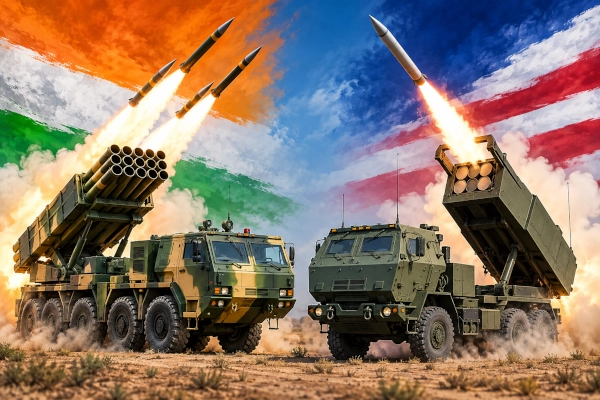
India’s indigenous Pinaka multi-barrel rocket system and the US Army’s M142 High Mobility Artillery Rocket System have come together within the same operational training environment during Exercise Yudh Abhyas 2026 at the Mahajan Field Firing Range in Rajasthan. The 22nd edition of the annual India-US Army exercise is being conducted simultaneously at Mahajan and Auli, with around 600 personnel from each side participating in training built around interoperability, Integrated Battle Groups, drones, autonomous systems and contemporary battlefield technologies.
At Mahajan, the emphasis has shifted towards integrated firepower. Indian forces have demonstrated Pinaka alongside M777 ultra-light howitzers, Dhanush artillery, L70 air-defence guns, Swathi weapon-locating radars and AH-64E Apache attack helicopters, while the US Army has brought HIMARS and the M-LIDS counter-UAS system into the exercise. The appearance of Pinaka and HIMARS in the same bilateral training environment is particularly significant because the two truck-mounted rocket systems illustrate two different approaches to modern land-based fires: Pinaka began as a high-volume battlefield rocket system and is rapidly acquiring longer-range precision capability, while HIMARS was developed around a smaller modular launcher capable of employing an increasingly diverse family of precision rockets and missiles.
Pinaka and HIMARS at a Glance
| Feature | Pinaka | M142 HIMARS |
|---|---|---|
| Country | India | United States |
| Primary developer | DRDO-led Indian programme | US Army programme |
| Basic role | Multi-barrel rocket artillery / precision fires | Mobile precision rocket and missile artillery |
| Launcher vehicle | High-mobility 8×8 truck | Wheeled 5-ton FMTV-family chassis |
| Rockets per standard launcher | 12 | 6 GMLRS-family rockets |
| Missile load | Pinaka variants use same in-service launcher | 1 ATACMS or 2 PrSM missiles |
| Original/standard rocket range | Around 40 km | GMLRS 70+ km class |
| Extended/guided capability | 75 km guided Pinaka demonstrated | ATACMS around 300 km |
| Latest long-range development | LRGR successfully tested to 120 km | PrSM exceeds 400 km; US Army sources cite approximately 500 km for current capability |
| Fire philosophy | High-volume salvos plus growing precision capability | Precision fires with modular rocket/missile ammunition |
| Launcher ammunition capacity | 12 rounds | 6 rockets, 1 ATACMS or 2 PrSM |
| Air transportability | Road-mobile artillery system | Designed for C-130 air transportability |
| Status | Operational Pinaka family with new longer-range variants under development | Mature operational system with successive generations of precision munitions |
The figures require an important qualification. Pinaka and HIMARS are launch systems rather than weapons with one fixed range. Their reach depends upon the ammunition loaded. Comparing a standard Pinaka rocket directly with a PrSM fired from HIMARS would therefore compare different classes of ammunition rather than simply comparing two launchers.
Pinaka: India’s Massed Rocket Artillery System
Pinaka was developed by the Defence Research and Development Organisation to provide the Indian Army with an indigenous multi-barrel rocket artillery system capable of delivering large volumes of fire against battlefield targets.
The standard launcher carries 12 rockets in two pods and is mounted on a high-mobility 8×8 vehicle. A complete Pinaka battery combines launchers with battery command posts, loader-cum-replenishment vehicles, replenishment vehicles and meteorological support, creating an integrated artillery system rather than merely a truck carrying rockets.
The original Pinaka was primarily an area-fire weapon. DRDO states that a six-launcher battery can deliver 72 rockets in approximately 44 seconds. This gives the system the ability to place a substantial concentration of fire over a target area in a very short period before the launch vehicles relocate.
Its potential targets include troop concentrations, soft-skinned and armoured vehicles, communication centres, ammunition and fuel storage areas and other battlefield infrastructure.
HIMARS: Mobility Built Around Precision
The M142 HIMARS emerged from a different requirement. The US Army wanted the firepower of the Multiple Launch Rocket System family on a lighter wheeled vehicle that could be moved rapidly and transported aboard a C-130 aircraft.
HIMARS consequently carries a single modular ammunition pod rather than the larger rocket load associated with traditional multi-launch rocket systems. The pod can contain six GMLRS-family rockets, one ATACMS tactical missile or two newer Precision Strike Missiles.
This ammunition flexibility has gradually transformed HIMARS from a relatively long-range rocket artillery system into a launcher capable of covering several levels of the land-attack mission, ranging from tactical precision fires to deep-strike missions hundreds of kilometres beyond the launcher.
Its relatively small ammunition load therefore tells only part of the story. HIMARS trades the sheer number of ready-to-fire rockets carried by Pinaka for a modular architecture capable of accepting different classes of precision ammunition.
Two Different Approaches to Rocket Artillery
The most striking difference between Pinaka and HIMARS becomes visible when the launchers are viewed side by side.
Pinaka carries 12 rockets, twice the six-round GMLRS load of a HIMARS launcher. Its original design placed strong emphasis on delivering concentrated battlefield fire rapidly. A six-launcher Pinaka battery can therefore place 72 rockets into an engagement in less than a minute.
HIMARS carries fewer rockets, but its ammunition family has increasingly emphasised precision and range. GMLRS provides precision rocket artillery, ATACMS extended the system into tactical ballistic-missile territory, and PrSM is pushing the launcher still further into long-range precision fires.
The distinction is becoming less rigid, however. Guided Pinaka has given the Indian system a precision-engagement capability, while the development of progressively longer-range Pinaka rockets is moving it into mission areas once associated mainly with dedicated long-range missile systems.
Range: A Comparison That Is Rapidly Changing
Early Pinaka rockets had a range of approximately 40 km. DRDO subsequently developed a 60 km-class Mk-II configuration and demonstrated guided Pinaka firings at ranges up to 75 km.
The most important recent development came with the Pinaka Long Range Guided Rocket, or LRGR. DRDO successfully conducted its maiden maximum-range trial in December 2025, when the LRGR-120 reached 120 km and struck its target with what the organisation described as textbook precision.
Another trial on 8 July 2026 demonstrated the same long-range rocket at a user-defined minimum range of 60 km. Significantly, the LRGR was launched from an in-service Pinaka launcher, demonstrating that India is seeking to extend the reach of the weapon without replacing the basic launcher architecture.
HIMARS currently possesses a considerably broader long-range ammunition family. Standard GMLRS ammunition belongs to roughly the 70 km-plus category, while ATACMS extends the system to around 300 km. The newer PrSM has exceeded 400 km, with recent US Army material describing a reach of approximately 500 km.
This does not mean the HIMARS launcher itself possesses a fixed 500 km range. It means that the launcher can employ a missile capable of reaching that distance.
Pinaka’s Twelve-Rocket Salvo Remains a Major Strength
Where Pinaka retains a very different character is magazine depth at launcher level.
Twelve ready-to-fire rockets give each Pinaka launcher substantial instantaneous fire volume. With six launchers in a battery, the system can create a large concentration of rockets within seconds.
This remains valuable against dispersed battlefield targets, troop concentrations, logistics areas and other targets where the desired effect may require multiple impacts across a wider area rather than a single precision strike.
Guided ammunition now allows that same basic launcher architecture to move towards precision engagements. Pinaka is therefore developing from a predominantly saturation-fire system into a broader rocket-artillery family capable of combining mass and precision.
HIMARS Uses a Smaller Magazine for a Wider Munition Family
HIMARS takes the opposite approach. A launcher carries only six GMLRS rockets, but its standardised pod provides considerable ammunition flexibility.
The same vehicle can transition from six precision-guided rockets to a single ATACMS missile or two PrSM rounds. This makes the launcher capable of addressing target sets at very different depths without redesigning the underlying vehicle.
The PrSM development is particularly significant. HIMARS originally carried a single ATACMS in its pod. PrSM places two missiles in the same space while providing greater range, effectively doubling the launcher’s ready deep-strike missile load.
This modularity has become one of HIMARS’ defining characteristics and helps explain why the system increasingly forms part of US Army long-range precision-fire concepts.
Mobility Is Central to Both Systems
Pinaka and HIMARS share an equally important characteristic: neither is intended to remain stationary after firing.
Both are truck-mounted systems designed to move rapidly between firing locations. Modern counter-battery radars, unmanned aircraft and other battlefield sensors can detect artillery launch positions quickly, making displacement after firing an important element of survivability.
Pinaka’s rugged 8×8 platform gives it strong cross-country mobility suited to Indian operating conditions. Its automated navigation, launcher laying and fire-control capabilities allow the system to deploy, engage and relocate without the lengthy preparation associated with older rocket artillery.
HIMARS achieves mobility through a lighter wheeled architecture. Its most distinctive mobility advantage is strategic and operational air transportability. The US Army designed the launcher to fit aboard a C-130, enabling HIMARS batteries to be repositioned rapidly between geographically separated operating areas.
The US military has repeatedly demonstrated this through rapid-infiltration missions in which HIMARS is flown into a location, unloaded, positioned for an engagement and subsequently displaced.
Precision Is No Longer Exclusively a HIMARS Advantage
HIMARS became internationally associated with precision rocket artillery largely through GMLRS, whose guidance system dramatically improved accuracy compared with conventional unguided battlefield rockets.
Pinaka’s development trajectory is closing the technological gap between traditional multiple rocket artillery and precision fires. The Guided Pinaka incorporates navigation and control systems to correct its flight path rather than relying purely on a ballistic free-flight trajectory.
DRDO completed the required flight tests of the Guided Pinaka Weapon System for PSQR validation in November 2024, evaluating range, accuracy, consistency, rate of fire and multiple-target engagement in salvo mode.
The 120 km LRGR development goes further by combining extended reach with precision while retaining compatibility with the existing launcher. That common-launcher approach is important because it allows the Army to enhance firepower through new ammunition rather than creating an entirely separate launch fleet for each increase in range.
Pinaka Has an Important Indigenous Industrial Dimension
The comparison becomes particularly significant for India when industrial ownership is considered.
Pinaka is an Indian-designed weapon family developed through DRDO laboratories and produced through an increasingly broad domestic industrial network. Munitions India Limited and Economic Explosives Limited are involved in ammunition production, while Tata Advanced Systems and Larsen & Toubro manufacture launcher and command-system elements.
Its development has progressively shifted India from dependence on imported multiple rocket systems towards a domestically controlled artillery ecosystem in which the launcher, ammunition, command architecture and future upgrades can be developed within the country.
The LRGR programme reinforces that advantage. Instead of replacing Pinaka as longer ranges become necessary, DRDO is expanding the existing system into a family of ammunition covering progressively larger engagement envelopes.
HIMARS Benefits From a Mature Family of Munitions
HIMARS possesses an advantage of a different kind: decades of development around the wider MLRS Family of Munitions.
Its launcher can employ ammunition developed for different battlefield requirements, and the US Army continues to expand that family. GMLRS established the system’s precision-rocket capability, ATACMS provided deep strike, and PrSM is becoming the next-generation long-range missile.
The US Army has already begun transitioning PrSM into production and deployment, while subsequent increments are intended to expand the target set further. Future versions are being developed for moving maritime and relocatable land targets, while still more ambitious concepts seek substantially greater ranges.
HIMARS is therefore best understood as a modular launch platform whose capability changes substantially according to the weapon pod fitted to it.
The 120 km Pinaka Changes the Comparison
A comparison based only on the original 40 km Pinaka and a modern HIMARS would now be outdated.
The successful 120 km LRGR trials show the direction of the Indian programme. The same launcher that originally delivered conventional battlefield rockets can now serve as the launch platform for a weapon demonstrated at three times the original Pinaka range.
That does not yet place Pinaka in the same deep-strike envelope as a PrSM-equipped HIMARS. The 120 km LRGR is also a newer capability progressing through development and trials, whereas different parts of the HIMARS ammunition family have established operational histories.
What it does demonstrate is that the relevant comparison is no longer simply mass-fire Pinaka versus precision-fire HIMARS. Both systems are increasingly becoming ammunition families capable of supporting different effects from a common mobile launcher.
Pinaka and HIMARS Serve Different Firepower Philosophies
Pinaka’s architecture gives the Indian Army considerable rocket volume at the launcher and battery levels. Twelve rockets per vehicle and 72 from a six-launcher battery provide substantial massed fire, while new guided variants progressively add precision and range.
HIMARS places greater emphasis on a smaller modular ammunition package coupled with high mobility and a wide spectrum of precision munitions. Six GMLRS rounds can serve conventional rocket-artillery missions, while ATACMS and PrSM extend the same launcher into operational-level deep strike.
Neither characteristic makes the systems interchangeable. Their ammunition loads, force structures and operational doctrines differ because they originated from different military requirements.
The important development is that technological evolution is steadily expanding the mission envelope of both.
Why Mahajan Is More Than a Display of Two Rocket Launchers
The significance of Yudh Abhyas 2026 is therefore not simply that Indian troops can observe HIMARS or American troops can see Pinaka.
At Mahajan, the wider training has involved the complete fire-support sequence: detecting and identifying targets, transmitting coordinates, issuing fire commands, conducting engagements and making post-engagement corrections. Drones, weapon-locating radars, artillery, rocket systems, attack helicopters, air defence and counter-UAS equipment are being brought into a broader battlefield network.
That is the environment in which Pinaka and HIMARS become most relevant. Modern rocket artillery derives much of its effectiveness not solely from the launcher but from how quickly reconnaissance assets can detect a target, how rapidly information reaches the fire-control network and how efficiently the appropriate weapon can engage it.
Exercise Yudh Abhyas therefore allows the two armies to examine each other’s procedures for connecting sensors, command systems and long-range fires rather than simply comparing the mechanical performance of two launch vehicles.
Confirmed Capability and Developmental Capability Must Be Separated
Any Pinaka-HIMARS comparison needs to distinguish weapons already fielded from those still progressing through development.
The Indian Army operates Pinaka, while guided and extended-range variants have progressively undergone qualification and induction-related trials. The 120 km Long Range Guided Rocket has demonstrated both its maximum 120 km range and a 60 km user-defined minimum-range engagement from an in-service launcher, but it represents the newest stage of the system’s evolution.
HIMARS is an established US Army launcher. GMLRS and ATACMS have long operational histories, while PrSM Increment 1 has entered the production and deployment phase after the first early operational-capability missiles were delivered to the US Army.
Similarly, still longer-range Pinaka concepts and future PrSM increments should not be treated as present-day operational capabilities simply because development plans exist for them.
Pinaka’s Evolution Is the Bigger Indian Story
HIMARS currently offers a larger maximum engagement envelope when its long-range missile family is included, particularly with PrSM. Pinaka, however, brings a different combination of characteristics: twelve-round launcher capacity, extremely rapid massed fires, indigenous production, an increasingly mature guided-rocket capability and a new 120 km weapon that can be launched from the existing system.
That common-launcher evolution is strategically important for India. It means Pinaka is no longer confined to the role for which its original 40 km rocket was designed. The system is developing into an expandable indigenous rocket-artillery architecture in which new ammunition can add precision and range without discarding the underlying launcher fleet.
At Mahajan, Pinaka and HIMARS therefore represent more than two competing pieces of artillery equipment. They illustrate two paths towards the same modern battlefield requirement: mobile launchers connected to increasingly sophisticated sensors and capable of delivering rapid, precise and progressively longer-range fires.
For India, the most consequential aspect is that Pinaka’s path is being pursued through an indigenous weapon family whose technological ceiling continues to move outward. The 120 km LRGR is the clearest evidence yet of how far the system has progressed from the original battlefield rocket launcher that entered service with the Indian Army.
References
- Ministry of Defence, Press Information Bureau — “India-US Joint Military Exercise Yudh Abhyas 2026 Commences at Auli and Mahajan,” 15 September 2026. (Press Information Bureau)
- United States Army — “US, Indian Armies Open Exercise Yudh Abhyas 2026,” 17 September 2026. (Army)
- DD India — “Yudh Abhyas 2026: India, US troops conduct live-fire drills in Rajasthan,” 23 September 2026. (DD India)
- Defence Research and Development Organisation — Pinaka Weapon System, official export product catalogue. The DRDO specification lists a 40 km range, 12 rockets per launcher and 72 rockets from a battery in 44 seconds. (DRDO)
- Ministry of Defence, Press Information Bureau — “DRDO successfully completes Flight Tests of Guided Pinaka Weapon System,” 14 November 2024. (Press Information Bureau)
- Ministry of Defence, Press Information Bureau — “DRDO successfully conducts maiden flight test of Pinaka Long Range Guided Rocket,” 29 December 2025. The LRGR-120 was tested to its maximum range of 120 km. (Press Information Bureau)
- Ministry of Defence, Press Information Bureau — “DRDO conducts successful flight-test of Pinaka Long Range Guided Rocket,” 8 July 2026. The LRGR was tested at a user-defined minimum range of 60 km from an in-service Pinaka launcher. (Press Information Bureau)
- US Army Acquisition Support Center — Weapon Systems Handbook, M142 High Mobility Artillery Rocket System. The official handbook specifies one pod carrying six GMLRS/MLRS rockets or one ATACMS missile. (Army Sustainment Command)
- US Army Acquisition Support Center — “ATACMS to PrSM: Out With the Old, In With the New.” PrSM provides two missiles per HIMARS pod and a range exceeding 400 km. (Army Sustainment Command)
- US Army Pacific — HIMARS multi-modal mobility demonstration, 2025. The US Army describes current PrSM capability as reaching approximately 500 km. (USARPAC)
- US Army Acquisition Support Center — “Precision Strike Missile Success at Talisman Sabre,” January 2026. PrSM Increment 1 entered the production and deployment phase following Milestone C approval in July 2025. (Army Sustainment Command)
You may also like
-
WB Group Plans Indian Production of Warmate Loitering Munition as Localisation Push Expands
-
BEL Flags Off Indigenous 3D CAR Prime Radar, Strengthening India’s Air-Defence Surveillance Capability
-
Jupiter Defence Gets 256 Acres in Purulia for West Bengal’s First Major Defence Manufacturing Facility
-
US Army Deploys M-LIDS Counter-Drone System at Mahajan During Yudh Abhyas 2026
-
Draft DAP 2026 Puts Indigenous Design and Indian IPR at the Centre of Defence Procurement
