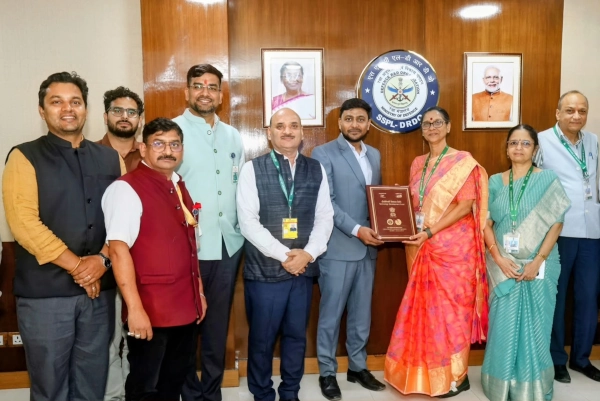
India has taken a significant step towards developing indigenous infrastructure for quantum technologies, with the Defence Research and Development Organisation signing its first high-value deep-tech project agreement with a startup under the Technology Development Fund scheme. The project will support the indigenous development of a 20 millikelvin dilution refrigerator, a specialised cryogenic system required for quantum computing and other technologies that operate at extremely low temperatures.
The agreement has been signed with Zero mK India Private Limited, a startup based in Alwar, Rajasthan. It marks the first high-value agreement under the ₹500-crore corpus approved for deep-tech and cutting-edge projects under the TDF framework.
A Critical Technology for Quantum Computing
Dilution refrigerators are highly specialised cooling systems capable of reaching temperatures only a fraction of a degree above absolute zero. Such temperatures are essential for several types of quantum processors, particularly superconducting quantum computers whose qubits must operate in an environment with extremely low thermal noise.
The system being developed under the DRDO project is designed to achieve temperatures of around 20 millikelvin, or 0.02 kelvin. At this level, thermal energy inside the experimental environment becomes sufficiently low for sensitive quantum devices to maintain the physical states required for quantum operations and precision measurements.
Dilution refrigerators therefore form part of the fundamental laboratory infrastructure required for the development, testing and characterisation of quantum processors, superconducting circuits, advanced sensors and several other emerging quantum technologies.
Reducing Dependence on Imported Cryogenic Systems
India’s expanding quantum technology ecosystem requires access to sophisticated scientific equipment, much of which has traditionally been sourced from specialised overseas manufacturers. Developing a domestic 20 mK dilution refrigerator could help establish an indigenous capability in one of the important infrastructure technologies supporting quantum research.
The programme is expected to build expertise not only in ultra-low-temperature refrigeration but also in cryogenic engineering, vacuum systems, thermal management, precision instrumentation and associated control technologies.
An indigenous platform could eventually support laboratories, universities, defence research establishments and companies developing quantum processors and related systems within India. It could also provide Indian researchers with greater flexibility to customise cryogenic platforms for specific applications.
Linked to India’s National Quantum Mission
The DRDO initiative complements India’s broader National Quantum Mission, which seeks to build national capabilities across quantum computing, quantum communication, quantum sensing and metrology, and quantum materials and devices.
Advanced cryogenic infrastructure is particularly important for quantum computing platforms based on superconducting circuits. Building such systems domestically can strengthen the technological foundation required to move beyond laboratory-scale research towards more sophisticated quantum hardware development.
The project therefore represents an intersection between India’s defence research ecosystem, its emerging deep-tech startup sector and the wider national effort to develop sovereign capabilities in strategic technologies.
₹500-Crore Deep-Tech TDF Corpus
The agreement is the first high-value project sanctioned from the ₹500-crore corpus created to support deep-tech and cutting-edge development through the Technology Development Fund.
The TDF scheme is intended to encourage Indian industries, particularly MSMEs and startups, to undertake the development of defence and dual-use technologies that require significant research, engineering and technological risk-taking.
By extending the programme into areas such as quantum technology, DRDO is widening the scope of industry participation beyond conventional defence manufacturing and into emerging scientific fields whose applications may span defence, computing, communications and advanced sensing.
Zero mK India Takes on Indigenous Development
Zero mK India Private Limited will undertake the development of the 20 mK dilution refrigerator in collaboration with DRDO. The company’s participation places an Indian startup at the centre of a technically demanding programme involving advanced cryogenic engineering.
The project will be monitored, mentored and supported by DRDO’s Solid State Physics Laboratory and its technical team. SSPL works in areas involving semiconductor materials, devices and advanced electronic technologies, making its expertise relevant to the development of infrastructure supporting quantum systems.
Officials from DRDO’s Micro Electronic Devices & Computational System and Cyber Security cluster, Technology Management Directorate and Solid State Physics Laboratory were present during the signing of the agreement in New Delhi.
A New Model for DRDO-Startup Collaboration
Raksha Mantri Rajnath Singh complimented DRDO, the participating industry and other stakeholders associated with the programme and expressed confidence that the partnership would establish an important precedent for future DRDO-industry collaboration in emerging technology domains.
Defence Secretary and Secretary, Department of Defence R&D and Chairman, DRDO Rajesh Kumar Singh also congratulated the teams associated with the initiative and wished them success in achieving the project’s objectives.
The initiative reflects a broader effort to involve Indian startups directly in high-risk technological development rather than limiting private-sector participation primarily to manufacturing technologies already developed by government laboratories.
Successful development of the 20 mK refrigerator would give India an indigenous capability in a highly specialised segment of the global quantum technology supply chain. It could also establish a pathway for Indian deep-tech companies to work alongside national laboratories on technologies where domestic capability remains limited.
Building a Quantum-Ready Technology Base
Quantum technologies are becoming strategically significant because of their potential applications in computing, secure communications, sensing, navigation and scientific research. Many of these technologies depend on sophisticated supporting infrastructure that remains concentrated among a relatively small number of international suppliers.
Developing such enabling technologies within India is therefore an important part of building a complete quantum ecosystem. The DRDO-Zero mK programme addresses one of these less visible but essential technological layers by targeting the extreme cryogenic environment required for advanced quantum hardware.
If the project achieves its intended objectives, India will gain domestic expertise in a technology that sits at the foundation of several quantum computing architectures. The agreement also demonstrates how the country’s defence research institutions and emerging deep-tech startups are beginning to collaborate on technologies whose importance extends well beyond conventional defence systems.
References
Press Information Bureau, Ministry of Defence — “DRDO inks first high-value deep tech project agreement with a start-up under TDF scheme for indigenous development of 20 mK Dilution Refrigerator for Quantum Applications,” 24 September 2026.
Defence Research and Development Organisation — Technology Development Fund Scheme.
Department of Science and Technology, Government of India — National Quantum Mission.
You may also like
-
Beyond one: Indian Researchers’ Experiment Could Lead to A New Tool for Quantum Measurement
-
Indian Scientists Reveal How Common Preservatives Destroy Bacteria From Within
-
ISRO–ESA Extend Space Partnership to 2032, Expand Into Human Exploration
-
India Strengthens Space Surveillance Network With ISRO’s NETRA Radar Facility in Assam
-
India Commissions 51st Doppler Weather Radar at Sambalpur, Plans Around 40 More Under Mission Mausam
