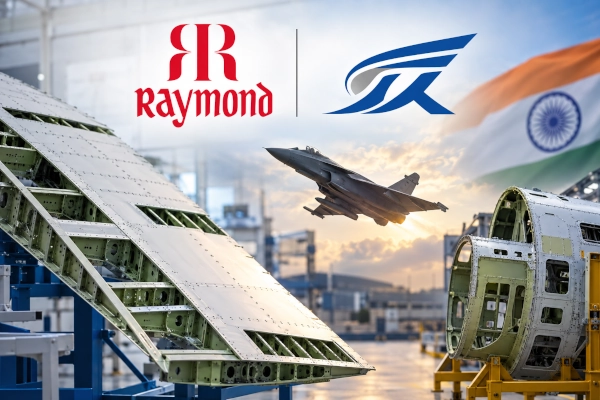
Raymond Limited has taken a significant step deeper into India’s aerospace manufacturing sector, with subsidiary JK Maini Global Aerospace Limited emerging successful in a tender for the assembly of major structural sections of an indigenous fighter aircraft.
The development, announced on September 23, 2026, marks Raymond’s proposed entry into aircraft structures, moving its aerospace business beyond precision components and individual parts into the assembly of large and complex sections of an aircraft.
Under the programme, JK Maini Global Aerospace will undertake the assembly of wing structures and centre-fuselage structures for a major indigenous fighter aircraft programme. The tender was floated by what Raymond describes as a leading Indian aerospace and defence original equipment manufacturer.
From Precision Components to Complete Aircraft Structures
The significance of the development lies in the type of work Raymond is preparing to undertake.
Manufacturing individual aerospace components and assembling major aircraft structures represent different levels of industrial capability. Wings and centre-fuselage sections are fundamental parts of an aircraft’s airframe and require highly controlled manufacturing, assembly, alignment, inspection and quality-assurance processes.
Raymond said the programme expands its capabilities beyond precision manufacturing into complex, higher-value aircraft assemblies. Successful execution would consequently establish credentials that could allow the company to participate in larger aerospace manufacturing programmes in India and overseas.
The development also broadens the pool of Indian private-sector companies capable of participating in higher levels of military aircraft production.
JK Maini Global Aerospace Leads the Programme
The company directly involved is JK Maini Global Aerospace Limited, Raymond’s aerospace subsidiary.
Raymond’s expansion into aerospace and defence accelerated following its acquisition of Maini Precision Products Limited in 2023. The acquisition gave the group an established precision-engineering platform serving aerospace and other advanced manufacturing sectors.
The engineering business now operates across aerospace and defence, tools and automotive components, representing a substantial transformation of Raymond’s business portfolio beyond the sectors with which the company was traditionally associated.
The new fighter-aircraft opportunity pushes this strategy into aircraft structural assembly for the first time.
Wings and Centre Fuselage Are Major Airframe Assemblies
The scope disclosed by Raymond covers both wing structures and the centre fuselage.
The wing is one of the primary load-bearing structures of a fighter aircraft. Apart from generating lift, it must withstand aerodynamic forces and manoeuvre loads while accommodating systems that can include fuel, control mechanisms, landing-gear components and weapon stations depending on the aircraft design.
The centre fuselage is similarly critical because it forms a major structural section of the airframe and interfaces with other principal assemblies.
Moving into the assembly of these structures therefore requires capabilities extending beyond machining individual components. It involves bringing numerous precision-manufactured parts together within extremely tight dimensional and structural tolerances.
Customer’s Existing Infrastructure Will Be Used
An unusual and important feature of the programme is the manufacturing model Raymond intends to follow.
The company has said the programme is envisaged to use the customer’s existing infrastructure. This will allow JK Maini Global Aerospace to develop structural-assembly capabilities without immediately making a large investment in entirely new production infrastructure.
The arrangement provides Raymond with an opportunity to acquire experience in major aircraft structural assembly while maintaining what the company describes as a capital-efficient approach.
Raymond Group CFO Rakesh Tiwary said the strategic importance of the opportunity extends beyond its immediate commercial potential because it gives the company entry into the high-value aircraft structures segment and an opportunity to establish critical execution credentials. Upstox – Online Stock and Share Trading
Part of a Wider Aerospace Expansion
The fighter-aircraft tender is not an isolated move by Raymond into aerospace manufacturing.
Earlier in September, the group’s aerospace subsidiary secured new business from an Indian aerospace and defence company involving more than 300 high-precision part numbers. The components are intended for multiple aircraft applications, with annual volumes exceeding 37,000 parts.
Raymond’s aerospace activities have consequently begun moving across different levels of the supply chain, from precision components towards structural assemblies.
That progression is important for India’s aerospace manufacturing ecosystem because domestic participation becomes more valuable as suppliers advance from individual components towards subassemblies, structures and eventually complete aircraft sections.
Private Industry Moves Deeper Into Fighter Aircraft Manufacturing
India’s indigenous combat-aircraft programmes increasingly require a broader industrial ecosystem capable of supporting higher production rates and future aircraft development.
Aircraft manufacturing depends on a large network of companies producing machined components, castings, forgings, composites, electronics, actuators, wiring, landing-gear systems and structural assemblies. Expanding the number of Indian companies capable of handling major airframe work can distribute manufacturing capacity beyond the traditional prime contractor.
Raymond’s entry into wing and centre-fuselage assembly is therefore significant from an industrial perspective even though the immediate financial value of the tender has not been disclosed.
It provides another example of an Indian private engineering company moving from component manufacturing towards higher-value aerospace integration work.
Fighter Programme Remains Undisclosed
The precise aircraft involved remains an important unanswered question.
Raymond has described it only as a “major indigenous fighter aircraft programme.” Neither the company nor the reports based on its regulatory disclosure identify the aircraft or the Indian OEM that conducted the tender.
It would therefore be premature to associate the contract specifically with Tejas Mk1A, Tejas Mk2, AMCA or another programme.
The absence of a disclosed contract value also means the commercial scale of the programme cannot yet be determined. Raymond itself has emphasised the strategic value of acquiring aircraft-structure manufacturing experience rather than presenting the development primarily in terms of immediate revenue.
Raymond Builds a New Identity in Aerospace Engineering
The development represents a striking evolution for a corporate name historically associated with textiles and consumer businesses.
Following restructuring and the expansion of its engineering operations, Raymond Limited now has core engineering interests spanning aerospace and defence, tools and automotive components. The acquisition of Maini Precision Products provided an important foundation for this transition, giving the group access to established precision-manufacturing capabilities and aerospace customers.
The fighter-aircraft programme now takes that evolution further by moving JK Maini Global Aerospace into the assembly of major airframe structures.
For India’s aerospace industry, the importance lies in the manufacturing capability being created. Building indigenous combat aircraft at increasing scale requires not only aircraft designers and final assembly lines but also a deeper domestic network capable of producing and assembling major structural sections.
Raymond’s successful tender for wing and centre-fuselage assembly represents another Indian private-sector company beginning that transition from aerospace component supplier to aircraft-structures manufacturer.
References
Raymond Limited — Regulatory disclosure and company announcement concerning JK Maini Global Aerospace Limited’s successful tender for an indigenous fighter aircraft programme, 23 September 2026.
Raymond Limited — Corporate and investor disclosures concerning its Aerospace & Defence engineering business.
Economic Times / Reuters — “From fabrics to fighter jets: Raymond moves into fighter aircraft assembly,” 23 September 2026.
ET Infra — “Raymond enters aircraft structures segment with wing, fuselage assembly order,” 23 September 2026.
Business Standard — “Raymond forays into high value aircraft structures segment,” 23 September 2026.
You may also like
-
INOX India Enters Semiconductor Fab Infrastructure With First Orbital-Welding Order
-
Indian Navy Seeks Six Indigenous LCU Mk V Amphibious Ships Under Make in India
-
From Sea to Fuel: How Indian Startups Are Building the Foundations of a Seaweed Bioenergy Industry
-
India’s Drone Ecosystem Expands Beyond 600 Companies as Military Demand Moves Towards Large-Scale Procurement
-
Alpha Design Emerges L1 for Indian Army’s 600 Indigenous Software-Defined Radios
