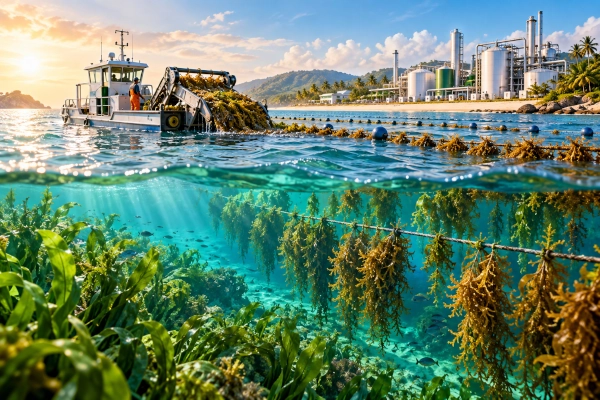
India’s search for the next generation of biofuels is beginning to move beyond crops, agricultural waste and used cooking oil towards an entirely different resource: seaweed. Unlike conventional biofuel feedstocks, seaweed does not require farmland or irrigation water in the same way as terrestrial crops, and it can generate large quantities of biomass in marine environments. It can also be processed into fuels, chemicals, bioplastics, agricultural inputs and a range of other industrial products.
For India, this opportunity is particularly important because the country possesses an extensive coastline and hundreds of locations identified as suitable for seaweed cultivation. The central challenge is no longer simply proving that seaweed can be converted into fuel. The much larger problem is developing an economic system capable of producing marine biomass in sufficiently large quantities and at sufficiently low cost for fuel production to become viable.
A small but increasingly important group of Indian startups, research institutions and technology organisations is now working on different parts of that problem. Bengaluru-based Sea6 Energy has emerged as the strongest Indian company pursuing an end-to-end model that combines mechanised seaweed cultivation with downstream biorefinery technologies and bio-crude development. At the same time, companies such as ClimaCrew are addressing the equally important upstream challenge of identifying cultivation zones, organising coastal production and building reliable supply chains.
Together, these companies are beginning to create the foundations of an Indian marine biorefinery industry in which seaweed could eventually become not only an agricultural or food resource, but also an industrial energy feedstock.
Sea6 Energy Began With the Ambition to Replace Petroleum
Sea6 Energy was founded in 2010 by a group of biotechnology graduates from IIT Madras together with Shrikumar Suryanarayan, who had earlier headed research and development at Biocon. From the beginning, the company’s ambition was much larger than developing another speciality biotechnology product. The founders wanted to identify a biological resource that could eventually substitute at least part of the world’s dependence on petroleum.
The company initially explored microalgae because certain microscopic algae can accumulate substantial quantities of oils. The economics, however, proved difficult. Microalgae generally require controlled cultivation systems, nutrient inputs, water management and significant downstream processing before useful quantities of fuel can be produced. These factors made it difficult to see a pathway towards very large-scale production at competitive cost.
The team subsequently shifted its focus towards macroalgae, or seaweed. Seaweed offered a different proposition because it could grow rapidly in marine environments without occupying agricultural land, while many species also contain relatively little lignin compared with terrestrial plant biomass. This makes parts of the material easier to process into useful industrial products.
The major problem, however, was scale. Producing food ingredients, agricultural biostimulants or speciality chemicals requires only limited quantities of biomass compared with the enormous volumes needed by the fuel industry. Sea6 therefore concluded that the first major technological challenge was not the refinery itself, but the ability to cultivate and harvest seaweed at industrial scale.
Mechanised Seaweed Farming Became the First Major Breakthrough
Traditional seaweed cultivation is highly labour intensive. Farmers generally use ropes, rafts and manually planted material in shallow or protected coastal areas, and such methods work well for food, hydrocolloid and other high-value industries. They are far more difficult to scale when the objective is to produce the very large quantities of biomass required by an energy industry.
Sea6 responded by developing mechanised cultivation and harvesting systems capable of operating across much larger areas. Its best-known technology is the SeaCombine, a specialised marine platform designed to harvest mature seaweed while also assisting with replanting. Mechanisation has the potential to reduce labour requirements and allow fewer workers to manage significantly larger cultivation areas.
The company has also worked on farming systems that can operate in deeper waters rather than being restricted entirely to shallow coastal zones. This is important because a future marine biofuel industry would need access to cultivation areas far larger than those currently used by conventional seaweed farming.
If seaweed is ever to supply fuel markets rather than only food, agricultural or speciality-chemical markets, this move towards mechanised ocean farming will be essential. The limiting factor is not simply whether the biomass can grow, but whether it can be produced, harvested and transported at a cost compatible with energy markets.
From Wet Seaweed to Bio-Crude
Sea6’s fuel-development work increasingly centres on hydrothermal liquefaction, a process that converts wet biomass into an energy-rich liquid known as bio-crude. The process subjects the biomass to elevated temperatures and pressures, causing complex organic molecules within the seaweed to break down and reorganise into a liquid intermediate with energy characteristics that can eventually be upgraded further.
This route is particularly well suited to seaweed because freshly harvested marine biomass contains large quantities of water. Many conventional biomass-processing methods require the material to be dried before conversion, but drying large volumes of wet seaweed would consume significant amounts of energy and could undermine the economics of the final fuel.
Hydrothermal liquefaction has an advantage because it can process wet biomass directly. In effect, the process accelerates the kind of transformation that geological processes accomplish over much longer periods, converting organic matter into an energy-rich liquid under controlled industrial conditions.
The resulting bio-crude is not a finished transport fuel and cannot simply be used directly in a vehicle. It must still undergo additional upgrading and refining before it can become a usable fuel or chemical feedstock. The technological significance lies in the ability to create a renewable hydrocarbon intermediate from marine biomass without first drying the seaweed.
NITI Aayog Has Highlighted Sea6 as a Marine Bioenergy Innovation
Sea6’s work received renewed attention in January 2026 when NITI Aayog’s Frontier Tech platform highlighted the company as an Indian example of marine bioenergy innovation. The government platform drew particular attention to the combination of mechanised seaweed farming and hydrothermal liquefaction as a potential pathway for producing high-energy biofuels without occupying farmland or consuming freshwater in the same manner as conventional energy crops.
The same assessment also pointed to the potential carbon advantages of seaweed-derived fuel. Carbon released when such a fuel is used originates from carbon absorbed by the seaweed during growth rather than from geological carbon extracted from underground fossil deposits.
The actual lifecycle emissions would still depend on the energy consumed in cultivation, harvesting, transportation, processing and refining, but the feedstock itself offers a fundamentally different carbon cycle from petroleum. This is one reason seaweed continues to attract interest despite the significant economic challenges associated with large-scale production.
Sea6 Has Built a Commercial Business While Fuel Technology Develops
One of the reasons Sea6 has been able to continue pursuing the more difficult fuel opportunity is that it has not depended on biofuel revenue while waiting for the technology to mature. The company has developed commercial products from seaweed for agriculture, aquaculture, food ingredients and biomaterials, giving it revenue streams that support continued research and development.
This is effectively a biorefinery strategy. Rather than treating seaweed as a raw material for only one product, a biorefinery attempts to extract several different forms of value from the same biomass. Higher-value agricultural chemicals, food ingredients, biomaterials and speciality products can help improve the economics of the overall system while fuel production absorbs much larger quantities of lower-value biomass or processing residues.
Such a model may ultimately be essential for seaweed biofuels. Petroleum fuels operate in extremely price-sensitive commodity markets, which makes it difficult for a new biological feedstock to compete if every kilogram of biomass has to be justified entirely by its fuel value. Extracting higher-value products first can improve the economics of the entire chain and make fuel production more realistic over time.
Sea6 Has Grown Beyond Its Startup Origins
By 2026, Sea6 had developed far beyond its beginnings as an IIT Madras-linked startup. The Bharat Innovates 2026 programme described it as a vertically integrated tropical seaweed cultivation and biorefinery company working across biostimulants, biomaterials and biofuels.
The company reported more than 400 employees, operations or market presence across more than a dozen countries and more than 30 patent families internationally. Its cumulative funding was reported at roughly $30 million, while strategic investors including BASF Venture Capital and Aqua-Spark have supported the business.
These investments are particularly important because seaweed-to-energy development requires considerably more capital than a conventional software startup. Large-scale marine farms, specialised harvesting equipment, coastal processing facilities and thermochemical conversion systems all require substantial physical infrastructure before fuel can be produced at industrial scale.
Tamil Nadu Forms an Important Part of Sea6’s Processing Base
Sea6 operates processing facilities in the Tuticorin region of Tamil Nadu, connecting its technology-development work with one of India’s most important seaweed-producing regions. Tamil Nadu has historically played a central role in Indian commercial seaweed cultivation, particularly around the Gulf of Mannar and surrounding coastal waters.
The company has used red seaweed as an important feedstock for several of its commercial products and has developed technologies intended to process fresh biomass while retaining valuable biological compounds. It has also worked on methods to extend the usable life of harvested seaweed, addressing one of the less visible but important logistical problems in the industry.
Fresh seaweed can deteriorate rapidly after harvest. If processing facilities are too far from production areas, biomass losses and transport costs can increase substantially. Preservation and local processing therefore become important parts of the economics of large-scale marine biomass.
ClimaCrew Is Solving the Feedstock Problem From the Upstream Side
While Sea6 is developing an integrated farming and biorefinery model, Mumbai-headquartered deep-tech startup ClimaCrew is approaching the seaweed economy from the cultivation and supply-chain side. The company uses satellite information, artificial intelligence, machine learning and marine data to identify coastal locations that may be suitable for seaweed farming.
Not every coastal area can support productive cultivation. Salinity, water temperature, currents, wave conditions, nutrient availability, turbidity, water quality and contamination can all influence yields. ClimaCrew analyses geospatial and environmental information before marine scientists conduct local validation, replacing part of the traditional trial-and-error approach with data-driven site selection.
For a future bioenergy industry, this capability could become extremely important. A refinery can operate reliably only if it receives predictable quantities of standardised biomass, and that requires cultivation areas that can produce consistently over time.
ClimaCrew Is Building Coastal Cultivation Networks
ClimaCrew is also working with fishing communities in Maharashtra and Gujarat to expand seaweed cultivation. Its model includes training coastal residents in farming techniques, selecting appropriate varieties and providing guidance on the construction and maintenance of seaweed farms.
By January 2026, the company reported that it had trained more than 800 people from fishing communities. It also operates a processing facility in Chiplun, Maharashtra, and reported supplying around 100 to 120 kilolitres of processed seaweed products each month to customers in sectors including agricultural chemicals, animal feed and food processing.
The startup had also raised approximately ₹15 crore from angel investors. ClimaCrew is not currently a seaweed-fuel producer, but its importance to a future bioenergy industry lies in the supply chain it is building. Without reliable and scalable feedstock production, even the most efficient seaweed-to-fuel conversion technology will remain confined to laboratories and pilot projects.
A Future Fuel Industry Will Depend on Companies Beyond Fuel Producers
A commercial seaweed-fuel industry would require far more than companies operating conversion reactors. It would need seed producers, hatcheries, marine farms, weather-data providers, satellite-monitoring systems, harvesting equipment, logistics companies, preservation technologies, testing laboratories and coastal processing infrastructure.
This means companies such as ClimaCrew form an important part of the enabling ecosystem even when their current customers are in agriculture, food or animal feed. If demand from fuel producers grows in the future, these cultivation networks could become important suppliers of biomass.
The structure would resemble other large energy industries, where the refinery itself represents only one part of a much larger system involving resource development, transport, processing and distribution.
Research Institutions Are Developing the Technologies Around the Startups
India’s startup effort is supported by a broader research ecosystem working on marine algae, advanced biofuels and biorefinery technologies. The Department of Biotechnology-backed TERI Centre of Excellence in Advanced Biofuels and Bio-commodities is investigating fuels derived from marine algae and other third-generation feedstocks.
The programme brings together TERI, IIT Guwahati, the Indian Agricultural Research Institute and industrial partners including Transtech Green Power. Its work includes marine algae cultivation, algal lipid recovery, biodiesel development, biohydrogen and other fuel-conversion pathways.
The centre also follows a biorefinery approach by studying higher-value products such as bioplastics, nutraceuticals, animal feed and industrial chemicals alongside fuel. This is significant because a viable seaweed-energy industry is more likely to emerge through collaboration between startups, universities, government laboratories and industrial companies than through a single company working in isolation.
Indian Researchers Are Also Studying Seaweed-Based Ethanol
Bio-crude is not the only possible pathway for extracting fuel from seaweed. Indian researchers are also examining the conversion of seaweed carbohydrates into ethanol, particularly through fermentation-based processes.
A scientific review published in 2026 by researchers associated with ICAR-Central Marine Fisheries Research Institute examined the potential for third-generation bioethanol from Indian seaweeds. Many seaweed species contain substantial quantities of carbohydrates while containing little or no lignin, which can make parts of the biomass easier to process than conventional lignocellulosic feedstocks.
Once these carbohydrates are broken down into fermentable sugars, microorganisms can potentially convert them into ethanol and other industrial chemicals. The challenge is that different seaweed species contain different carbohydrate structures, which may require specialised enzymes and microorganisms for efficient conversion.
India’s Seaweed Resource Base Is Expanding
The commercial opportunity for startups rests on the growth of India’s national seaweed-cultivation programme. The Government reported that India produced approximately 72,385 tonnes of wet seaweed in 2023, while research institutions have identified significant additional cultivation potential along the coastline.
By February 2026, ICAR-CMFRI and CSIR-CSMCRI had identified 384 locations covering approximately 24,707 hectares as potentially suitable for seaweed cultivation across India’s coastal states and Union Territories.
The Pradhan Mantri Matsya Sampada Yojana has supported seaweed rafts, monolines, tube nets, seed banks, hatcheries, training and related infrastructure. The Government has also approved a Multipurpose Seaweed Park in Tamil Nadu and designated the Mandapam Regional Centre of CMFRI as a Centre of Excellence for seaweed development.
These programmes are currently aimed primarily at fisheries livelihoods and conventional seaweed products, but they are also creating infrastructure that could eventually support larger industrial biomass requirements.
Why Seaweed Is Particularly Attractive for India
The appeal of seaweed is closely connected to India’s resource constraints. Large-scale production of conventional biofuel can place pressure on agricultural land, freshwater and food supplies, particularly when energy crops compete with crops intended for human or animal consumption.
Seaweed avoids much of that competition because it can be cultivated in seawater without occupying farmland. Depending on the species and production system, it can also avoid the freshwater and fertiliser requirements associated with many terrestrial energy crops.
The biomass grows rapidly and can often be harvested several times a year. For a densely populated country with limited land available for dedicated energy crops, these characteristics make seaweed particularly attractive.
India’s extensive tropical coastline also provides conditions in several regions that could support year-round cultivation, giving the country a natural resource base on which a marine-bioeconomy sector could be built.
Commercial Fuel Production Has Not Yet Arrived
Despite the technological progress, seaweed-derived transport fuel remains an emerging technology globally, and India does not yet operate a large commercial refinery producing petroleum-scale quantities of fuel from marine macroalgae.
The biggest challenge remains feedstock economics. Biofuel is a bulk commodity and cannot support the same feedstock prices as pharmaceuticals, speciality chemicals or food ingredients. Seaweed therefore has to be cultivated, harvested, transported and processed at extremely low cost if it is to compete meaningfully with petroleum.
This is why Sea6 has invested heavily in mechanisation and why companies working on cultivation and supply-chain efficiency are so important. The central bottleneck is not proving that a kilogram of seaweed can be converted into fuel. It is producing millions of tonnes of biomass cheaply and reliably enough to feed an industrial refinery.
Large-Scale Ocean Farming Will Need Careful Environmental Management
Expanding seaweed cultivation to the scale required by an energy industry would also raise environmental questions. Large marine farms interact with fisheries, navigation, coastal livelihoods, local water chemistry and marine ecosystems.
Species selection will be particularly important because some commercially valuable seaweeds can behave differently when introduced outside their natural ecological range. Indian research organisations are therefore examining native species as well as established commercial varieties.
Any large-scale expansion would require environmental assessment, biodiversity monitoring and careful selection of cultivation areas. A sustainable seaweed-bioenergy industry cannot simply transfer the logic of terrestrial monoculture into the ocean without considering the ecological consequences.
The Biorefinery Model May Decide Whether Seaweed Fuel Becomes Economic
Seaweed fuel may ultimately become most viable when it is produced as one output within a wider biorefinery rather than as the sole product.
A biorefinery can first extract higher-value compounds for food, agriculture, pharmaceuticals or biomaterials and subsequently convert the remaining biomass into fuels, biochar or industrial chemicals. This allows more economic value to be generated from every tonne of harvested seaweed.
Sea6 has effectively built its business around this principle. Its commercial products already generate value from seaweed while its fuel technology continues to mature.
As cultivation scale expands and conversion efficiency improves, lower-value, higher-volume products such as fuel could gradually account for a larger share of the output.
India’s Marine Biotechnology Ecosystem Is Also Growing
The policy environment surrounding the industry is becoming more supportive. Karnataka has announced a Marine Biotechnology Policy for 2026–31 aimed at developing a larger blue bioeconomy and promoting marine biomanufacturing, seaweed-based products and sustainable marine enterprises.
This has particular relevance because Sea6 Energy is headquartered in Bengaluru and much of India’s biotechnology and deep-tech talent is concentrated in Karnataka.
The combination of coastal production in states such as Tamil Nadu, Gujarat and Maharashtra with biotechnology research centres in Bengaluru and other technology hubs could become an important feature of the emerging industry.
Such an ecosystem can bring together marine farming, biotechnology, engineering, data science and industrial processing in a way that no single company could achieve alone.
Seaweed Could Eventually Become a Refinery Feedstock
At present, most Indian seaweed is used for hydrocolloids, food, agriculture, cosmetics, pharmaceuticals and animal-feed applications. A mature bioenergy industry would add an entirely different type of customer: the refinery.
Fuel markets consume feedstock in enormous quantities compared with speciality-product markets. Even replacing a small share of India’s petroleum consumption would require a dramatic expansion in marine biomass production.
This explains why mechanised farming is so central to seaweed-bioenergy development. The question is not simply whether scientists can convert seaweed into fuel, because that has already been demonstrated in several forms. The larger question is whether India can produce enough biomass sustainably, consistently and cheaply enough to make the process commercially meaningful.
An Industry Is Taking Shape Before the Fuel Market Fully Exists
India does not yet have dozens of startups commercially selling seaweed-derived diesel or aviation fuel, but it is beginning to develop something more important at this stage: an ecosystem capable of making such an industry possible.
Sea6 Energy is developing the core seaweed-to-biocrude pathway while simultaneously working on mechanised ocean farming. ClimaCrew is applying satellite data, artificial intelligence and marine science to expand cultivation and organise coastal supply chains. Research institutions such as TERI, IITs, ICAR institutes and government-supported centres are developing marine-algal conversion technologies and biorefinery processes.
Government programmes are simultaneously expanding seed banks, cultivation sites, processing infrastructure and coastal skills. These pieces remain fragmented, and the economics of fuel are still challenging, but the technological direction is becoming clearer.
India’s first major seaweed-fuel industry may therefore emerge not from a conventional oil company discovering a new feedstock, but from the combination of biotechnology startups, fishing communities, satellite-data companies, marine engineers, research institutions and advanced-biofuel developers.
References
NITI Aayog Frontier Tech — From Sea to Fuel: How Indian Researchers Are Turning Seaweed into Clean Energy, January 2026.
Sea6 Energy — Official company information on mechanised ocean farming, biorefineries, renewable chemicals and biofuel research.
Bharat Innovates 2026 — Sea6 Energy startup profile and company data.
BASF Venture Capital — BASF Venture Capital and Aqua-Spark Investment in Sea6 Energy.
IIT Madras Shaastra — From Seaweed to Fuel: Sea6 Energy and Hydrothermal Liquefaction.
IIT Madras Office of Alumni and Corporate Relations — Sea6 Energy development and seaweed biofuel programme.
C-CAMP — Sea6 Energy innovation profile and seaweed biorefinery development.
YourStory — ClimaCrew’s AI-Based Seaweed Cultivation Programme Along India’s Western Coast, January 2026.
Department of Biotechnology / TERI — DBT-TERI Centre of Excellence in Advanced Biofuels and Bio-commodities.
ICAR-Central Marine Fisheries Research Institute — Harnessing Seaweeds for Third-Generation Bioethanol: Opportunities in the Indian Context, 2026.
Press Information Bureau, Ministry of Fisheries, Animal Husbandry & Dairying — Seaweed Farming in India, February 10, 2026.
Press Information Bureau, Ministry of Fisheries, Animal Husbandry & Dairying — Seaweed Production and PMMSY Support, March 18, 2025.
Government of Karnataka — Marine Biotechnology Policy 2026–31.
You may also like
-
PTC Industries Secures Safran Order to Manufacture Titanium Components for LEAP Aircraft Engines
-
India’s Coir Exports Surge 305% to ₹6,614 Crore as Traditional Industry Expands Global Reach
-
India’s Central Government Debt-to-GDP Ratio Declines to 55.6% as Fiscal Consolidation Progresses
-
India Expands Global Trade Partnerships to Economies Worth $70 Trillion, Says Piyush Goyal
-
Chak-Hao Black Rice: The Fragrant Purple-Black Grain of Manipur and Nagaland
