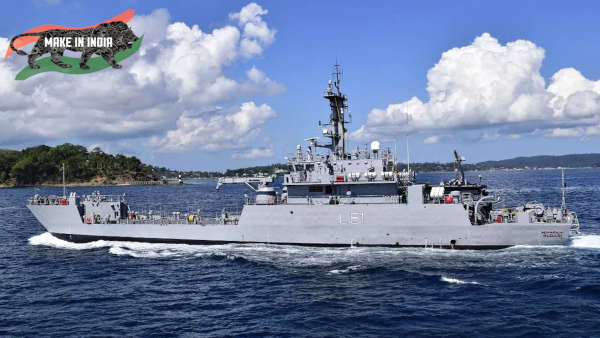
The Indian Navy has initiated the process for acquiring six new Landing Craft Utility Mk V vessels, opening the way for a significantly larger and longer-ranged generation of indigenous amphibious ships. The proposed vessels are intended to transport tanks, infantry combat vehicles, troops and military equipment while supporting amphibious operations, island logistics and humanitarian missions.
The Navy has issued a Request for Information to assess the capabilities of Indian shipyards for the programme. The proposed acquisition is envisaged under the Buy (Indian–IDDM) category, placing indigenous design, development and manufacturing at the centre of the project.
The programme is presently at the RFI stage. No shipyard has been selected, and a construction contract has not yet been awarded. The final configuration, cost and delivery schedule will emerge as the acquisition moves through subsequent procurement stages.
A Much Larger Landing Craft
The specifications outlined for the LCU Mk V indicate a substantial increase in size and capability compared with the Indian Navy’s existing LCU Mk IV vessels.
The proposed ship is expected to measure approximately 85 metres in length and displace around 1,500 tonnes. Diesel propulsion is envisaged, while the Navy has specified a maximum speed of at least 15 knots.
More significant is the requirement for an endurance of approximately 4,500 nautical miles. This would give the Mk V considerably greater operational reach than the current LCU Mk IV and allow it to undertake longer missions without frequent replenishment.
The vessels are also expected to operate in challenging sea conditions and have a service life of approximately 30 years, making them long-term assets for India’s amphibious and island-support capabilities.
Four Main Battle Tanks and Four BMPs
The proposed carrying capacity demonstrates the scale of the Mk V.
Each vessel is expected to transport at least four Main Battle Tanks and four BMP infantry combat vehicles along with as many as 190 fully equipped troops. This would allow a single LCU to move a substantial package of armour, mechanised infantry and personnel directly towards a beach or another suitable landing area.
Landing Craft Utility vessels are specifically designed to transport heavy military equipment between ships, islands and shorelines where conventional harbour infrastructure may be unavailable. Their ability to approach and beach on suitable shores allows vehicles to be driven directly onto or off the vessel through a ramp.
Such ships are not restricted to amphibious assault operations. They can also transport engineering equipment, ammunition, vehicles, stores and personnel between dispersed island locations and remote coastal areas.
4,500-Nautical-Mile Endurance Marks a Major Change
One of the most important aspects of the Mk V requirement is its proposed endurance of around 4,500 nautical miles.
The existing LCU Mk IV was designed with an endurance of approximately 1,500 nautical miles. The Mk V requirement therefore represents roughly a threefold increase in endurance, substantially expanding the geographical area within which the vessel could operate.
This change is particularly significant because an LCU has traditionally been associated with relatively short-distance movement between ships and shore. A 4,500-nautical-mile endurance would give the Mk V far greater independence and enable sustained movement between distant island territories and operational areas.
For India, such range has particular relevance to the Andaman and Nicobar archipelago, where military facilities and civilian settlements are distributed across a long chain of strategically positioned islands.
Building on India’s LCU Mk IV Experience
The Indian Navy already operates eight indigenous LCU Mk IV vessels constructed by Garden Reach Shipbuilders & Engineers in Kolkata.
The Mk IV programme established an important domestic capability for designing and building specialised amphibious ships. These vessels were designed primarily to transport Main Battle Tanks, armoured vehicles, troops and military equipment from ship to shore.
The LCU Mk IV is approximately 62.8 metres long and capable of speeds of around 15 knots. The class can embark troops in addition to tanks and other combat vehicles and incorporates a bow ramp that enables equipment to be loaded and unloaded during beaching operations.
The ships also use ballasting and de-ballasting arrangements to achieve the appropriate trim for approaching suitable beaches and conducting loading or unloading operations.
The eighth and final vessel of the class, IN LCU L58, was commissioned into the Indian Navy in March 2021, completing the eight-ship programme.
Mk V Takes the Indigenous Design to Another Scale
The proposed Mk V would take the basic operational concept considerably further.
At around 85 metres in length and approximately 1,500 tonnes displacement, it would be substantially larger than the Mk IV. Its requirement to carry four Main Battle Tanks, four BMPs and 190 troops also establishes a significant heavy-lift capability for amphibious operations.
The most important improvement, however, would be operational reach. Increasing endurance from approximately 1,500 nautical miles to around 4,500 nautical miles would change the character of the platform from a relatively short-range landing craft into a vessel capable of considerably more independent operations.
The Mk V therefore represents more than a straightforward replacement for the existing generation. The specifications point towards a larger amphibious logistics platform designed to transport significant military loads over much greater distances.
Strengthening India’s Island Logistics
India’s maritime geography creates a strong requirement for ships capable of supporting remote islands without depending entirely on large ports.
The Andaman and Nicobar Islands extend for hundreds of kilometres across the eastern Indian Ocean, close to important maritime routes connecting the Indian Ocean with Southeast Asia. The Lakshadweep archipelago presents another dispersed island environment in the Arabian Sea.
Landing craft can transport Army vehicles, engineering machinery, stores, ammunition and personnel to locations where larger naval or commercial ships may not be able to unload directly.
During military contingencies, LCUs can reinforce island positions, transfer troops and equipment between locations and sustain forces operating away from major naval bases. Their ability to use suitable beaches provides additional flexibility when established port infrastructure is unavailable or inaccessible.
An Important Role Beyond Combat
The usefulness of the LCU Mk V would extend beyond amphibious warfare.
Landing craft are particularly valuable during Humanitarian Assistance and Disaster Relief operations because they can transport heavy engineering machinery, vehicles, relief supplies and large numbers of personnel directly to affected coastal or island areas.
This capability becomes particularly important following cyclones, earthquakes or tsunamis, when ports, jetties and road networks may have suffered extensive damage.
A large landing craft capable of beaching can deliver excavators, trucks, generators, medical supplies, food, water and disaster-response personnel without requiring a functioning commercial port. The same characteristics that make the vessel useful during amphibious operations therefore provide considerable value during civilian emergencies.
Make in India at the Centre of the Programme
The proposed procurement under the Buy (Indian–IDDM) category places domestic design and production at the heart of the LCU Mk V programme.
Indian shipyards have already accumulated considerable experience in constructing increasingly sophisticated naval vessels, ranging from landing craft and survey vessels to frigates, destroyers and aircraft carriers. The LCU Mk IV programme also provides a direct domestic foundation for developing the next generation of amphibious ships.
The Mk V programme could expand this capability further by requiring Indian industry to design and manufacture a larger vessel with greater endurance, increased payload capacity and modern navigation, communication and combat-support systems.
The programme would also generate opportunities for Indian manufacturers supplying propulsion equipment, electrical systems, auxiliary machinery, sensors, communications equipment, pumps, valves and other marine components.
A New Generation of Indian Amphibious Capability
The requirement for six LCU Mk V vessels signals a substantial evolution in the Indian Navy’s amphibious logistics capability.
A vessel of approximately 1,500 tonnes displacement, capable of carrying four Main Battle Tanks, four BMPs and 190 troops while possessing an endurance of around 4,500 nautical miles, would offer considerably greater reach and carrying capacity than the current Mk IV generation.
The project remains at an early procurement stage, and the eventual shipbuilder, final design, contract value and construction schedule are yet to be determined. The specifications released through the RFI nevertheless provide a clear indication of what the Navy is seeking: an indigenous amphibious platform capable of transporting substantial military forces over considerably greater distances while remaining useful for island logistics and disaster-response missions.
The programme also represents the next potential step in an indigenous landing-craft lineage already established through the eight LCU Mk IV vessels. If taken forward into construction, the LCU Mk V will extend that experience into a larger and significantly longer-ranged class designed for India’s evolving maritime requirements.
References
Indian Navy — Request for Information for procurement of six Landing Craft Utility Mk V vessels, September 2026.
Press Information Bureau, Ministry of Defence — Commissioning of IN LCU L51, 28 March 2017.
Press Information Bureau, Ministry of Defence — Commissioning of IN LCU L58, 18 March 2021.
Garden Reach Shipbuilders & Engineers Limited — Official information and releases concerning the design and construction of the LCU Mk IV class.
Ministry of Defence, Government of India — Defence Acquisition Procedure and Buy (Indian–IDDM) procurement framework.
You may also like
-
PTC Industries Secures Safran Order to Manufacture Titanium Components for LEAP Aircraft Engines
-
India and ASEAN Strengthen Defence Cooperation for a Secure and Stable Indo-Pacific
-
Indian Navy Completes Historic First Command of Combined Task Force 154, Training Personnel from 39 Nations
-
ideaForge Secures ₹151 Crore Government Support to Develop YETI Heavy-Lift Autonomous Logistics Drone
-
JSR Dynamics Advances Indigenous Jet-Powered Weapons and Guided Rockets
