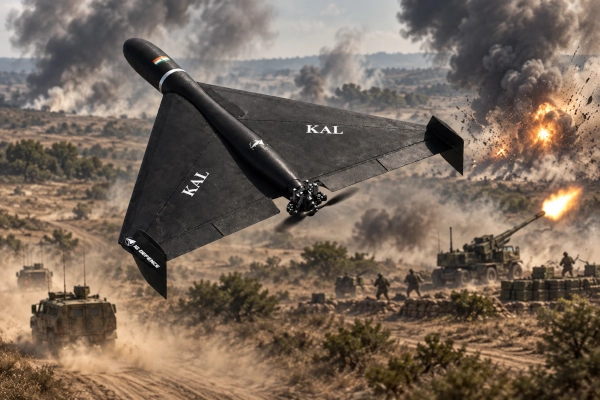
India’s indigenous long-range unmanned strike capability has moved forward with IG Defence successfully testing its KAL long-range one-way attack drone at the Pokhran Field Firing Range in Rajasthan. The flight trial was conducted on September 20, 2026, using a vehicle-mounted launch platform, and focused on validating the combined functioning of the drone’s airframe, propulsion, avionics, navigation and mission systems under field conditions.
The test marked an important stage in the development of KAL because it brought the major subsystems together in a complete flight configuration. Long-range unmanned strike platforms depend on close integration between structure, propulsion, flight control, navigation and mission software, and the Pokhran trial was intended to demonstrate that these elements could operate together as a single system rather than as separately tested components.
KAL Designed for Long-Range One-Way Strike Missions
KAL has been developed as a long-range one-way attack drone intended for missions where the aircraft flies towards a designated target and does not return to its launch point. IG Defence has positioned the platform for deep-strike roles in which range, endurance, payload carriage and autonomous navigation are more important than recovery.
The company has stated that the platform is designed for a range of up to 1,000 kilometres, endurance of approximately seven to eight hours and a payload capacity of up to 50 kilograms. These figures represent company-declared design specifications, and IG Defence has not publicly disclosed the exact distance flown, endurance achieved or payload carried during the Pokhran trial itself.
Pokhran Test Focused on Integrated System Performance
The principal achievement of the September trial was the validation of the drone as an integrated platform. The test brought together propulsion, onboard electronics, flight-control systems, navigation equipment and mission-management functions within a realistic field-launch environment.
This type of integration testing is essential for an unmanned strike system because successful operation depends not only on individual components performing correctly but also on their ability to communicate and respond together throughout the flight. The Pokhran trial therefore represents a transition from component-level development towards complete-system validation.
Vehicle-Mounted Launch Adds Operational Flexibility
The KAL drone was launched from a vehicle-mounted platform, giving the system greater flexibility in deployment. A mobile launcher allows the aircraft to be transported and operated from different locations without depending on fixed launch infrastructure.
This approach can be particularly useful for long-range unmanned systems that may need to be dispersed, repositioned and launched from temporary sites. Mobile deployment also broadens the range of locations from which the system can be operated during exercises or operational missions.
Navigation Architecture Built for Autonomous Flight
IG Defence has stated that KAL uses a navigation suite combining multi-band Global Navigation Satellite System inputs with inertial navigation. The combination is intended to support autonomous flight over extended distances while providing positional continuity throughout the mission.
Reliable navigation is one of the most important requirements for a long-range one-way attack system because even small cumulative errors can become significant over hundreds of kilometres. The integration of satellite-based and inertial navigation therefore forms a central part of the platform’s overall mission capability.
GRID Provides the Digital Mission Layer
KAL is also linked to IG Defence’s proprietary GRID Battle Management System, which provides the digital architecture supporting mission planning, data handling and platform management. The integration of the drone with a broader battle-management environment indicates that the programme is being developed as part of a networked operational system rather than as an isolated aircraft.
The Pokhran trial therefore involved more than simply proving that the drone could fly. It also demonstrated the interaction between the airborne platform and the software architecture intended to support mission execution and control.
KAL Featured During IAF Dronathon 2026
IG Defence also showcased KAL during IAF Dronathon 2026 at Pokhran, where the company presented a range of indigenous unmanned and precision-strike systems. The event brought together military users and Indian defence companies for demonstrations and evaluation of emerging drone technologies.
KAL was presented as part of IG Defence’s growing portfolio of unmanned systems, alongside other platforms intended for reconnaissance, strike and battlefield support roles. Its presence at Dronathon placed the programme within the wider effort to expand domestic capability in unmanned aerial systems.
Indigenous Long-Range Drone Development Expands
The development of KAL reflects the increasing participation of Indian private companies in advanced unmanned warfare technologies. Long-range one-way attack drones have become an important category because they can combine extended reach, autonomous navigation and useful payload capacity within a relatively compact platform.
India’s defence industry is now working across a broad spectrum of unmanned technologies, ranging from tactical quadcopters and loitering munitions to longer-range systems designed for missions deep beyond the immediate battlefield. Programmes such as KAL show how private-sector developers are moving from prototype demonstrations towards increasingly complex integrated flight trials.
Trial Marks a Step Towards Further Validation
The September 20 Pokhran flight does not establish that every declared performance parameter has already been demonstrated in full operational conditions. What it confirms is that KAL has progressed into a field-testing phase in which its principal subsystems have been exercised together as a complete aircraft.
Further testing will be important for validating endurance, range, payload performance, navigation robustness and operational reliability across a broader set of conditions. The successful Pokhran trial nevertheless represents a significant engineering milestone for the programme and provides a foundation for subsequent stages of development.
References
IG Defence — Official company updates on the KAL Pokhran trial and Project KAL, September 2026.
IG Defence — Official information on the GRID Battle Management System and unmanned systems portfolio.
IG Defence — Official participation update from IAF Dronathon 2026 at Pokhran.
Moneycontrol — Report on KAL’s Pokhran flight trial, September 21, 2026.
You may also like
-
India’s Semiconductor Market Could Cross US$200 Billion by 2035 as Domestic Demand Accelerates
-
Pace Robotics Moves Construction Automation From Pilot Stage to Commercial Deployment
-
JCBL Receives DRDO Technology for Indigenous 20-Tonne Heavy Drop System for C-130J and C-17
-
DRDO Moves 30 kW Laser Weapon Towards Production, Industry Partner Selection Planned Within Six Months
-
Vajra Air Defence Warriors Validate AKASHTEER Sensor-to-Shooter Network in Day-Night Firing Drills
