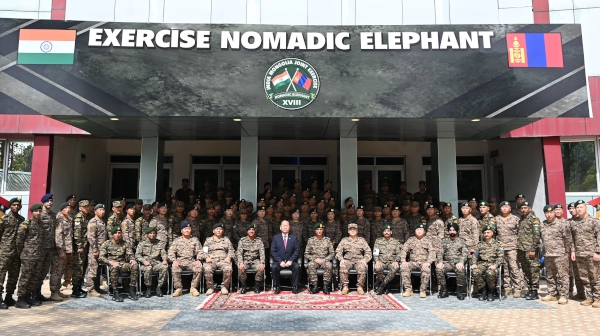
The 18th edition of the India–Mongolia Joint Military Exercise Nomadic Elephant commenced on September 21, 2026, at the Foreign Training Node in Pithoragarh, Uttarakhand, bringing together contingents from the Indian Army and the Mongolian Armed Forces for nearly two weeks of joint operational training.
The exercise will continue until October 3, 2026. Both countries have deployed contingents of 45 personnel each, reflecting the platoon-level structure of the annual bilateral exercise.
Annual Exercise Alternates Between India and Mongolia
Exercise Nomadic Elephant is conducted annually, with the venue alternating between India and Mongolia. The previous edition was held in Ulaanbaatar, Mongolia, during May and June 2025.
The 2026 edition continues the long-running defence engagement between the two countries and provides both armies with an opportunity to train together in terrain and operational conditions relevant to contemporary peacekeeping and counter-insurgency missions.
Focus on Counter-Insurgency Operations
The primary objective of the exercise is to strengthen the joint military capability of the Indian and Mongolian forces to undertake counter-insurgency operations in semi-urban and mountainous terrain under a United Nations mandate.
The location in Pithoragarh offers terrain suitable for such training, particularly for operations that require mobility, coordination and tactical response in difficult mountainous environments.
Both contingents will work together on operational planning, execution of tactical drills and refinement of procedures that can be applied during joint missions.
Tactical Training and Interoperability
A major focus of Nomadic Elephant 2026 is the improvement of interoperability between the Indian Army and the Mongolian Armed Forces.
Troops from both sides will exchange operational experience, compare tactical procedures and refine joint drills through realistic field scenarios. The training is intended to strengthen coordination at the small-unit level while improving familiarity with each other’s operating methods.
Such exercises also allow participating troops to develop common procedures for command, communication and execution during multinational operations.
Cordon and Search and Room Intervention Drills
The training programme includes cordon and search operations, which are commonly used in counter-insurgency and counter-terrorism environments to isolate an area, restrict movement and systematically search for threats.
The contingents will also practise room intervention drills, requiring troops to operate in confined and built-up environments where close coordination, speed and precision are critical.
These activities simulate situations that soldiers may encounter during security operations in semi-urban terrain.
Special Heliborne Operations
The exercise will include training in Special Heliborne Operations, allowing troops to practise rapid deployment and tactical movement using helicopters.
Heliborne operations are particularly significant in mountainous regions where ground movement can be restricted by terrain, weather and limited road access.
Training in such operations helps troops develop the ability to insert forces rapidly into difficult areas and coordinate air and ground elements during tactical missions.
Drones and Counter-Drone Systems
Nomadic Elephant 2026 also reflects the growing importance of unmanned systems on the modern battlefield.
The training curriculum includes the employment of drones and counter-drone systems, enabling troops to gain practical experience in the use of unmanned aerial platforms for surveillance and tactical awareness while also practising methods to detect and counter hostile drones.
The inclusion of these systems highlights how bilateral military exercises are increasingly incorporating technologies that have become central to contemporary operations.
Cyber Security Training Added to Operational Curriculum
Cyber security forms another important element of the exercise.
Indian and Mongolian personnel will undertake cyber security training alongside conventional tactical drills, recognising the growing role of secure communications, digital networks and information protection in military operations.
The combination of field exercises, unmanned systems and cyber training gives the exercise a broader operational scope than traditional infantry-based joint drills.
Strengthening India–Mongolia Defence Cooperation
Exercise Nomadic Elephant has become an established component of the defence relationship between India and Mongolia.
Regular interaction between the two armies provides opportunities to share experience, develop mutual understanding and improve their ability to operate together in multinational and United Nations-led missions.
The 2026 edition in Pithoragarh is expected to further strengthen professional cooperation between the two armed forces while reinforcing the broader relationship of friendship and mutual trust between India and Mongolia.
References
Press Information Bureau, Ministry of Defence, Government of India — India-Mongolia Joint Military Exercise Nomadic Elephant Commences at Pithoragarh, September 21, 2026.
Ministry of Defence, Government of India — Official information on Exercise Nomadic Elephant and India–Mongolia defence cooperation.
You may also like
-
Former DRDO Chief Samir Kamat Confirms Akash Missile Exports to Tajikistan and Turkmenistan
-
MoD Signs ₹586 Crore Contract for Indigenous Auxiliary Power Units for T-72 and T-90 Tanks
-
Agni-5 Heavy Penetrator Concept Emerges as India Studies Long-Range Bunker-Busting Capability
-
DRDO Gives Private Industry Greater Freedom to Refine Secondary Designs and Subsystems
-
Suryakiran Aerobatic Team Makes Historic Debut Over Meerut Skies
