India’s effort to give its armoured forces a new layer of protection against modern anti-tank weapons is becoming increasingly visible, with fresh details emerging about the Defence Research and Development Organisation’s indigenous hard-kill Active Protection System for tanks.
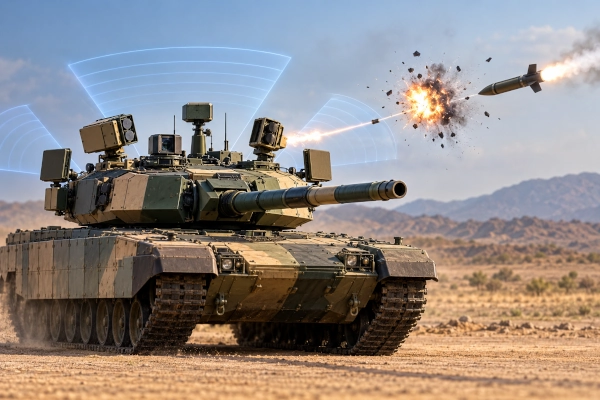
A new visual representation associated with DRDO’s Active Protection System programme provides a clearer indication of how the sensors and countermeasure launchers could be arranged around the turret of a main battle tank. The configuration broadly corresponds with technical details disclosed by DRDO officials during Aero India 2025, when the organisation confirmed that it was developing a hard-kill APS for integration with main battle tanks.
Rather than representing the unveiling of an entirely new system, the latest disclosure offers a more complete picture of how the indigenous APS could be installed on an operational armoured platform. It also comes at a significant time for the Indian Army, with the Defence Acquisition Council having formally approved the procurement of Active Protection Systems for tanks in July 2026.
A Defensive Shield Around the Tank
An Active Protection System is designed to defend an armoured vehicle before an incoming weapon actually strikes its armour. Instead of relying exclusively on composite armour, explosive reactive armour or other passive protection, a hard-kill APS attempts to detect an incoming projectile, calculate its trajectory and physically intercept it at a safe distance from the vehicle.
DRDO’s configuration uses multiple radar sensors positioned around the turret to create overlapping surveillance coverage. According to details disclosed at Aero India 2025, the indigenous system incorporates four X-band radar panels intended to provide 360-degree coverage around the tank.
The latest configuration imagery appears consistent with this architecture, showing sensors distributed around the turret rather than relying on a single radar installation. Such an arrangement is important because an APS must continuously observe different sectors around the vehicle and rapidly determine whether an approaching object is actually on a collision course.
Once a genuine threat has been identified, the system can cue its hard-kill countermeasure toward the incoming projectile.
Twin Traversable Countermeasure Launchers
The interceptor element of the DRDO system is built around two traversable launcher units mounted on the upper section of the turret. DRDO officials previously indicated that each launcher would carry two anti-threat munitions.
Each launcher is intended to cover approximately 180 degrees in azimuth and can elevate to as much as 90 degrees. When combined with the four radar panels, this arrangement is intended to create broad hemispherical protection around the vehicle rather than restricting the system to threats approaching horizontally from the front or sides.
This is particularly important as the threat facing tanks has changed considerably. Modern armoured vehicles must contend not only with conventional anti-tank guided missiles and rocket-propelled grenades but increasingly with weapons approaching from elevated trajectories.
The ability to elevate the countermeasure launchers also gives the architecture greater flexibility against threats approaching from higher angles, although publicly available information does not yet establish the system’s full operational capability against every category of top-attack weapon.
Intercepting the Threat Before Impact
The hard-kill element of the system employs an explosive countermeasure intended to destroy or disrupt an incoming anti-armour projectile before it reaches the tank.
At Aero India 2025, DRDO officials indicated an interception envelope of approximately 20 to 50 metres from the protected vehicle. The system was described as being developed against a broad range of battlefield threats, including anti-tank guided missiles, rocket-propelled grenades, HEAT and HESH ammunition. DRDO officials also identified FSAPDS rounds among the threats the system could detect and engage.
The short interception window illustrates the technological challenge involved. An incoming missile or projectile can cover the final tens of metres extremely rapidly. The APS must therefore detect the object, establish its speed and trajectory, determine whether it poses a genuine threat, select an interceptor solution, orient the launcher and deploy the countermeasure within a fraction of the weapon’s remaining flight time.
The effectiveness of such a system consequently depends not merely on the explosive countermeasure, but on the integration of radar, high-speed processing, fire-control algorithms and extremely fast launcher mechanisms.
DRDO Divides the Challenge Between Specialist Laboratories
DRDO’s own technology-development roadmap confirms that Active Protection System work is being pursued through specialised laboratories.
The Combat Vehicles Research and Development Establishment, or CVRDE, is responsible for Active Protection System technologies intended to defeat chemical-energy anti-armour threats. Meanwhile, the High Energy Materials Research Laboratory, or HEMRL, is working on blast-based hard-kill countermeasures and propulsion technologies intended to defeat different anti-tank threats.
This division reflects the multidisciplinary nature of an APS. CVRDE brings expertise in combat-vehicle design, integration and electronic systems, while HEMRL contributes expertise in energetic materials, explosive effects and specialised propulsion technologies.
Successfully integrating these technologies into a tank requires considerably more than simply attaching radar panels and launchers to the turret. The system must function alongside the tank’s main gun, sights, communication antennas, smoke grenade launchers, remote weapon stations and other equipment without obstructing their operation.
It must also survive vibration, shock, dust, extreme temperature variations and the intense electromagnetic environment associated with a modern armoured formation.
Detection Capability Extends to Small Drones
One particularly interesting aspect of the DRDO system is the sensitivity of its radar architecture.
DRDO officials told Janes during Aero India 2025 that the system could detect small and micro unmanned aerial vehicles at distances of around 2 kilometres.
This capability is increasingly relevant because small drones have become an important element of anti-armour warfare. Reconnaissance quadcopters can expose tank positions, while first-person-view drones and loitering munitions can attack vulnerable sections of a vehicle from directions that traditional armour was never primarily designed to defend.
Nevertheless, the ability to detect small UAVs could potentially allow the APS sensors to contribute information to a wider vehicle self-protection or counter-UAS architecture in future configurations.
Why Hard-Kill Protection Has Become Increasingly Important
For decades, improvements in tank survivability largely depended on adding stronger armour. Composite armour was followed by increasingly sophisticated explosive reactive armour, while smoke grenade systems, laser warning receivers and electronic countermeasures provided additional defensive layers.
Modern precision weapons have complicated that approach.
Anti-tank guided missiles can attack heavily protected vehicles from considerable distances, while top-attack weapons seek to strike the comparatively thinner armour on a tank’s roof. At the same time, inexpensive drones can manoeuvre around battlefield obstacles and approach vehicles from directions that are difficult to protect simply by adding more armour.
There are practical limits to how much passive armour can be added to a tank. Increasing protection also increases vehicle weight, placing additional demands on the engine, transmission, suspension and bridges while potentially reducing mobility.
An APS offers another approach. Instead of attempting to make the vehicle physically strong enough to absorb every impact, it seeks to prevent selected threats from reaching the armour at all.
This does not eliminate the need for conventional armour. Rather, an APS becomes another layer within a wider survivability system combining armour, reactive protection, signature management, electronic countermeasures, situational awareness and tactical manoeuvre.
Indian Army Requirement Gives the Programme Greater Relevance
The indigenous development effort has acquired added importance following the Defence Acquisition Council meeting of 3 July 2026.
The DAC, chaired by Defence Minister Rajnath Singh, granted Acceptance of Necessity for defence acquisition proposals estimated at approximately ₹52,000 crore. Among the systems approved for the Indian Army was an Active Protection System for Tanks. The Ministry of Defence specifically stated that the APS was intended to improve the defensive mechanism and survivability of tanks.
Acceptance of Necessity represents an important stage in India’s defence acquisition process, although it should not be confused with the award of a production contract.
The July decision nevertheless establishes a formal Army requirement for the capability and creates a significant opportunity for an indigenous solution if DRDO’s system successfully completes the necessary development, evaluation and user-trial stages.
A Major Step Toward Layered Tank Survivability
DRDO’s indigenous hard-kill APS represents an important shift in the philosophy of armoured protection in India. Future tank survivability will increasingly depend on detecting and defeating threats before they hit, rather than relying exclusively on armour to survive the impact.
The latest configuration provides the clearest visual indication yet of how DRDO intends to combine distributed X-band radar coverage with rapidly traversing countermeasure launchers around the turret of a main battle tank.
The programme now sits at the intersection of two important developments: an established indigenous DRDO technology effort and a formal Indian Army requirement for tank Active Protection Systems.
References
- Defence Research and Development Organisation (DRDO) — Technology Foresight: Armoured Combat Vehicles
https://drdo.gov.in/drdo/en/offerings/technology-foresight/armoured-combat-vehicles - Press Information Bureau, Ministry of Defence — Defence Acquisition Council accords Acceptance of Necessity for capital acquisition proposals worth approximately ₹52,000 crore, 3 July 2026
https://www.pib.gov.in/PressReleasePage.aspx?PRID=2280728 - Janes — Aero India 2025: DRDO develops hard-kill active protection system
https://www.janes.com/defence-intelligence-insights/defence-news/land/aero-india-2025-drdo-develops-hard-kill-active-protection-system
You may also like
-
Tata Electronics, Sojitz and NRS Build Critical Materials Supply Chain for ₹91,000-Crore Dholera Semiconductor Fab
-
Cochin Shipyard Lays Keel for Indian Navy’s First Next Generation Missile Vessel
-
Philippines Tests Hermes UAV–BrahMos Sensor-to-Shooter Kill Chain in Maritime Strike Exercise
-
HAL Clears Technical Hurdles in F414 Local Production Talks, Targets 10 Tejas Mk1A Deliveries by March 2027
-
BEL Secures Major Export Order From Elbit Systems for Aircraft DIRCM Sub-Assemblies
