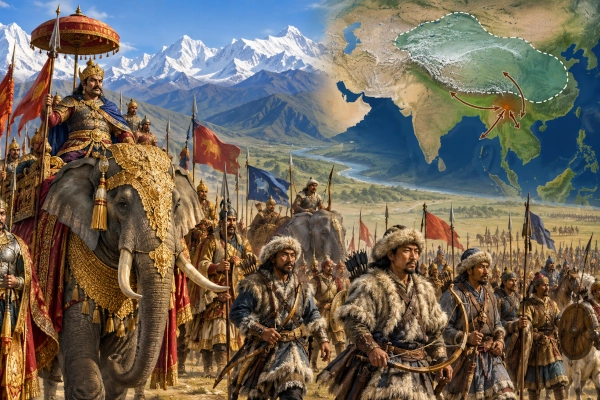
The Mahabharata does not confine its geographical imagination to the Gangetic plains, central India or the northwestern kingdoms surrounding the Kuru political sphere. Its narrative repeatedly extends across mountain systems, trade corridors and distant frontier regions to peoples who stood far beyond the immediate world of Hastinapura and Indraprastha. Among the most intriguing of these are the Cīnas, rendered in older English translations as Chinas, Chins or Chinas.
Cina appears in the epic in several very different contexts. The Pandavas pass through a country bearing the name during their Himalayan travels. Cinas are counted among the distant peoples present at Yudhishthira’s Rajasuya. Textiles manufactured in Cina reach the Pandava court through other communities, while Dhritarashtra possesses deer skins brought from Cina and proposes them among the gifts intended for Krishna. Bhima recalls a ruler called Dhautamulaka of the Cinas when warning of kings whose destructive conduct brought ruin upon their own people, while Cina warriors later appear within Bhagadatta’s contingent on the Kaurava side before the Kurukshetra War.
Taken together, these references place Cina within several interconnected spheres of the epic world: mountain geography, political memory, long-distance exchange, diplomacy and warfare. They suggest that the Mahabharata tradition possessed a recognisable awareness of peoples living beyond or across the Himalayan world, even though the precise political boundaries of Cina cannot be reconstructed with certainty.
The Name Cīna and Its Wider Historical Context
The Sanskrit form is Cīna — चीन. Related forms later appear in several languages across Central and Western Asia, and the name has often been connected with the ancient Chinese state of Qin, which eventually unified much of China in the third century BCE. This etymology remains influential because similar forms for China appear across several linguistic traditions associated with long-distance exchange.
The linguistic connection, however, should not be treated as an exact political identification. Geographical names frequently travelled through merchants, intermediaries and frontier communities, and a name could spread far beyond the territory of the state from which it may originally have derived. The presence of Cīna in Sanskrit literature therefore does not automatically mean that every reference describes the territory of the Qin state or any later Chinese empire.
For historical geography, the most defensible description is that Cina represented a northern or trans-Himalayan people associated with the wider Chinese or Inner Asian world, while the precise location indicated by individual Mahabharata passages remains uncertain. The term may have referred to communities immediately beyond the Himalayan crest in some contexts and to a wider eastern or trans-Himalayan region in others.
Cina as Part of the Northern World
The Mahabharata repeatedly places the Cinas within its northern geographical horizon. In its broader catalogues of peoples, the Cinas occur alongside communities such as the Yavanas, Kambojas, Shakas and other peoples associated with the north and northwest. This repeated positioning gives the name a clear geographical direction even where precise borders remain unavailable.
The Cinas therefore belong to the same wider frontier world in which the epic places peoples such as the Kiratas, Daradas, Tukharas and Kambojas. These groups are not presented as belonging to one single cultural or political zone, but their repeated appearance in northern and trans-Himalayan settings shows that the Mahabharata imagined the lands beyond the central kingdoms as populated, connected and politically relevant.
The Pandavas’ Journey Through the Himalayan Countries
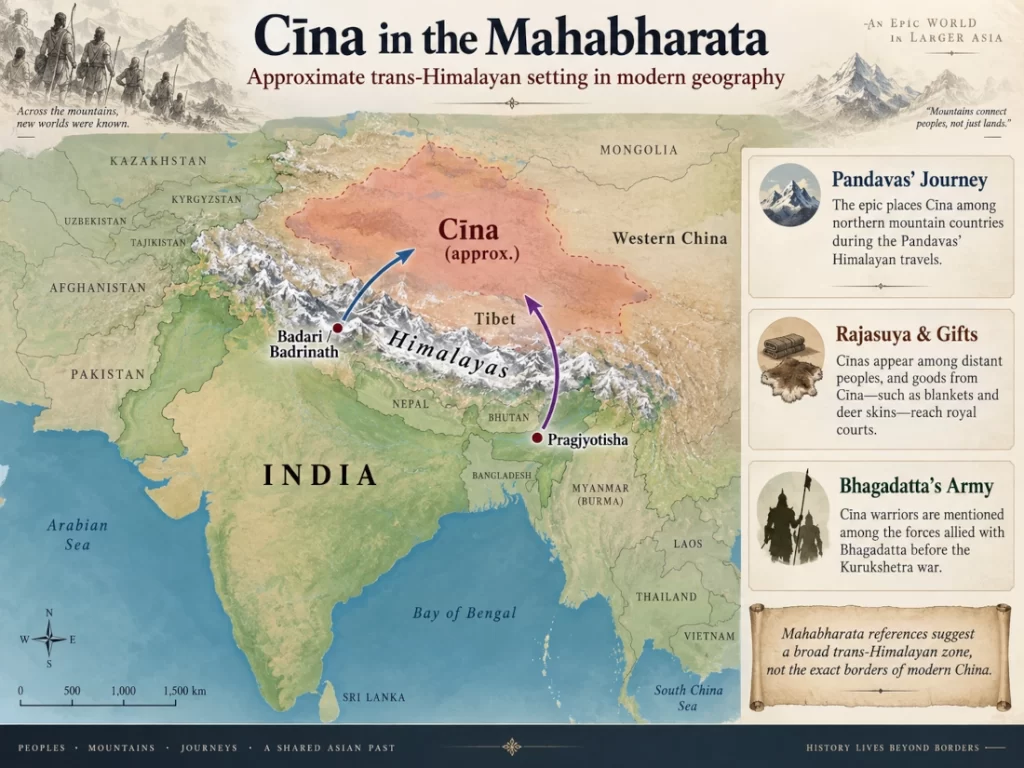
One of the most important geographical references to Cina occurs during the Pandavas’ exile. As the brothers travel through the Himalayan world, the narrative places them in a landscape associated with Badari, high mountains, hermitages and distant frontier peoples. In the course of this journey, the text names Cina, Tukhara, Darada and Kulinda among the countries encountered before the Pandavas reach the realm of King Suvahu.
This passage is significant because Cina is not merely inserted into a general list of remote nations. It appears within the description of an actual journey through the northern mountain world. The neighbouring names help define the geographical setting: Kulinda is generally associated with Himalayan country, Darada with the upper Indus and adjoining mountain regions, while Tukhara points farther toward Central Asia. Cina therefore belongs to a broad geographical arc extending across the Himalayas and toward Inner Asia.
The passage does not, however, provide the kind of detail required to reconstruct a precise route. It gives no distances, identified passes or securely defined borders, and it would therefore be excessive to trace the Pandavas through specific locations in modern Tibet or western China. What the episode establishes more securely is that Cina was imagined as part of the northern world accessible through the Himalayas.
Badari and the Trans-Himalayan Setting
The association with Badari offers an important geographical clue. Badari is traditionally identified with the Badrinath region of present-day Uttarakhand, an area connected historically with high-altitude routes leading toward the Tibetan Plateau. For centuries, communities on both sides of the Himalayan watershed maintained commercial, pastoral and religious contacts despite the severe terrain.
This does not prove that the Cina of the Mahabharata should simply be identified with Tibet. It does, however, make a trans-Himalayan interpretation plausible, particularly for the passages associated with the Pandavas’ northern travels. Rather than imagining Cina as a compact kingdom corresponding to a modern political unit, it is more reasonable to treat it as a broad region or people associated with territories beyond the Himalayan crest.
Such an interpretation also helps explain why Cina appears in different parts of the epic alongside peoples associated with both the central and eastern Himalayas. The name may have covered a wider geographical zone than a single valley or kingdom, especially across the long period during which the epic developed and took shape.
Cina at Yudhishthira’s Rajasuya
Cina appears in a very different context during Yudhishthira’s Rajasuya. After the ceremony, Duryodhana describes the extraordinary wealth and the numerous peoples who had gathered at the Pandava court. His recollection functions almost as a geographical catalogue of the wider world, bringing together distant rulers, foreign peoples, rare animals, textiles and precious objects.
Among the visitors are Cinas, together with other northern and northwestern communities. Their presence contributes directly to the political symbolism of the Rajasuya. The ceremony is not presented merely as a regional gathering but as an event capable of drawing peoples from the farthest reaches of the known world, thereby emphasising Yudhishthira’s prestige.
The Cina reference is therefore significant not simply because the people are named, but because they appear within a ritual setting designed to demonstrate the scale of royal recognition. Their presence places them within the diplomatic and ceremonial geography of the epic rather than at its margins.
Blankets Manufactured in Cina
The Rajasuya account also preserves one of the most revealing economic references connected with Cina. Duryodhana describes woollen blankets that were manufactured in Cina but presented by the Valhikas. The distinction between the place of manufacture and the people who carried the goods is especially important because it implies circulation across more than one region.
The episode suggests that luxury goods could originate in one distant country, pass into the hands of another people and ultimately reach a major royal court. The Mahabharata does not identify the merchants, market centres or precise route involved, so the passage should not be treated as documentary proof of a specific Silk Road corridor. It does, however, reveal an awareness that valuable objects could move across considerable distances through chains of exchange.
The geographical name itself appears to have carried commercial significance. A blanket described as being made in Cina was sufficiently distinctive to be mentioned among the prestigious goods displayed at one of the most important royal ceremonies in the epic.
Cina and Long-Distance Exchange
The reference to Cina-made textiles becomes even more meaningful when viewed against the broader pattern of northern trade. The northwestern subcontinent was connected through Gandhara and the upper Indus to Bactria and Central Asia, while other routes crossed Kashmir, the Karakoram, the Hindu Kush and the central or eastern Himalayas. These routes did not function as a single continuous highway but as networks of valleys, mountain passes and regional markets through which goods and travellers moved in stages.
Within this context, the Mahabharata’s repeated association of Cinas with Tukharas, Daradas, Kiratas, Kambojas and other northern peoples becomes easier to understand. These communities occupied different regions, but they belonged to a larger interconnected world in which horses, wool, skins, precious objects, military manpower and political information moved across long distances.
The Cina references therefore fit naturally within the wider economic geography of the epic. They suggest that the distant north was not imagined as isolated or inaccessible, but as a region tied to the subcontinent through exchange.
Deer Skins from Cina for Krishna
Another important reference appears before Krishna’s diplomatic mission to Hastinapura. As war approaches, Dhritarashtra discusses the elaborate reception he intends to arrange for Krishna, proposing valuable objects, animals, textiles and other treasures as suitable gifts. Among these are one thousand deer skins brought from Cina.
This passage again associates Cina with prestigious goods. The skins had travelled far enough to reach the Kuru court and were considered valuable enough to form part of a reception intended for one of the most important diplomatic figures in the epic. Their presence therefore indicates more than simple geographical awareness; it shows that Cina had entered the material world of elite political life.
The wording should nevertheless be handled carefully. Dhritarashtra proposes these objects as gifts, but the passage does not establish that Krishna ultimately accepted them. The significance of the episode lies in the value attached to Cina products and in the ability of such goods to circulate through the political centres of northern India.
Cina as a Source of Prestige Goods
The references to blankets and deer skins together suggest that Cina was associated with valuable commodities originating in colder northern environments. Wool, hides and other animal products recur frequently in ancient descriptions of northern tribute, and their presence in royal collections would have conveyed both material value and geographical distance.
The epic does not reveal the exact points of origin of these goods, nor does it explain how many intermediaries were involved in their transport. A commodity identified as being from Cina need not have travelled directly from a single court or capital. It may have passed through several mountain and Central Asian communities before arriving in the plains.
What matters is that Cina had become part of the economic vocabulary of the epic. The name identified a distant source region whose products were sufficiently well known to be recognised at major royal centres.
Dhautamulaka of the Cinas
Cina also appears within the Mahabharata’s political memory. Before Krishna departs on his peace mission, Bhima urges him to deal carefully with Duryodhana because a reckless ruler can destroy not only himself but his entire lineage. To strengthen the warning, Bhima recalls rulers whose conduct had brought catastrophe upon their people.
Among those rulers is Dhautamulaka of the Cinas. The reference is brief, but its significance is considerable because it presents Cina as more than an anonymous distant land. The epic associates it with a named ruler whose conduct had become memorable enough to serve as a political example.
The Mahabharata does not provide a dynasty, capital, chronology or detailed biography for Dhautamulaka, and attempts to identify him with a particular ruler from Chinese history remain speculative. The safer conclusion is that the epic tradition possessed some political memory connected with Cina and regarded its rulers as part of the wider historical world from which examples of kingship could be drawn.
Cina Warriors in Bhagadatta’s Army
The military dimension of Cina becomes explicit in the account of Bhagadatta. The ruler of Pragjyotisha joins Duryodhana with a large army that includes Cinas and Kiratas, placing warriors from the northern or trans-Himalayan frontier directly within the Kaurava coalition.
This is one of the strongest references to Cina in the entire epic because it moves beyond trade goods, geographical catalogues and distant political memory. Cina warriors are shown participating directly in the military mobilisation that precedes the Kurukshetra War.
The passage does not state that Bhagadatta ruled the whole of Cina, nor does it say that his entire force consisted of Cinas. His army was clearly composite. Even so, their presence under his command demonstrates that the Mahabharata envisaged military relationships between the northeastern frontier and peoples living farther into the Himalayan or trans-Himalayan world.
Bhagadatta and the Eastern Himalayan Connection
Bhagadatta’s association with Pragjyotisha adds an important geographical dimension. Pragjyotisha is traditionally associated with the northeastern part of the subcontinent, especially the Brahmaputra region. From there, the landscape opens naturally toward the eastern Himalayas, Bhutan, Arunachal Pradesh and the Tibetan Plateau.
The pairing of Cinas and Kiratas within Bhagadatta’s forces therefore fits an eastern Himalayan setting. Kiratas are repeatedly associated in Sanskrit literature with mountain and forest communities along the Himalayan frontier, and their appearance beside the Cinas strengthens the impression that both belonged to a wider northern and northeastern zone.
The precise political relationship between Bhagadatta and these groups remains unclear. They may have been allies, tributaries, recruited warriors or frontier communities associated with his wider sphere of influence. The text establishes the military connection without explaining its constitutional form.
From the Himalayas to Kurukshetra
The appearance of Cina warriors at Kurukshetra reveals the scale of the epic’s political geography. A people associated elsewhere with distant mountain regions becomes directly involved in the central conflict between the Kauravas and Pandavas. Through Bhagadatta’s army, the far northern frontier is drawn into the struggle for the Kuru realm.
This reinforces one of the Mahabharata’s recurring themes: the Kurukshetra War is presented not as a conflict among a handful of neighbouring kingdoms but as a confrontation involving alliances drawn from a much wider world. The presence of Cinas, along with many other distant peoples, helps create the impression of a war with interregional consequences.
Cina therefore occupies a dual position in the epic. It lies near the edge of the known geographical world, yet its warriors, products and political memories are fully integrated into the central narrative.
Was Cina the Same as Tibet?
It would be misleading to equate Cina directly and exclusively with Tibet. Tibet is a useful modern geographical reference, especially for the passages associated with Himalayan travel and frontier connections, but the Mahabharata does not define Cina according to the boundaries of the modern Tibet Autonomous Region.
The term may have had a wider or changing geographical meaning. In some contexts it may have referred to peoples living immediately north of the Himalayas, while in others it may have reflected knowledge of territories farther east connected with the ancient Chinese world. The long period of composition and transmission of the Mahabharata makes such variation entirely possible.
The safest approach is therefore to treat Tibet and adjoining trans-Himalayan regions as part of the probable geographical setting of Cina without reducing the term to one modern political unit.
Was Cina the Qin Empire?
The possible linguistic connection between Cīna and Qin remains important, but it should not be converted automatically into a territorial identification. Geographical names often spread through trade and intermediaries, and they may survive long after the political entity from which they originated has disappeared or changed.
It is therefore possible that the Sanskrit name ultimately derived from Qin while being used more broadly in India for peoples and territories associated with the trans-Himalayan or Chinese world. The linguistic history of the term and the geographical meaning of individual Mahabharata passages are related questions, but they are not identical.
The Mahabharata itself does not provide enough evidence to identify Cina with the precise territory of the Qin dynasty or with any later Chinese imperial state.
Cina and the Formation of the Mahabharata
The chronological problem becomes even more significant when the long textual history of the Mahabharata is considered. The epic reached its surviving form through a prolonged process of composition, expansion and redaction, and its geographical references may therefore preserve information from different periods.
A name such as Cina may have entered the tradition at one stage and later become incorporated into narrative material of different origin. Some passages may reflect awareness of nearer Himalayan communities, while others may preserve a broader understanding of lands farther east.
This makes it unwise to treat every Cina reference as if it were the observation of a single traveller at a single moment in history. The name may instead preserve several layers of geographical knowledge accumulated across generations.
Locating Cina on a Modern Map
A modern reconstruction should therefore avoid presenting Cina as a sharply defined kingdom matching the borders of present-day China. The most responsible approach would be to mark an approximate trans-Himalayan zone north and northeast of the Indian subcontinent, with particular emphasis on the Tibetan Plateau and adjoining territories farther east.
Several geographical relationships should be shown together. Badari and the central Himalayan region are relevant because Cina appears within the Pandavas’ mountain journey. Pragjyotisha and the Brahmaputra frontier are important because Bhagadatta’s army includes Cinas and Kiratas. The wider trans-Himalayan belt should also be indicated because the epic repeatedly places Cina within the northern world connected with Inner Asia.
A suitable map label would therefore be: “Cīna — approximate trans-Himalayan region associated with Tibet and territories farther east; exact Mahabharata boundaries uncertain.” Such a description reflects the evidence without implying a precision that the text does not provide.
A People Known Through Travel, Trade and War
The importance of Cina lies in the range of contexts in which it appears. The Pandavas encounter its geographical world during their travels, Cina visitors appear at Yudhishthira’s Rajasuya, goods manufactured there reach royal courts through long-distance exchange, and deer skins from Cina are stored among the treasures of Hastinapura. A ruler associated with the Cinas survives in political memory, while Cina warriors march with Bhagadatta to support the Kaurava alliance.
No single passage defines the country completely, but the references reinforce one another. Together, they create a coherent picture of a distant northern people connected with the Indian world through movement, commerce, diplomacy, political memory and warfare.
The Himalayas therefore emerge not simply as a barrier at the edge of the epic’s geography, but as a frontier crossed by people, objects and ideas.
Cina and the Wider Geography of the Mahabharata
Cina also helps reveal the extraordinary range of the Mahabharata’s geographical imagination. The epic places the Indian kingdoms within a wider network that includes Gandhara, Kamboja, Bahlika, Shaka, Tushara and other regions connected with Iran and Central Asia, while along and beyond the northern mountains appear Kiratas, Daradas, Kulindas and Cinas.
Through this wider world moved horses, wool, skins, precious materials, tribute, warriors and information. The epic’s geography is therefore not simply a list of kingdoms but a network of relationships extending across large parts of South and Inner Asia.
Cina occupies an important position within that network because it appears in geographical, economic, diplomatic, political and military contexts. Its repeated presence suggests that the world beyond the Himalayas was distant but by no means unknown.
The Trans-Himalayan Horizon of the Epic
The most cautious and defensible identification is that Cīna was a northern or trans-Himalayan people and country known to the Mahabharata tradition, probably associated broadly with the Tibetan Plateau and territories connected with the ancient Chinese world. The name has often been linked linguistically with Qin, but the epic does not provide enough evidence to identify Cina with the full territory of any specific Chinese dynasty or with the borders of modern China.
Its real significance lies elsewhere. The Mahabharata portrays a world in which distant northern peoples were connected with the Indian subcontinent through travel, commerce, diplomacy and war. Goods crossed the mountains, warriors entered alliances, rulers were remembered in political discourse, and names from beyond the Himalayas became part of the epic’s mental map.
Cina therefore stands near one of the farthest geographical horizons of the Mahabharata, yet it is never entirely outside the epic’s world. The Himalayas form a formidable boundary, but the references to Cina show that they were also a zone of passage and contact, linking the Indian subcontinent with the wider trans-Himalayan and Inner Asian world.
You may also like
-
Lanka in the Mahabharata: The Island Kingdom Beyond India’s Southern Shore
-
India and France Sign Agreement to Preserve and Digitise Ancient Indian Manuscripts
-
Huna in the Mahabharata: Nakula’s Western Campaign, the Harahunas and Central Asia’s Changing Frontiers
-
GeM’s AABHAR Collection Showcases 294 Indigenous Products, Strengthens Market Access for Indian Artisans
-
Tushara in the Mahabharata: The Lands Beyond the Hindu Kush and the Horsemen Who Faced Arjuna
