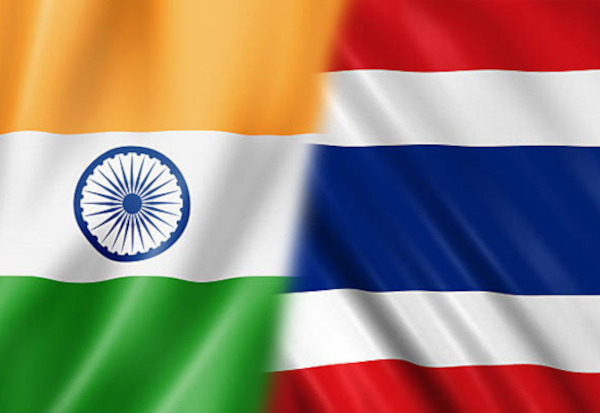
India and Thailand have intensified efforts to expand their economic partnership, with the two sides focusing on removing tariff and non-tariff barriers, identifying complementary areas for investment and building a more balanced bilateral trading relationship.
India’s Ambassador to Thailand, Puneet Agrawal, met Thailand’s Deputy Prime Minister and Minister of Commerce Suphajee Suthumpun in Bangkok on September 17, continuing a series of high-level economic engagements between New Delhi and Bangkok during September.
During the discussions, the two sides exchanged views on strengthening trade and investment by identifying sectors where the economies can complement each other, addressing existing tariff and non-tariff barriers and working towards a trading relationship that delivers greater mutual benefit.
The meeting comes as India and Thailand seek to convert their longstanding political and strategic relationship into deeper commercial integration.
Record Trade Brings the Imbalance Into Focus
Economic ties between India and Thailand have expanded substantially during the past several years.
According to official Indian government data, bilateral trade reached a record $20.93 billion in calendar year 2025, up sharply from $16.51 billion in 2024.
However, the trade relationship remains considerably tilted in Thailand’s favour. India exported goods worth approximately $5.06 billion to Thailand during 2025 while importing around $15.87 billion, resulting in an Indian trade deficit of about $10.81 billion.
This imbalance helps explain the growing emphasis in recent bilateral meetings on expanding Indian market access, resolving trade barriers and developing new sectors where companies from both countries can participate more evenly.
India and Thailand are therefore looking beyond merely increasing the headline value of bilateral commerce and are placing greater emphasis on creating a more diversified and sustainable trade structure.
Goyal-Suthumpun Meeting Set Out Wider Economic Agenda
The September 17 discussions build upon talks held in New Delhi on September 9 between Union Commerce and Industry Minister Piyush Goyal and Suphajee Suthumpun.
During that meeting, India and Thailand discussed strengthening bilateral trade and investment, expanding business opportunities and creating stronger business-to-business linkages.
The two governments also examined opportunities for cooperation and co-creation in sectors capable of supporting more balanced and sustainable growth.
The areas identified for deeper engagement extend well beyond conventional merchandise trade. They include tourism, logistics, pharmaceuticals, food processing, clean energy, automobiles, space technologies, cold-chain infrastructure, health and wellness, innovation and investment promotion.
The presence of these sectors suggests that the emerging India-Thailand economic partnership is increasingly centred on technology, manufacturing, services and modern supply chains rather than being restricted to traditional goods trade.
AITIGA Review Could Be Crucial
One of the most significant components of the bilateral economic discussions is the ongoing review of the ASEAN-India Trade in Goods Agreement, commonly known as AITIGA.
The agreement came into force in 2010 and forms the principal tariff framework governing much of India’s merchandise trade with ASEAN countries, including Thailand.
India and Thailand have agreed on the importance of advancing the review so that the framework becomes simpler, more trade-facilitative and better suited to contemporary commercial conditions.
Both governments have also emphasised deeper engagement through the India-Thailand Joint Trade Committee, which provides a bilateral mechanism for resolving market-access problems and identifying new commercial opportunities.
For India, improvements to the trading framework could be particularly important in addressing the widening goods deficit with Thailand while increasing opportunities for Indian manufacturers and exporters.
Complementary Manufacturing Economies
The economic structures of India and Thailand offer several areas of natural complementarity.
Thailand has developed strong manufacturing capabilities in automobiles and automotive components, electronics, machinery, food processing, chemicals and agricultural products. India, meanwhile, has rapidly expanded its capabilities in pharmaceuticals, digital services, electronics, renewable energy, engineering, automobiles and emerging technologies.
These overlapping but complementary strengths provide opportunities to build integrated supply chains rather than viewing bilateral commerce simply in terms of imports and exports.
Indian companies already have a significant presence in Thailand, including businesses from the Tata Group, Aditya Birla Group, Tech Mahindra, Larsen & Toubro, Bajaj Auto, Royal Enfield, Thermax and Apollo Tyres.
Thai companies have similarly established operations in India across agriculture, food processing, electronics, automobiles, infrastructure and retail.
Greater investment flows could therefore allow companies from both countries to use each other as manufacturing and distribution platforms for wider regional markets.
Thailand as a Gateway to Southeast Asia
Thailand occupies an important position in India’s wider economic engagement with Southeast Asia.
Situated at the centre of mainland Southeast Asia, Thailand provides access to major ASEAN markets and forms an important link between South Asia and the Greater Mekong region.
India’s Act East Policy and Thailand’s Act West Policy increasingly complement each other by encouraging stronger connectivity, trade, investment and strategic cooperation between South and Southeast Asia.
Thailand has consequently emerged as one of India’s major trading partners within ASEAN.
The economic relationship also has a wider regional dimension through mechanisms such as ASEAN, BIMSTEC, the Mekong-Ganga Cooperation and other regional platforms connecting India with Southeast Asia.
Strategic Partnership Expands Beyond Trade
Economic engagement is developing alongside a broader strengthening of India-Thailand relations.
Ambassador Puneet Agrawal also met Thailand’s Vice Minister for Foreign Affairs Vijavat Isarabhakdi on September 7. The two sides discussed strengthening their Strategic Partnership, including trade and investment, high-level exchanges and preparations for the 80th anniversary of diplomatic relations in 2027.
Their discussions also covered regional and international developments, particularly in the Indo-Pacific.
India and Thailand established diplomatic relations in 1947, but bilateral cooperation now extends across defence and security, maritime cooperation, connectivity, science and technology, culture, education, tourism and people-to-people exchanges.
Thailand’s position as both an ASEAN member and India’s maritime neighbour gives the relationship significance beyond purely commercial considerations.
From Higher Trade to Better-Structured Trade
The latest discussions indicate that New Delhi and Bangkok are now trying to move the economic relationship into a more mature phase.
Bilateral trade has already reached historically high levels. The next challenge is to improve its composition by reducing unnecessary barriers, widening market access, encouraging greater two-way investment and creating partnerships in new technology-intensive sectors.
Progress on the AITIGA review, stronger engagement through the Joint Trade Committee and cooperation in areas such as pharmaceuticals, clean energy, automobiles, logistics and space could all contribute to that transition.
The September 17 meeting therefore reflects a broader shift in India-Thailand economic engagement — from simply expanding trade volumes towards building a more balanced, diversified and mutually reinforcing economic partnership.
You may also like
-
PM Modi to Distribute Over 51,000 Government Appointment Letters at 20th Rozgar Mela on 19 September
-
India and Nepal Move to Expand Market Access as Trade, Customs and Cross-Border Connectivity Talks Advance
-
India, Trinidad and Tobago Deepen Parliamentary Ties
-
Banaganapalle Mangoes — The Golden Benishan of the Deccan and the Geography Behind a Celebrated Indian Mango
-
L&T Semiconductor and Tata Electronics Join Forces to Manufacture India-Designed Chips at Scale
