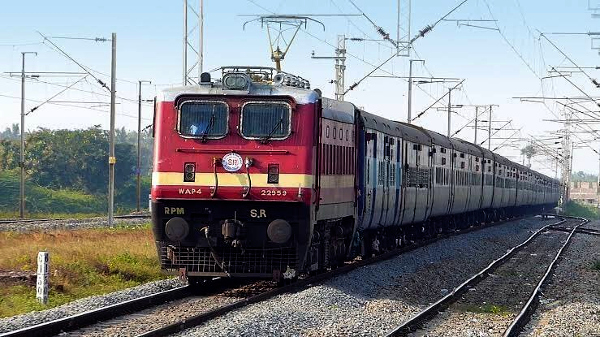
Southern Railway has completed the electrification of its entire 5,068-route-kilometre Broad Gauge network, bringing electric traction to every broad-gauge route under the zone and completing an electrification programme that began nearly a century ago.
The milestone was reached with the completion of electrification on the 71-km Pattukkottai–Karaikkudi section in Tamil Nadu, the final unelectrified broad-gauge stretch under Southern Railway. The newly electrified section underwent statutory inspection on September 9, 2026, after which Southern Railway announced that its complete broad-gauge network had reached 100 per cent electrification.
The achievement means electric locomotives can now operate across Southern Railway’s broad-gauge network without requiring a switch to diesel traction because of an unelectrified section. This gives the railway greater freedom in locomotive deployment while reducing the operational complications associated with traction changes.
Pattukkottai–Karaikkudi Completes the Network
The Pattukkottai–Karaikkudi section formed the last major gap in Southern Railway’s electrification programme. Once overhead electrification work on the 71-route-kilometre stretch was completed, Southern Railway Principal Chief Electrical Engineer Ganesh carried out the statutory inspection on September 9.
The successful completion of this section brought the zone’s entire 5,068 RKM Broad Gauge network under electric traction. Southern Railway said the change would allow seamless electric train operations across the zone while improving locomotive utilisation and operational flexibility.
The latest milestone represents a rapid completion of the remaining network. As recently as July 2026, Ministry of Railways data placed Southern Railway at 98.7 per cent Broad Gauge electrification, compared with several other railway zones that had already reached 100 per cent. Completion of the remaining Tamil Nadu section has now closed that gap.
No More Traction Changes on Broad-Gauge Routes
One of the most immediate operational benefits is the elimination of traction changes caused by unelectrified sections within the Southern Railway broad-gauge network.
Where a train moving under electric power encountered a non-electrified route, railway operations could require the train to use a diesel locomotive or change locomotives before continuing. Such changes consume time, require additional locomotives and crews and make fleet planning more complicated.
With the entire broad-gauge network electrified, Southern Railway can deploy electric locomotives continuously over its routes. The railway expects this to improve locomotive utilisation, reduce unnecessary detention and support more reliable train operations.
Full electrification does not by itself increase the maximum speed of every railway section, since operating speed also depends on track condition, signalling, curves and other infrastructure. It does, however, remove a major operational constraint and allows electric traction to be used consistently across the network.
Lower Dependence on Diesel
The completion also reduces Southern Railway’s dependence on diesel for normal broad-gauge train operations.
Indian Railways has accelerated electrification nationally because electric traction is generally more energy-efficient and reduces dependence on imported petroleum. Ministry of Railways data released in July showed that 99.6 per cent of India’s Broad Gauge network had already been electrified, with only a small number of sections still awaiting completion.
The Railways has said the national electrification programme contributed to a substantial decline in diesel consumption for railway traction. Diesel use fell from 293 crore litres in 2015-16 to 108 crore litres in 2024-25, according to the Ministry.
Electric traction also allows the railway system to increasingly draw power from renewable sources as more solar and wind capacity is added to the railway energy network. The environmental benefit therefore grows as the electricity used by trains becomes progressively cleaner.
A Journey That Began in Madras in 1931
Southern Railway’s electrification history predates the formation of the present railway zone.
Electric traction was introduced in Madras on May 11, 1931, making it the second metropolitan city in India after Bombay to receive an electric railway service. This marked the beginning of what would eventually become a much larger electrified railway network across southern India.
Another important stage came in 1968, when the 25 kV AC electrification system was commissioned between Madras Beach and Tambaram. The 25 kV AC system subsequently became the standard used across most of the Indian Railways electrified network.
From those early suburban operations around Madras, electrification gradually expanded onto trunk routes, inter-city corridors and branch lines across Southern Railway.
The completion of Pattukkottai–Karaikkudi in September 2026 therefore closes an electrification journey extending over approximately 95 years.
Southern Railway Covers a Major Part of South India
Southern Railway is one of Indian Railways’ major zonal systems and serves large parts of Tamil Nadu and Kerala, along with portions of neighbouring states and the Union Territory of Puducherry.
Its routes include some of southern India’s busiest passenger corridors and connect major cities, ports, industrial centres and tourism destinations. Completing electrification across the entire broad-gauge network therefore has significance beyond individual train services.
A fully electrified system simplifies the movement of locomotives between divisions and routes. It can also improve the economics of freight and long-distance passenger operations by reducing the requirement to maintain diesel traction solely for unelectrified gaps.
The benefits are likely to become more visible as Southern Railway simultaneously upgrades line capacity, signalling, station infrastructure and traction-power systems.
Electrification Does Not Mean Modernisation Is Complete
Achieving 100 per cent broad-gauge electrification is an important infrastructure milestone, but it does not mean that railway modernisation within the zone has finished.
Several sections continue to undergo doubling, capacity augmentation and traction-power upgrades. In Kerala, for example, Indian Railways approved the ₹220.51-crore doubling of the 10.65-km Mararikulam–Alappuzha section in June 2026, addressing the last remaining single-line stretch on an important coastal corridor where other doubling projects are already complete or underway.
Elsewhere, Indian Railways is progressively upgrading existing electric traction infrastructure from conventional 1×25 kV arrangements to more powerful 2×25 kV systems on heavily used corridors. Such upgrades allow already-electrified railway routes to handle higher traffic volumes and heavier trains more effectively.
Electrification is therefore one layer of a wider network-modernisation process that also includes additional tracks, signalling improvements, higher-capacity power systems and station redevelopment.
Southern Railway Joins India’s Fully Electrified Zones
Southern Railway’s completion comes as Indian Railways approaches the end of one of the world’s largest railway-electrification programmes.
The Ministry of Railways reported in July that 99.6 per cent of India’s Broad Gauge railway network was electrified, with Southern Railway then among the few zones still short of complete coverage.
The completion of the Pattukkottai–Karaikkudi section now places Southern Railway among the railway zones that have achieved 100 per cent Broad Gauge electrification.
For passengers, the change may not always be immediately visible because electric trains already operated over the overwhelming majority of the network. Operationally, however, eliminating the last unelectrified gap is significant. Electric locomotives can now move throughout Southern Railway’s broad-gauge network without an electrification-related traction change, while diesel dependence for regular traction can be reduced further.
The completion of all 5,068 route kilometres therefore marks both the end of a long infrastructure programme and the beginning of a fully electric operating environment across Southern Railway’s broad-gauge network.
You may also like
-
India’s Non-Fossil Power Capacity Overtakes Fossil Sources as Total Installed Capacity Reaches 552 GW
-
India Removes Registration Barrier for Export Shipments Up to ₹3 Lakh in Major MSME Trade Reform
-
Sber Says India-Russia Payments Now Settle Within Minutes as Local-Currency Trade Infrastructure Expands
-
Bengaluru’s Kerael Robotics Develops Indigenous Propulsion for Heavy-Lift UAV Platform Targeting 2,500-kg Payloads
-
India’s First Commercial Silicon-Carbide Fab Moves Ahead in Odisha With ₹3,406-Crore Investment
