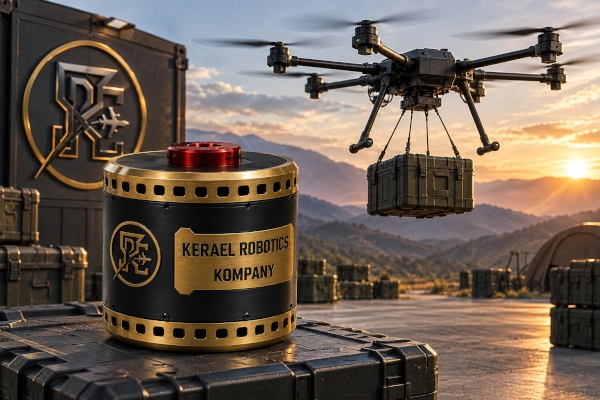
Bengaluru-based deep-tech company Kerael Robotics Kompany Private Limited is developing an indigenous propulsion system for heavy-lift unmanned aerial vehicles, with the company working towards an aircraft architecture intended to eventually carry payloads of up to 2,500 kg.
The programme is centred on Kerael’s internally developed Black Bird series of electric motors, supported by custom electronic controllers, large propellers and a multi-rotor configuration designed for substantially heavier loads than those carried by conventional commercial drones. The company has positioned the technology for defence logistics, cargo transport, industrial operations and other applications where large payloads need to be moved without a crewed aircraft.
Kerael describes itself as an Indian manufacturer specialising in heavy-payload electric propulsion systems for unmanned aircraft. Its published product information shows that the company is developing motors and associated propulsion hardware specifically for large UAV applications rather than adapting propulsion units originally intended for smaller civilian drones.
Black Bird Motor Family Forms the Core of the Programme
The main propulsion technology under development is Kerael’s Black Bird motor family, which has been designed for high-torque applications requiring much greater thrust than ordinary multirotor systems.
According to the company’s published technical information, the Black Bird range includes several motor variants designed for different voltage, current and power requirements. Kerael says the motors use a Halbach-array configuration, which is intended to concentrate magnetic flux within the motor and improve performance.
The largest Black Bird configuration publicly detailed by the company, the BB-120, is listed with an operating voltage range of 95 to 145 volts, continuous power of 14.5 kW and peak power of 30.5 kW. Kerael also gives a maximum stated thrust figure of around 160 kgf for the configuration shown in its product material.
The company is developing the motor, controller and propeller as an integrated propulsion package. This approach is important for heavy-lift UAVs because increasing the size of an aircraft requires the propulsion, electrical and structural systems to be designed around one another rather than treated as separate components.
2,500-kg Figure Is a Development Target
Kerael has described a future heavy-lift UAV architecture with a target payload capacity of 2,500 kg. The proposed design combines multiple indigenous propulsion units with a coaxial multi-rotor arrangement and a cargo or winch system intended for heavy logistics missions.
The company has not, however, demonstrated a completed aircraft carrying 2.5 tonnes in flight. The figure should therefore be treated as the target capacity of the planned platform, rather than as an already proven operational performance figure.
That distinction is important because developing a UAV capable of carrying several tonnes is a considerably more difficult engineering challenge than producing a conventional tactical drone. The propulsion system must lift not only the cargo but also the batteries or power source, motors, controllers, structural frame and the aircraft’s own safety and redundancy systems.
Testing Currently Focused on Propulsion Hardware
Kerael’s public development updates show that the programme is still progressing through propulsion testing.
The company has reported bench testing of its motor systems at rotational speeds above 60,000 RPM, with development work also referring to a 150-kg payload benchmark. Its engineers have been examining rotor stability, vibration, throttle response, current behaviour and thermal performance before moving towards sustained high-power testing and integration with a complete aircraft.
The company has indicated that later stages will include ground testing followed by flight trials. This means the propulsion system is further along than the complete 2,500-kg-class aircraft, which remains a developmental objective.
The step-by-step testing process is particularly important for large electric propulsion systems because higher motor power and larger propellers create far greater structural and thermal loads than those encountered in smaller drones.
Heavy-Lift UAVs Could Support Military Logistics
One of the main applications identified by Kerael is military logistics.
Heavy-lift unmanned aircraft could potentially transport ammunition, food, fuel, engineering stores and other supplies between military positions without committing a crewed helicopter to every mission. Such platforms could be particularly useful in mountainous or remote terrain where road access is poor and where resupply by conventional means is slow or difficult.
A UAV capable of lifting hundreds of kilograms or more would also occupy a different operational category from the smaller logistics drones already being examined by armed forces. At the higher end of the scale, such systems would function more like unmanned aerial transport vehicles than conventional tactical UAVs.
Their practical military value would depend on much more than maximum payload. Range, endurance, altitude performance, weather tolerance, reliability, redundancy and the method used to generate electrical power would all determine whether such an aircraft could operate effectively in military conditions.
Kerael has not yet published enough flight-test information to assess these aspects for the proposed 2,500-kg platform.
Indigenous Propulsion Is the More Significant Immediate Development
The more immediate importance of Kerael’s programme lies in its effort to develop indigenous propulsion systems for heavy UAVs.
India’s drone sector has expanded rapidly, but motors, controllers and other specialised propulsion components remain important areas where domestic capability is still being developed. Heavy-lift UAVs place even greater demands on these systems because they require higher torque, more efficient cooling and substantially greater electrical power.
Kerael says its propulsion systems are internally designed and that its wider development programme includes several motor architectures intended for different classes of unmanned aircraft.
The company is also working on its White Bird series of high-speed axial-flux motors, which are aimed at VTOL and other demanding applications. Published specifications for certain models in the series indicate rotational speeds of up to 60,000 RPM.
Developing such propulsion systems domestically could have value beyond a single aircraft project. Motors, controllers and propellers can eventually be supplied to other Indian UAV manufacturers, creating a wider domestic component ecosystem around heavy unmanned aircraft.
You may also like
-
Southern Railway Achieves 100% Electrification of Entire 5,068-km Broad-Gauge Network
-
India’s Non-Fossil Power Capacity Overtakes Fossil Sources as Total Installed Capacity Reaches 552 GW
-
India Removes Registration Barrier for Export Shipments Up to ₹3 Lakh in Major MSME Trade Reform
-
Sber Says India-Russia Payments Now Settle Within Minutes as Local-Currency Trade Infrastructure Expands
-
Historic First as IPS Officer Sanjukta Parasor Becomes First Woman to Lead CRPF’s Elite CoBRA Force
