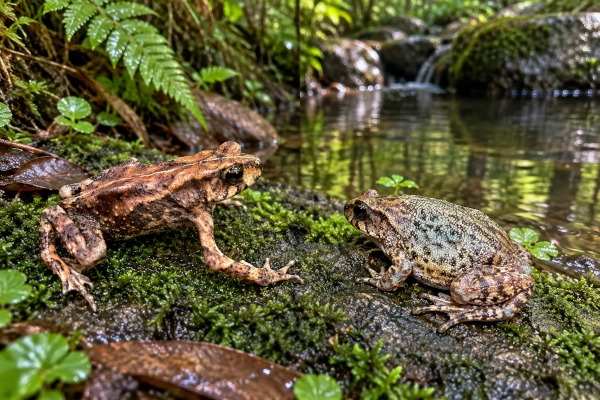
Mizoram has added two previously unknown amphibians to India’s biodiversity records, with scientists describing a small stream-dwelling frog from the outskirts of Aizawl and a montane toad from the high forests of Phawngpui National Park.
The two species, Ingerana aizawl and Duttaphrynus phawngpui, were described in separate scientific papers published in September 2026. Together, the discoveries underline how much of the amphibian diversity of Mizoram and the wider Indo-Burma biodiversity region remains incompletely documented.
The two animals occupy strikingly different environments. Ingerana aizawl was identified along a stream running through the Mizoram University campus near the state capital, while Duttaphrynus phawngpui is so far known only from montane habitat above 2,000 metres in Phawngpui National Park.
A New Frog Hidden on a University Campus
The story of Ingerana aizawl is unusual because the frog was not discovered in an inaccessible wilderness. It was living along Hratdawng Stream on the Mizoram University campus, around 15 kilometres west of central Aizawl.
Populations of these small frogs in Mizoram had historically been identified as Ingerana borealis. Researchers revisited that classification after recent taxonomic work raised questions about whether the Mizoram animals actually belonged to the same species.
The team used an integrative taxonomic approach combining detailed external morphology with analysis of mitochondrial 16S rRNA DNA sequences.
The results showed that the Mizoram population formed a distinct evolutionary lineage within the genus Ingerana. The frogs also differed consistently from recognised relatives in body proportions, the structure of the tympanum or external eardrum, dorsal skin texture and other anatomical characters.
The researchers consequently recognised the population as a new species and named it Ingerana aizawl after Mizoram’s capital. The description was published in Zootaxa on September 14.
Genetic Evidence Resolves Years of Taxonomic Confusion
The genetic evidence revealed just how distinct the Aizawl frogs are from populations with which they had previously been grouped.
Researchers found that Ingerana aizawl differed genetically from its close relative Ingerana occidens by approximately 4.8–6.6% in the mitochondrial marker examined. Its divergence from populations of I. borealis from Arunachal Pradesh was considerably larger, at approximately 15.3–17.6%.
That finding helps resolve a long-running identification problem.
Frogs from Mizoram had been reported as I. borealis for years, but improved genetic sampling across Northeast India has increasingly shown that animals that look superficially similar can belong to separate evolutionary lineages.
The researchers concluded that diversity within Ingerana in northeastern India is probably still underestimated and that wider molecular and morphological surveys will be needed to establish the true distribution of its species.
Small Frog With a Distinctive Call
Ingerana aizawl is a small, stout-bodied frog. Adult males measure roughly 22–25.5 millimetres from snout to vent, while females measure around 24.4–26 millimetres.
The species has a distinctly wrinkled dorsal surface, a clearly visible circular tympanum and small rounded discs at the ends of its fingers and toes. Its colour ranges largely from dark brown to reddish brown.
Researchers observed the frogs around small forest streams, particularly during the monsoon months. Breeding activity was recorded between May and July, with males calling at night and mating pairs found near stream margins.
The advertisement call provides another identifying characteristic. A typical call consists of a rhythmic sequence of about 12 short notes, with an analysed call lasting around 1.42 seconds.
No eggs or larvae were documented during the field observations, leaving parts of the species’ reproductive biology still unknown.
A New Toad From Mizoram’s Highest Mountain
The second new species comes from an entirely different landscape.
Researchers described Duttaphrynus phawngpui from Phawngpui National Park, home to Phawngpui or Blue Mountain, the highest peak in Mizoram.
The species was encountered at elevations above 2,000 metres, with specimens reported from around 2,144 metres in humid montane forest containing dense shrubs, bamboo patches and leaf litter.
The new toad was named after Phawngpui itself, directly associating its scientific identity with the high-elevation landscape from which it is currently known.
Its description was published in Taprobanica on September 13.
DNA and Morphology Establish a Distinct Montane Lineage
Researchers used three complementary approaches to establish the identity of the Phawngpui toad: conventional morphological examination, statistical analysis of body measurements and mitochondrial 16S rRNA sequencing.
Phylogenetic analysis placed Duttaphrynus phawngpui within the Duttaphrynus stuarti species group but recovered it as a distinct lineage separate from D. stuarti, D. chandai and D. dhara.
Genetic divergence from recognised relatives ranged from approximately 3.8% to 5.5%, while morphometric analysis also separated the Phawngpui specimens from related species.
The agreement between genetic, anatomical and statistical evidence gave researchers the basis to recognise the population as a distinct species rather than simply a local form of another montane toad.
A Toad Adapted to the High Mountains
The new species is considerably larger than Ingerana aizawl, with a recorded snout-to-vent length of approximately 47.72–56.26 millimetres.
Its dorsal surface carries glandular warts and irregular dark markings, while a narrow pale stripe runs along the middle of the back. The species also possesses moderate webbing between the toes.
One notable characteristic is its relatively indistinct tympanum. It also lacks many of the prominent cranial ridges present in some closely related toads.
These features, combined with differences in its digital proportions and other anatomical characters, helped distinguish the species from its closest relatives.
Known From Just One High-Elevation Locality
Perhaps the most important aspect of the Duttaphrynus phawngpui discovery is how restricted its currently known distribution appears to be.
The species has so far been documented only around its type locality in high-elevation habitat above 2,000 metres in Phawngpui National Park.
Mountain populations such as these can become geographically isolated from related animals at lower elevations. Over long periods, this isolation can produce genetically distinct populations and eventually new species.
Such high-elevation habitats are sometimes described as ecological “sky islands” because suitable conditions are effectively separated by warmer lowlands.
The same isolation that encourages evolution can also increase vulnerability. A species restricted to a narrow climatic and geographical zone has fewer alternative habitats available if environmental conditions change.
For D. phawngpui, however, scientists currently lack sufficient information on population size and distribution to make firm conclusions about its conservation status.
Two Discoveries, Two Different Conservation Lessons
The two Mizoram species illustrate different aspects of biodiversity conservation.
Duttaphrynus phawngpui demonstrates the importance of protecting remote high-altitude landscapes where highly localised species may occur nowhere else.
Ingerana aizawl, by contrast, shows that scientifically important biodiversity can survive even within green spaces close to a major urban centre.
The Mizoram University campus covers a large forested landscape containing streams and relatively undisturbed vegetation. The presence of a previously undescribed frog there demonstrates the value of maintaining such institutional and peri-urban habitats rather than viewing biodiversity conservation exclusively through the lens of distant protected areas.
Recognition of I. aizawl also creates a new conservation question. The Mizoram population had previously been included within the distribution of Ingerana borealis. Once a population is recognised as a separate species, however, its geographical range, abundance and threats have to be assessed independently.
Northeast India Still Holds Undocumented Amphibian Diversity
The discoveries add to a growing body of research showing that Northeast India’s amphibian diversity remains considerably more complex than older species lists suggested.
Modern taxonomic research increasingly combines field observations and traditional anatomical examination with DNA sequencing, allowing scientists to distinguish between populations that may appear almost identical externally but have followed separate evolutionary histories.
Mizoram is particularly important because it lies within the Indo-Burma biodiversity hotspot, a region recognised for exceptional biological richness as well as intense pressure on natural habitats.
The almost simultaneous descriptions of Ingerana aizawl and Duttaphrynus phawngpui demonstrate that important discoveries can emerge from both ends of the landscape — from a small stream on a university campus to an isolated forest more than two kilometres above sea level.
For Mizoram, the two species are more than additions to a taxonomic catalogue. They are evidence that significant portions of the state’s amphibian diversity remain undocumented, and that both its mountain forests and smaller stream ecosystems may still contain species that science has yet to recognise.
You may also like
-
New Metallic Golden-Green Beetle Species Discovered in Wayanad Wildlife Sanctuary
-
ZSI Publishes Major Faunal Inventory of Visakhapatnam as Urban Biodiversity Comes Into Focus
-
Rare Tibetan Fish Recorded in India for First Time From Arunachal’s High-Altitude Lake
-
India Produces Badri Calf Through OPU-IVF, Opening New Route for Conserving Uttarakhand’s Indigenous Cattle
-
Scientists Discover New Underground Stingless Bee Species in Nagaland
