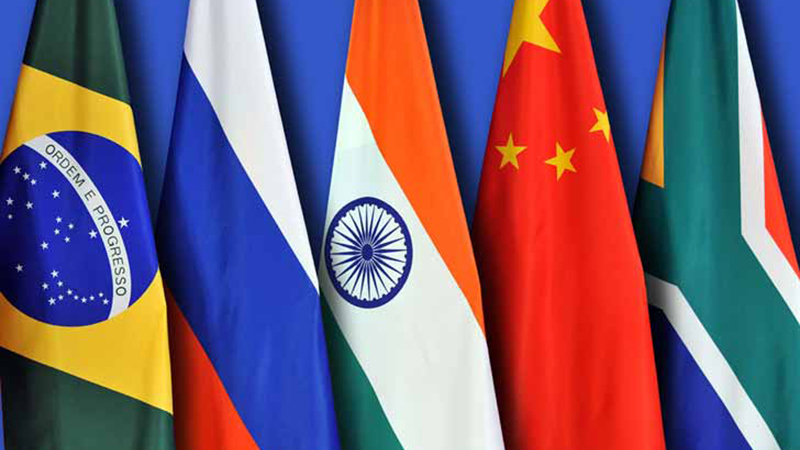
India’s trade with BRICS economies has more than doubled in five years, rising from $203 billion in 2020-21 to $417 billion in 2025-26, highlighting the growing economic importance of the grouping for Indian trade, investment and supply-chain diversification.
The figures were highlighted by the ASSOCHAM Global Research and Strategy Centre in its report, The Rise of BRICS Nations: An Opportunity to Scale Indian Exports to USD 200 Bn to BRICS by 2030. The study identifies a substantial opportunity for India to expand exports to BRICS economies as developing countries seek deeper South-South trade and investment links.
Indian Exports to BRICS Reach $96 Billion
India exported goods worth around $96 billion to BRICS partner countries during 2025-26. ASSOCHAM estimates that this could increase to as much as $200 billion by 2030 if India succeeds in expanding market access, strengthening commercial partnerships and increasing its presence across the growing economies of the grouping.
The target would require Indian exports to BRICS markets to more than double over the coming years. According to the report, stronger South-South cooperation could provide Indian companies with opportunities to diversify beyond traditional export destinations while building deeper commercial relationships with emerging economies.
The expansion of BRICS has also widened the economic geography available to Indian exporters, bringing together major markets, resource producers, manufacturing economies and rapidly developing consumer markets within a single cooperation framework.
Engineering, Pharmaceuticals and Electronics Offer Major Opportunities
ASSOCHAM identified a wide range of industries that could benefit from greater trade engagement with BRICS economies.
Engineering goods, pharmaceuticals, chemicals, textiles and apparel, automobiles and electronics are among the sectors with potential for increased exports. Minerals and metals, gems and jewellery, agricultural products, marine products, renewable energy, healthcare and digital services were also identified as areas where Indian businesses could expand their presence.
The opportunity is therefore considerably broader than conventional merchandise trade. India’s growing capabilities in technology, digital services, healthcare and renewable energy could allow companies to enter markets that are simultaneously expanding infrastructure, industrial capacity and consumer demand.
BRICS Could Help India Diversify Export Markets
Greater engagement with BRICS economies could help reduce India’s dependence on a relatively limited group of traditional export destinations.
ASSOCHAM noted that trade opportunities within the grouping should not be viewed solely in terms of higher exports. Deeper economic cooperation can also help India strengthen production networks, sourcing arrangements and regional value chains while improving access to technologies, capital and strategic resources.
The grouping can additionally provide Indian businesses with opportunities to study and adapt successful industrial and commercial practices developed within other BRICS economies.
Trade outcomes, however, will continue to depend on the economic performance of member countries, their individual trade policies and changes in the wider global economy.
Stronger Manufacturing and Value Chains Could Follow
The rapid expansion of India-BRICS trade comes at a time when global companies and governments are reassessing supply chains amid geopolitical disruptions and changes in international trade patterns.
ASSOCHAM sees deeper cooperation with BRICS economies as an opportunity for India to strengthen domestic manufacturing while integrating Indian companies more closely with regional and global value chains.
Improved sourcing arrangements could provide industries with access to raw materials and intermediate inputs, while stronger manufacturing partnerships could create opportunities for Indian companies to move into higher-value segments of international production networks.
This could be particularly important in sectors where access to technology, specialised inputs or strategic resources determines long-term manufacturing competitiveness.
Critical Minerals and Energy Add Strategic Dimension
The economic relationship with BRICS also carries importance for India’s access to critical minerals, energy and other strategic resources.
Several BRICS economies possess substantial reserves of hydrocarbons, minerals and raw materials required by modern manufacturing industries. Closer trade and investment cooperation could therefore contribute to India’s efforts to secure reliable supplies for energy, electronics, renewable technologies and advanced manufacturing.
Critical minerals are becoming increasingly important as countries expand production of batteries, electronics, electric vehicles, renewable-energy systems and other high-technology products.
For India, stronger resource partnerships within BRICS could complement domestic exploration and processing while helping diversify international supply sources.
New Settlement Systems Could Support Trade Expansion
ASSOCHAM also highlighted settlement mechanisms as an area where stronger BRICS cooperation could support economic engagement.
Efficient payment and settlement arrangements can become increasingly important as trade volumes expand across economies using different currencies and financial systems. Improvements in these mechanisms could reduce transaction friction and facilitate greater commercial activity between businesses across member countries.
Such financial infrastructure would complement efforts to strengthen production, sourcing, investment and supply-chain cooperation across the grouping.
India’s Economic Growth Strengthens Its Position
India’s economic performance provides an important foundation for expanding its role within BRICS. According to the ASSOCHAM report, the Indian economy recorded average growth of more than 7 per cent during the five financial years from 2021-22 to 2025-26.
ASSOCHAM said India’s position as one of the fastest-growing major economies gives it the potential to play a larger role in expanding economic engagement within the grouping and in developing coordinated responses to changes in the international economic environment.
ASSOCHAM President Nirmal K. Minda said the growing international importance of developing and emerging economies within BRICS reflects the potential for greater growth based on resilience, innovation, cooperation and sustainability.
He also pointed to initiatives aimed at strengthening trade and cross-border investment as potential catalysts for growth across several sectors.
From $417 Billion Trade to a Larger BRICS Economic Partnership
The increase in India-BRICS trade from $203 billion to $417 billion within five years demonstrates how rapidly the economic relationship has expanded. The next challenge will be to increase India’s export share while building stronger manufacturing, technology and investment links with partner economies.
Raising Indian exports from $96 billion in 2025-26 to the ASSOCHAM projection of $200 billion by 2030 would represent a major expansion of India’s commercial presence across BRICS markets.
You may also like
-
When Trade Routes Become Weapons: Why BRICS Needs a Resilient Supply-Chain Architecture
-
India and Uruguay Agree Trade and Connectivity Roadmap as Montevideo Ratifies International Solar Alliance
-
The Return of Multipolarity: Why the World Is Moving Beyond a Single Centre of Power
-
The Financial Chokepoint: Why BRICS Can No Longer Depend on SWIFT and the Dollar Alone
-
India Expands Market Access for South African Citrus With New In-Transit Cold Treatment Rules
