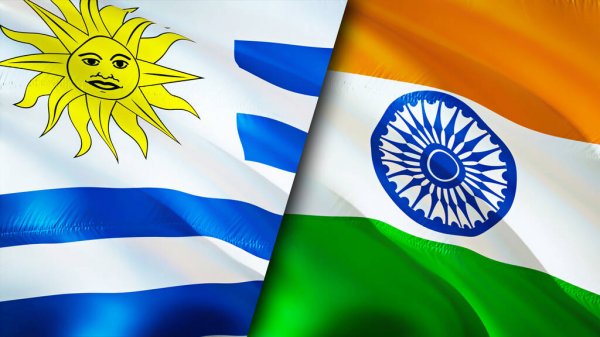
India and Uruguay have agreed to develop a focused roadmap for expanding bilateral cooperation in trade, connectivity and culture, while Montevideo has formally completed another important step in joining the International Solar Alliance.
External Affairs Minister S. Jaishankar met Uruguayan Foreign Minister Mario Lubetkin in New Delhi on September 11, 2026, during Lubetkin’s visit for the 18th BRICS Summit. The meeting comes at a time when India is significantly increasing its diplomatic and economic engagement with Uruguay and the wider Latin American region.
Jaishankar said the two ministers held discussions on advancing bilateral ties and had agreed on a focused roadmap covering trade, connectivity and cultural cooperation. India also thanked Uruguay for supporting stronger engagement with both the Community of Latin American and Caribbean States, or CELAC, and MERCOSUR, the South American trading bloc.
Uruguay Hands Over International Solar Alliance Ratification
One of the most concrete outcomes of the meeting was Uruguay’s formal handover of its Instrument of Ratification of the International Solar Alliance Framework Agreement to India.
Uruguay had signed the ISA Framework Agreement in New Delhi on May 27, 2017, but had remained among the countries that had not completed ratification. Its parliament approved the agreement in 2026, and the legislation was officially published in Uruguay in July.
Jaishankar confirmed after the September 11 meeting that he had received Uruguay’s Instrument of Ratification.
The development strengthens India–Uruguay cooperation in renewable energy and formally brings Montevideo closer into the institutional framework of an organisation originally launched by India and France to accelerate solar deployment, investment, technology cooperation and capacity building.
Uruguay already has an unusually clean electricity system based heavily on renewable energy. Participation in the ISA can therefore create opportunities for cooperation not only in conventional solar generation but also in areas such as energy storage, grid management, green hydrogen and integration of renewable power.
Trade Roadmap Could Open a Wider South American Market
The more strategically important part of the meeting may be the decision to create a focused roadmap for bilateral economic engagement.
India and Uruguay currently have a relatively modest direct trade relationship compared with India’s commerce with larger Latin American economies such as Brazil. Both governments increasingly see room to expand that relationship across sectors where their economies are complementary.
Uruguay is a significant agricultural and food exporter, while India offers a vast consumer market and strengths in pharmaceuticals, automobiles, engineering goods, information technology, chemicals, machinery and digital services.
For Indian companies, Uruguay also has potential value beyond its domestic market. Its membership of MERCOSUR, together with Brazil, Argentina and Paraguay, places it within one of South America’s most important economic groupings.
The September meeting therefore linked bilateral trade with India’s broader objective of strengthening engagement with MERCOSUR.
Uruguay has itself publicly supported renewed dialogue between MERCOSUR and India. During its current MERCOSUR agenda, Montevideo has identified India among the countries with which the bloc intends to pursue further discussions on external economic relations.
Connectivity Becomes Part of the Economic Agenda
The inclusion of connectivity in the bilateral roadmap is also significant.
Geographical distance remains one of the largest constraints on India–Latin America commerce. Expanding economic ties therefore requires more efficient maritime links, logistics chains, aviation connectivity and digital connections.
Better maritime and logistics arrangements could make it easier for Uruguayan agricultural and other products to reach India while reducing costs for Indian exporters trying to enter the Uruguayan and wider South American markets.
Digital connectivity could become equally important, particularly because Indian companies have strong capabilities in information technology, financial technology and digital public infrastructure.
The decision to make connectivity one of the three pillars of the new roadmap suggests that New Delhi and Montevideo intend to address some of the practical obstacles that have limited bilateral trade.
India’s First Resident Embassy in Uruguay Adds Momentum
The foreign ministers’ meeting comes immediately after another historic step in bilateral relations.
On September 7, 2026, Indian Ambassador Binoy George presented his credentials to Uruguayan President Yamandú Orsi, becoming the first resident Indian ambassador in the history of diplomatic relations between the two countries.
Uruguayan Foreign Minister Mario Lubetkin described the establishment of India’s resident diplomatic presence as historic.
Until now, India’s engagement with Uruguay had been managed without a resident embassy in Montevideo. Establishing a permanent mission gives New Delhi a much stronger platform for supporting Indian companies, developing political contacts, promoting cultural ties and identifying commercial opportunities.
The timing is particularly important. The opening of the embassy and the agreement on a new bilateral roadmap have occurred within days of each other, suggesting that the relationship is entering a more active phase.
Uruguay Could Become a Bridge to MERCOSUR
Uruguay’s significance to India extends beyond the size of its domestic economy.
Montevideo has traditionally supported outward-looking trade policies and deeper external economic engagement. Its position within MERCOSUR could consequently make it a useful partner as India seeks stronger commercial ties with South America.
India already has a Preferential Trade Agreement with MERCOSUR, but both sides have periodically discussed expanding its scope.
Stronger bilateral engagement with Uruguay could therefore complement India’s larger negotiations with the South American bloc, particularly in sectors such as pharmaceuticals, engineering products, automobiles, agricultural products and services.
Jaishankar’s explicit appreciation of Uruguay’s support for deeper Indian engagement with MERCOSUR indicates that New Delhi sees Montevideo as an important partner in this wider strategy.
Culture Added Alongside Trade
The roadmap is not limited to commercial issues.
India and Uruguay also agreed to strengthen cultural cooperation, reflecting an effort to build a wider foundation for relations through education, tourism, academic exchanges and people-to-people contacts.
These links remain relatively underdeveloped compared with India’s cultural engagement with some larger Latin American countries.
A permanent Indian embassy in Montevideo could make it easier to organise cultural programmes, educational partnerships and exchanges while increasing awareness of India in Uruguay.
A Small Relationship Beginning to Gain Strategic Depth
No large bilateral trade agreement or investment package was signed during the September 11 meeting, and the precise projects under the new roadmap have yet to be announced.
Nevertheless, the meeting produced tangible institutional progress.
Uruguay has now handed over its International Solar Alliance ratification instrument, both governments have agreed to a focused roadmap covering trade, connectivity and culture, and India has established its first resident embassy in Montevideo.
Taken together, these developments suggest that India–Uruguay relations are moving from relatively limited diplomatic interaction towards a more structured partnership.
For India, Uruguay offers an increasingly useful gateway into MERCOSUR and the wider Latin American economy. For Uruguay, India represents a rapidly growing market, technology partner and potential source of investment.
The next test will be whether the new roadmap translates that political momentum into higher trade, improved connectivity and concrete commercial partnerships.
You may also like
-
The Return of Multipolarity: Why the World Is Moving Beyond a Single Centre of Power
-
The Financial Chokepoint: Why BRICS Can No Longer Depend on SWIFT and the Dollar Alone
-
India Expands Market Access for South African Citrus With New In-Transit Cold Treatment Rules
-
South Africa Invites Indian Firms Into $100-Billion Infrastructure Pipeline as BRICS Ties Deepen
-
Russia Steps Up Fertiliser Supplies to India as Both Sides Explore Digital Currency Trade Settlements
