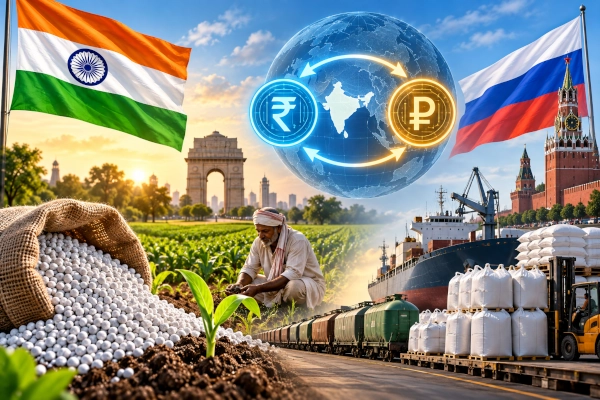
India and Russia are moving to deepen their economic partnership on two interconnected fronts, with Russian fertiliser supplies to India continuing to rise while financial authorities explore the use of central bank digital currencies and local-currency mechanisms for bilateral trade settlements.
The developments, highlighted around the BRICS Summit in New Delhi, show how the relationship is gradually expanding beyond traditional energy and defence ties into agricultural security and financial infrastructure. As physical trade between the two economies grows, both sides are also looking for faster and more reliable ways to settle transactions without allowing payment bottlenecks to constrain commerce.
Russian Fertiliser Supplies Reach 2.8 Million Tonnes
Russia supplied approximately 2.8 million tonnes of fertilisers to India during the first six months of 2026, according to Russian Fertilizer Producers Association President Andrey Guryev.
Speaking on the sidelines of the BRICS Business Forum in New Delhi, Guryev said Russian producers had supplied 6.5 million tonnes to India during 2025, representing an increase of around 40% over the previous year and roughly six times the volume supplied in 2021.
Russia has consequently become one of India’s most important overseas sources of fertilisers. According to Guryev, roughly one out of every three tonnes of fertiliser imported by India now originates in Russia.
The increase has direct significance for Indian agriculture because fertiliser availability and prices influence cultivation costs across major crops. Reliable supplies of potash, phosphatic products and other mineral fertilisers are therefore closely connected to India’s wider food-security strategy.
Putin Had Asked Russian Industry to Meet Indian Demand
Guryev linked the growth in supplies to an understanding reached at the 2024 BRICS Summit in Kazan, where Russian President Vladimir Putin directed Russian producers to ensure that Indian demand for fertilisers was adequately met.
The approach was subsequently incorporated into the broader India–Russia economic relationship. An official bilateral document issued by the Kremlin following India–Russia discussions welcomed steps aimed at ensuring the long-term supply of fertilisers to India and recorded discussions on the possible creation of joint ventures in the sector.
Such joint ventures could eventually move cooperation beyond buyer-seller arrangements towards production, processing and distribution partnerships involving companies from both countries.
BRICS Becoming an Increasingly Important Market for Russian Fertilisers
India forms part of a wider shift in Russian fertiliser exports towards BRICS economies.
Guryev said BRICS members now account for approximately half of Russia’s mineral-fertiliser exports. Russian shipments to BRICS countries reached a record 23.4 million tonnes in 2025, compared with 21.5 million tonnes in 2024.
The trend demonstrates how agricultural inputs are becoming another important component of trade among the expanding group of emerging economies.
For India, however, the rapid increase in purchases from Russia also creates a parallel challenge: ensuring that payments for growing bilateral trade can be completed efficiently.
India and Russia Explore Digital Currency Settlements
That challenge is now bringing the two countries into another emerging field: central bank digital currencies, or CBDCs.
Sberbank Chief Executive Herman Gref said in New Delhi on September 11 that the Central Bank of Russia and the Reserve Bank of India are working on a mechanism that could allow digital currencies to be used for bilateral trade settlements.
According to Gref, discussions are still at an early stage, but digital currencies could eventually create a faster and more efficient channel for cross-border payments.
Russia has introduced the digital ruble, while India has been running pilots of the digital rupee, or e₹, since 2022. Connecting such sovereign digital currencies could eventually allow trade payments to move between regulated central-bank-backed systems without depending entirely on traditional correspondent banking channels.
Not a Common BRICS Currency
The initiative should not be confused with proposals for a single BRICS currency.
India’s current approach is focused instead on linking existing national payment systems, increasing settlements in local currencies and examining interoperability between sovereign digital currencies.
Commerce and Industry Minister Piyush Goyal told BRICS members in New Delhi that they should link their payment systems and promote greater trade using their own currencies.
India has also been pushing the broader BRICS grouping to examine connections between CBDCs as a means of making international transactions faster and less expensive, rather than creating a new supranational currency.
Local-Currency Settlement Already Part of India–Russia Strategy
India and Russia have already officially agreed to expand bilateral settlement mechanisms using their national currencies.
An India–Russia joint document states that the two countries will continue developing settlement systems based on national currencies to ensure uninterrupted bilateral trade. Crucially, it also records an agreement to continue consultations on interoperability between national payment systems, financial messaging networks and central bank digital currency platforms.
The current CBDC discussions therefore do not represent an entirely new policy direction. They are the technological evolution of a bilateral financial strategy already agreed at government level.
Tackling the Rupee Imbalance
Payments have been a persistent issue in India–Russia trade because India imports substantially more from Russia than it exports.
Russian exporters accumulated large rupee balances after Indian purchases of Russian commodities increased sharply. Gref said the problem has become less significant because Russian companies have found additional ways to deploy those rupees, including investment in Indian government securities.
However, both countries recognise that a more balanced trading relationship would provide a more sustainable long-term solution.
India wants to substantially increase exports of pharmaceuticals, engineering goods, agricultural products, electronics, automobiles and services to Russia, while Moscow is seeking to maintain its position as a major supplier of energy, fertilisers and other commodities.
$100-Billion Trade Target Adds Urgency
India and Russia have set a target of increasing bilateral trade to $100 billion by 2030.
Achieving that target will require more than simply increasing the volume of goods crossing borders. Both governments have repeatedly identified payment mechanisms, logistics, market access and trade imbalances as obstacles that need to be addressed.
The official India–Russia framework specifically links the $100-billion objective with the removal of logistical bottlenecks, smoother payment mechanisms and increased use of national currencies.
Digital-currency interoperability could eventually become another tool within that architecture.
Fertilisers Show Why Payment Infrastructure Matters
The connection between the fertiliser story and the digital-payment discussions is therefore significant.
India is already buying millions of tonnes of an agriculturally critical commodity from Russia, while Russian energy and other exports have pushed bilateral trade to historically high levels. As those commercial flows become larger, the ability to process payments reliably becomes strategically important.
A CBDC mechanism could potentially offer faster settlement, lower transaction costs and reduced dependence on complex intermediary banking networks, although substantial technical, regulatory and currency-convertibility questions would still have to be resolved before such a system could operate at scale.
There has been no announcement yet that an India–Russia digital-currency settlement platform is operational.
From Commodity Trade to Financial Connectivity
The two developments together illustrate the changing nature of the India–Russia economic relationship.
On one side, Russia is consolidating its position as a major supplier of strategically important commodities to India, with fertiliser shipments reaching 2.8 million tonnes in just six months of 2026.
On the other, New Delhi and Moscow are exploring the financial infrastructure required to support an increasingly large and complex trading relationship.
If digital-rupee and digital-ruble interoperability eventually moves from discussion to implementation, India and Russia could create a new regulated settlement channel alongside existing national-currency mechanisms.
The combination of long-term commodity supply, greater use of local currencies and emerging digital-payment technology consequently points towards a broader objective: making India–Russia trade larger, more resilient and less vulnerable to disruptions in conventional international payment channels.
You may also like
-
The Return of Multipolarity: Why the World Is Moving Beyond a Single Centre of Power
-
The Financial Chokepoint: Why BRICS Can No Longer Depend on SWIFT and the Dollar Alone
-
India Expands Market Access for South African Citrus With New In-Transit Cold Treatment Rules
-
South Africa Invites Indian Firms Into $100-Billion Infrastructure Pipeline as BRICS Ties Deepen
-
India and Russia Move Into Titanium Sponge Production as Rosatom’s Giredmet Partners Hyderabad-Based ALT Metals
