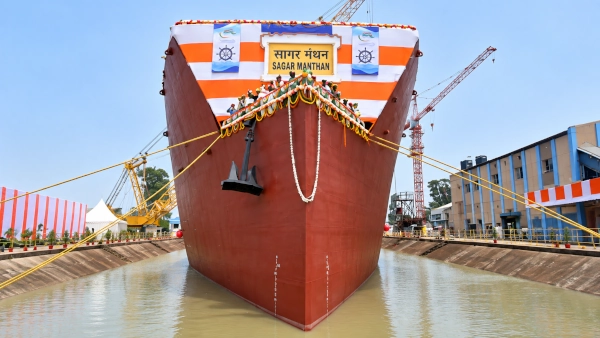
India has launched one of its most advanced indigenous oceanographic research platforms, with Garden Reach Shipbuilders & Engineers Limited putting the new Ocean Research Vessel Sagar Manthan into the water at its Rishi Bankim Shipyard in Kolkata on September 9.
Designed, engineered and constructed by the Defence Ministry PSU for the National Centre for Polar and Ocean Research under the Ministry of Earth Sciences, Sagar Manthan will significantly expand India’s ability to explore the deep ocean, map the seabed, study marine resources and collect scientific data from some of the world’s most challenging ocean environments.
Union Minister for Earth Sciences Dr Jitendra Singh formally launched the vessel virtually, while it was named Sagar Manthan by Manju Singh.
The approximately ₹840-crore vessel is being constructed under Vertical-4 — Deep Ocean Survey and Exploration — of India’s Deep Ocean Mission. It is expected to enter service with NCPOR following completion, system integration and sea trials in 2028.
Built in India for Deep-Ocean Exploration
Sagar Manthan represents an important shift in India’s scientific shipbuilding capability.
Instead of acquiring a sophisticated oceanographic vessel from abroad, India is designing and constructing the platform domestically through GRSE, one of the country’s principal defence shipyards.
The original contract between NCPOR and GRSE was signed on July 16, 2024, at a value of ₹839.55 crore.
At 89.5 metres long, it was described by NCPOR when ordered as the largest research vessel being built by an Indian shipyard specifically for deep-sea exploration.
The vessel is designed for multidisciplinary oceanographic missions and can operate in demanding environments, including the Southern Ocean.
Its projected operational life is approximately 30 years.
Searching the Deep Ocean for Critical Minerals
A major mission for Sagar Manthan will be exploring the Indian Ocean for mineral resources.
The ship will conduct surveys along mid-ocean ridges to identify deposits of multi-metal hydrothermal sulphides. Such deposits can contain strategically important metals associated with deep-sea geological processes.
The vessel will also help establish environmental baselines before potential deep-sea resource development.
Its work will support India’s wider Deep Ocean Mission, which seeks to develop indigenous capabilities for exploring and eventually utilising resources in the deep ocean while improving scientific understanding of marine ecosystems.
Advanced Sensors to Map What Lies Beneath the Ocean
Sagar Manthan will carry a sophisticated suite of scientific instruments.
Among its principal systems are multibeam bathymetric equipment, which can produce detailed maps of the ocean floor, and multichannel seismic systems, which allow scientists to study geological structures beneath the seabed.
It will also carry systems for sub-bottom profiling, atmospheric observation, ocean profiling, seabed sampling and water-column measurements.
A drop keel will allow sensitive scientific sensors to be lowered beneath the hull, reducing interference from the ship itself during measurements.
The platform will also have facilities to deploy both Remotely Operated Vehicles and Autonomous Underwater Vehicles, considerably expanding the area and depths that scientists can investigate.
DP2 Keeps the Ship Precisely Over a Research Site
One of Sagar Manthan’s most important capabilities is its DP2 dynamic positioning system.
Instead of relying only on anchors, dynamic positioning integrates propulsion, thrusters, navigation systems and computers to maintain the vessel at an extremely precise geographical position.
This becomes critical while lowering instruments thousands of metres into the ocean, collecting seabed samples, conducting detailed sonar mapping or operating underwater robotic systems.
NCPOR said when the vessel was ordered that DP2 would provide the precise manoeuvring and station-keeping required for high-accuracy scientific operations.
The ship is also being constructed to Silent-A specifications, reducing underwater radiated noise that could interfere with acoustic measurements and sensitive scientific equipment.
Floating Laboratory for 34 Scientists
Sagar Manthan is effectively being designed as a large floating scientific laboratory.
It will accommodate up to 34 scientists and contain specialised laboratories where samples and data can be processed while the vessel remains at sea.
Its maximum speed is around 14 knots, while its all-weather design will allow extended scientific operations far from the Indian coastline.
The vessel is being constructed under dual classification by the Indian Register of Shipping and American Bureau of Shipping and will comply with applicable international maritime environmental standards.
Successor to the Veteran Sagar Kanya
Sagar Manthan will eventually replace the ageing ORV Sagar Kanya, which India acquired from Germany in 1983.
For more than four decades, Sagar Kanya has played an important role in Indian oceanographic research.
The new vessel represents a generational leap in sensors, positioning, underwater robotics, seabed mapping and onboard analytical capability.
From Contract to Launch in Just Over Two Years
Construction has also progressed rapidly.
The contract was signed in July 2024, steel cutting began on November 29, 2024, and the keel was laid on April 8, 2026.
Only about five months after keel laying, the hull entered the water on September 9.
The vessel will now undergo further superstructure construction, equipment installation, system integration and extensive sea trials before its planned delivery in 2028.
For GRSE, better known for building frigates, corvettes, patrol ships and other naval platforms, Sagar Manthan also demonstrates how India’s defence shipbuilding infrastructure is increasingly being applied to highly specialised scientific vessels.
Once operational, the ship will give Indian scientists an indigenous platform capable of investigating the ocean floor, searching for critical mineral resources, studying climate and ocean processes and deploying advanced underwater robotic systems — strengthening both India’s Deep Ocean Mission and its wider maritime technological capability.
You may also like
-
ICAR Scientists Develop Indigenous Protective Gloves for Cotton Farmers, Sign Commercial Manufacturing Agreement
-
India Moves Towards Five-Year Assured Orders for Defence Startups Under New Procurement Reforms
-
BHEL–Coal India Joint Venture Begins Construction of ₹25,016 Crore Indigenous Coal Gasification Project in Odisha
-
Zen Technologies Introduces Indigenous Hyper-Strike Falcon AI-Guided Counter-Drone Interceptor
-
L&T and Germany’s SCHOTTEL Expand Partnership for Controllable Pitch Propeller Systems in Indian Shipbuilding
