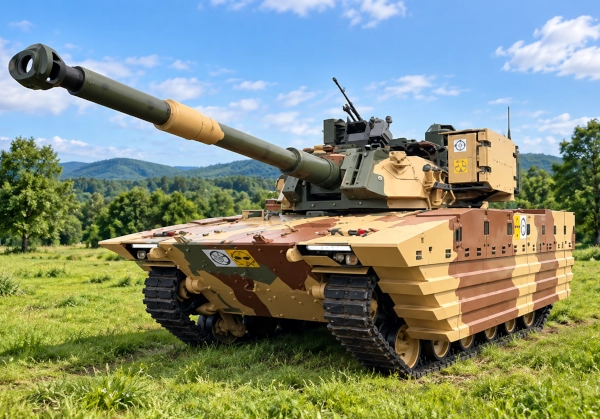
Tata Advanced Systems Limited has emerged as the lowest evaluated bidder in the Indian Army’s competition to develop a new generation of indigenous light tanks under Project Zorawar, marking an important step in the growing participation of India’s private sector in the manufacture of frontline armoured combat vehicles.
According to a report published on September 9, TASL emerged as the L1 bidder following a nearly three-year evaluation of technical and commercial proposals submitted by five competing entities. The programme is estimated to be worth close to ₹20,000 crore once it progresses towards large-scale procurement.
The immediate development, however, should not be interpreted as Tata receiving a ₹20,000-crore production contract.
TASL is expected to move into the prototype-development stage, under which it will develop and demonstrate two light-tank prototypes within approximately 130 weeks. Mahindra Defence Systems, which emerged as the second-lowest bidder, is also expected to be invited to develop a prototype, allowing the Army to evaluate competing indigenous designs before moving towards serial production.
A Private-Sector Track Under Project Zorawar
The competitive programme is being pursued under the Defence Ministry’s Make-I acquisition framework, which allows the government to fund up to 70% of eligible prototype-development costs.
The requirement is formally associated with an Armoured Fighting Vehicle–Indian Light Tank, or AFV-ILT, designed to operate not only in very high-altitude terrain but also in deserts, marshlands and other environments where heavier main battle tanks can face mobility restrictions.
Tata’s selection is especially significant because it could eventually make the company one of India’s principal private-sector manufacturers of tracked armoured combat vehicles.
TASL already has experience supplying tactical and protected military vehicles to the armed forces. Its entry into a full light-tank programme would take that capability considerably further, requiring integration of the turret, weapon systems, protection, propulsion, electronics, sensors and other major subsystems.
According to the latest report, Tata’s proposal incorporates an indigenous turret system and company-developed loitering-munition capability.
Not the Same as the Existing DRDO-L&T Zorawar Prototype
An important distinction is that India already has a Zorawar light tank developed by DRDO’s Combat Vehicles Research and Development Establishment with Larsen & Toubro as the industry partner.
That vehicle has already undergone desert and high-altitude testing. The government earlier stated that it successfully fired at altitudes above 4,200 metres, following its first-phase desert trials.
The Army’s broader requirement has historically been placed at around 354 light tanks. The programme architecture envisaged an initial 59 tanks through the DRDO-L&T development route, while the remaining requirement would be addressed through competitive procurement involving Indian industry. DRDO’s own documentation has referred to the remaining tanks being selected through an open bidding process.
The latest Tata-Mahindra competition therefore represents the competitive private-industry component of the much larger Indian light-tank requirement, rather than replacing the DRDO-L&T Zorawar that has already been built and tested.
Why the Army Wants Light Tanks
The renewed emphasis on light armour followed the deployment challenges encountered in the Himalayan region, particularly after the military confrontation along the Line of Actual Control in eastern Ladakh.
Heavy platforms such as the T-72 and T-90 provide significant protection and firepower, but moving and sustaining them through narrow mountain roads, weak bridges and extremely high-altitude terrain creates logistical challenges.
A roughly 25-tonne-class light tank offers greater strategic and tactical mobility while retaining the firepower and protection needed to support infantry and mechanised formations.
The Indian Army has consequently sought a platform combining high-altitude mobility with modern surveillance, communications, protection and firepower.
You may also like
-
ICAR Scientists Develop Indigenous Protective Gloves for Cotton Farmers, Sign Commercial Manufacturing Agreement
-
India Moves Towards Five-Year Assured Orders for Defence Startups Under New Procurement Reforms
-
BHEL–Coal India Joint Venture Begins Construction of ₹25,016 Crore Indigenous Coal Gasification Project in Odisha
-
Zen Technologies Introduces Indigenous Hyper-Strike Falcon AI-Guided Counter-Drone Interceptor
-
L&T and Germany’s SCHOTTEL Expand Partnership for Controllable Pitch Propeller Systems in Indian Shipbuilding
