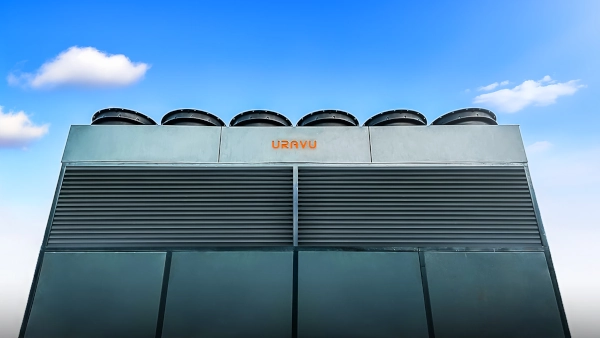
Fresh water usually reaches cities and industries through rivers, reservoirs, groundwater wells, treatment plants and extensive distribution networks. Bengaluru-based Uravu Labs is developing a very different source of water by extracting the moisture already present in the atmosphere.
The company has developed an atmospheric water-generation technology that uses liquid desiccant salts to absorb water vapour from air. Once these salts become saturated with moisture, relatively low-temperature heat is used to release the captured water. The resulting vapour is condensed, collected and purified for use.
What makes the system particularly interesting is that the heat required for this process does not necessarily have to come from conventional electricity or fossil fuels. Uravu is developing systems that can use solar thermal energy, renewable heat and recovered industrial waste heat, including heat generated by data centres and manufacturing facilities.
The technology therefore combines water production with circular engineering. Instead of treating unwanted heat as waste, Uravu attempts to use it as the energy source for producing fresh water.
From an Engineering Idea to a Bengaluru Climate-Tech Company
Uravu Labs traces its origins to engineers Swapnil Shrivastav and Venkatesh R, who studied at the National Institute of Technology Calicut and began exploring technologies that could address water scarcity. They were later joined by Pardeep Garg and Govinda Balaji, and the company was established in 2019.
The team focused on a fundamental problem with conventional atmospheric water generators. Many existing systems work by cooling air below its dew point so that water vapour condenses into liquid. Although this method is technically straightforward, refrigerating large quantities of air can consume substantial amounts of electricity.
Uravu therefore chose a different approach. Instead of cooling the entire volume of air, its technology uses hygroscopic materials that naturally attract and absorb moisture. The company has since developed this concept into a platform intended for commercial and industrial applications.
Using Liquid Salts to Capture Moisture
At the heart of Uravu’s technology is a liquid desiccant solution containing salts that strongly attract water molecules. When atmospheric air comes into contact with this solution, the desiccant absorbs moisture from the air and gradually becomes diluted.
This process allows atmospheric water to be captured without first cooling large volumes of air to very low temperatures. Once the desiccant has absorbed enough moisture, the solution moves into the regeneration stage.
Heat is then applied to separate the captured water from the desiccant. The released water vapour is condensed into liquid water, while the regenerated salt solution returns to the absorption stage and begins another cycle.
Because the desiccant is reused repeatedly, the process can operate as a continuous closed-loop system.
Waste Heat Becomes a Useful Resource
One of the most important aspects of Uravu’s technology is its ability to use low-grade heat.
Industrial plants, data centres, refrigeration systems and other facilities regularly produce large amounts of heat that must be removed to keep equipment operating safely. Much of this thermal energy is released into the environment through cooling systems.
However, relatively low-temperature heat is often difficult to convert economically into electricity. Uravu’s desiccant process offers another potential use for it.
Instead of wasting the heat, an industrial facility could direct part of it toward regenerating the moisture-loaded desiccant. The same thermal energy that would otherwise be discarded can therefore help generate fresh water.
This creates an unusual combination in which an industrial waste stream becomes an input for water production.
Solar Thermal Energy Can Drive the Process
Uravu’s technology can also operate using solar thermal energy.
India receives strong solar radiation across large parts of the country, and solar heat can be captured directly using thermal collectors. This heat can then regenerate the desiccant without requiring the electricity-intensive refrigeration systems commonly associated with conventional atmospheric water generators.
The company has worked on solar-thermal atmospheric water systems capable of operating continuously by combining moisture absorption with thermal regeneration.
This approach could become particularly useful in regions where water supplies are limited but solar energy remains abundant.
Rather than converting sunlight into electricity and then using that electricity to run a compressor, the system can potentially use solar heat more directly.
Producing Water Without Drawing from Aquifers
The ability to generate water from atmospheric moisture could become particularly relevant in places suffering from groundwater depletion.
Many Indian cities and industrial regions depend heavily on borewells when municipal water supplies cannot meet demand. Repeated groundwater extraction can gradually lower water tables, forcing users to drill deeper wells and increasing pressure on aquifers.
Atmospheric water generation offers a different model. Instead of extracting water stored underground, a facility can capture part of the moisture continuously circulating through the atmosphere.
The technology is not intended to replace rivers, reservoirs, rainwater harvesting or municipal systems. However, it could provide an additional decentralised source of water for locations where conventional supplies are expensive, unreliable or environmentally stressed.
Producing water close to the point of use could also reduce dependence on tanker deliveries that consume fuel and move water over long distances.
From Drinking Water to Industrial Applications
Uravu initially demonstrated its technology through drinking-water applications and supplied atmospheric water to hospitality and consumer businesses in Bengaluru.
These early deployments helped demonstrate that water extracted from air could be processed into a usable product. However, the company’s larger opportunity may lie in industrial applications where significant quantities of waste heat are already available.
Uravu has increasingly focused on sectors such as data centres, pharmaceutical manufacturing and large industrial facilities. These environments often combine two conditions favourable to the company’s technology: substantial water demand and a continuous supply of low-temperature waste heat.
This could allow atmospheric water generation to move beyond a niche consumer product and become part of industrial utility infrastructure.
Data Centres Could Become Water Producers
The rapid expansion of artificial intelligence, cloud computing and digital services is driving construction of increasingly powerful data centres around the world.
Servers operating continuously generate enormous quantities of heat. Data-centre operators must remove this heat to maintain safe operating temperatures, often using energy-intensive cooling systems. Some cooling configurations can also consume substantial amounts of water.
Uravu sees an opportunity to connect these problems.
Waste heat from a data centre can potentially be redirected into the atmospheric-water system. The heat regenerates the desiccant, which has already absorbed moisture from the surrounding air. That captured moisture is then released and condensed into fresh water.
In this model, a data centre would not simply consume energy and water. Part of its waste heat could become the energy source for producing water.
Water-Positive Cooling
Uravu is developing this idea through systems designed to combine cooling and atmospheric water generation.
Instead of treating server cooling and water supply as completely separate infrastructure, the company aims to integrate them into one thermodynamic system. Heat removed from computing equipment can help drive water production, while the process can also assist in managing thermal loads.
Uravu has described this concept as water-positive cooling, particularly for data centres that generate large and predictable quantities of low-grade heat.
The economics will depend on local humidity, cooling architecture, water prices and the amount of usable heat available. However, the concept demonstrates how circular engineering can transform a waste stream into an operational resource.
Industrial and Pharmaceutical Applications
Pharmaceutical manufacturing is another sector where Uravu’s technology could find applications.
Drug-production facilities require large quantities of high-quality water for manufacturing, cleaning and processing. In some regions, plants must rely on groundwater or externally supplied water before using extensive purification systems.
Atmospheric water could provide an additional raw-water source.
Uravu’s approach can capture moisture directly from the air before subjecting the collected water to the purification processes required for specific industrial or pharmaceutical standards.
The system could be particularly attractive at manufacturing locations where waste heat is already available and freshwater supplies are constrained.
Reducing Dependence on Conventional Raw Water
Traditional industrial water treatment often begins with groundwater, surface water or municipal supplies. These sources may contain salts and contaminants that require extensive treatment before the water can be used.
Reverse-osmosis systems are commonly employed, but they also generate concentrated reject water that must be managed or disposed of.
Atmospheric water extraction begins with water vapour rather than saline liquid water. This changes the nature of the initial purification challenge.
The condensed atmospheric water may still require treatment depending on its intended use, but the extraction process does not begin by processing large quantities of contaminated groundwater.
For industries facing groundwater restrictions or high water-treatment costs, that distinction could become increasingly important.
Modular Water Production
Uravu is developing its technology as a modular platform.
This means water-production capacity can potentially be increased by adding additional units rather than building an entirely new centralised plant.
Such an architecture is useful because water requirements differ significantly between users. A commercial building may need a relatively small system, while an industrial campus or data centre could require much larger production capacity.
Containerised or modular equipment could also allow atmospheric water systems to be installed alongside existing industrial infrastructure without requiring major changes to regional water networks.
The modular approach therefore fits naturally with decentralised water generation.
Atmospheric Water Has Practical Limits
Although the atmosphere contains enormous quantities of water, atmospheric water generation is not free from physical constraints.
Water output depends heavily on temperature, humidity, airflow, available thermal energy and system efficiency. Warm and humid environments generally contain more recoverable moisture than cold and dry regions.
The amount of energy required to capture and release water also affects the economics of the process.
Uravu’s liquid-desiccant system is designed to operate across a broader range of conditions than many simple condensation-based machines, but each installation still requires careful engineering.
Atmospheric water should therefore be viewed as a complementary source rather than a universal replacement for conventional freshwater systems.
Connecting India’s Water and Energy Challenges
Uravu’s technology highlights the close relationship between water and energy.
Water requires energy for pumping, treatment and transportation. Industrial and digital infrastructure needs water for cooling and processing. At the same time, industrial activity generates enormous quantities of heat that often have little economic value.
Uravu attempts to connect these flows.
Instead of importing water from one location while separately rejecting heat into the environment, a facility could use the waste heat itself to produce part of its water requirement.
This is a fundamentally different way of thinking about infrastructure. Water, energy and cooling are treated as interconnected systems rather than independent utilities.
Indian Intellectual Property in Climate Engineering
Uravu Labs represents a form of Make in India that goes beyond conventional manufacturing.
Its core technology combines materials science, thermodynamics, heat-transfer engineering, fluid systems and water purification.
The company’s work on desiccant-based atmospheric water generation has also produced intellectual property around solar-thermal and waste-heat-driven systems.
Such technologies are strategically important because many of India’s future climate challenges will require physical engineering solutions rather than software alone.
Water scarcity, industrial heat recovery and sustainable cooling all require new equipment, materials and processes.
Companies such as Uravu are attempting to build those capabilities domestically.
A Technology Built Around India’s Constraints
India presents a particularly relevant environment for atmospheric water technology.
Several cities already experience seasonal water shortages. Groundwater extraction is intense in many regions, while industrialisation and urban expansion continue to increase demand.
At the same time, the country possesses abundant solar energy and a rapidly growing base of factories, data centres, pharmaceutical plants and other facilities that generate waste heat.
Uravu’s technology attempts to connect these conditions.
Where conventional infrastructure sees unwanted humidity and unwanted heat, the company sees two resources that can be combined to generate fresh water.
From Waste Heat to Circular Engineering
The broader significance of Uravu Labs lies in this circular approach.
A data centre generates heat while operating its servers. Instead of simply releasing that heat through cooling equipment, the thermal energy can help regenerate a liquid desiccant.
The desiccant captures moisture from the surrounding atmosphere. Heat then releases that moisture, and the resulting vapour is condensed into water.
The desiccant returns to the absorption cycle, while the newly produced water becomes available for use.
The process transforms two resources that are normally ignored — atmospheric moisture and low-grade waste heat — into something economically useful.
Building a New Source of Water in India
Uravu Labs is still developing and scaling its technology, and the economics of atmospheric water generation will vary significantly depending on climate, waste-heat availability, energy costs and local water prices.
The technology is unlikely to replace India’s reservoirs, rivers, groundwater systems or municipal networks. Its real potential lies in creating an additional source of water for facilities where conventional supplies are increasingly constrained.
Data centres, pharmaceutical plants, industrial facilities, hotels and commercial developments all require reliable water. Many of these same facilities also generate significant amounts of low-temperature heat.
Uravu is attempting to connect those two realities through an Indian-developed platform.
Its liquid salts capture invisible moisture from the atmosphere. Renewable energy or recovered waste heat releases the water. The vapour is condensed and collected, while the desiccant returns to capture moisture again.
What begins as ordinary air can therefore become a decentralised source of fresh water.
As India expands its industrial and digital economy while confronting growing water stress, technologies capable of turning waste energy into useful resources could become increasingly valuable.
Uravu Labs represents one such Make in India innovation: using atmospheric moisture, materials science and recovered heat to create water where it is needed.
You may also like
-
ICAR Scientists Develop Indigenous Protective Gloves for Cotton Farmers, Sign Commercial Manufacturing Agreement
-
India Moves Towards Five-Year Assured Orders for Defence Startups Under New Procurement Reforms
-
BHEL–Coal India Joint Venture Begins Construction of ₹25,016 Crore Indigenous Coal Gasification Project in Odisha
-
Zen Technologies Introduces Indigenous Hyper-Strike Falcon AI-Guided Counter-Drone Interceptor
-
L&T and Germany’s SCHOTTEL Expand Partnership for Controllable Pitch Propeller Systems in Indian Shipbuilding
