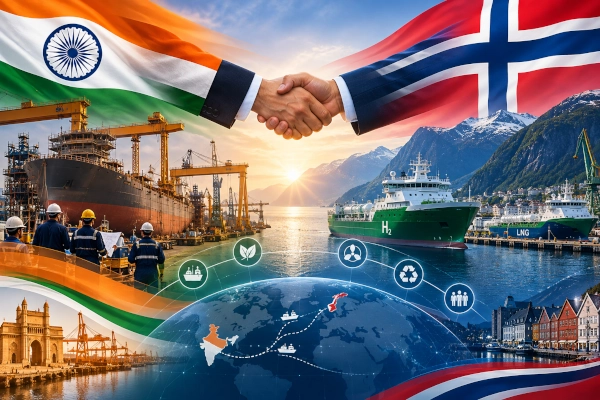
India and Norway have taken another step towards expanding their maritime partnership, with senior officials and industry representatives exploring new cooperation in shipbuilding, sustainable ship recycling, specialised vessels, green shipping and advanced maritime technologies during meetings in Norway on September 2–3, 2026.
The engagements included the 11th India–Norway Joint Working Group on Maritime in Oslo, co-chaired by Vijay Kumar, Secretary in India’s Ministry of Ports, Shipping and Waterways, and Mette I. Wikborg, Secretary General in Norway’s Ministry of Trade, Industry and Fisheries.
India’s Ministry of Ports, Shipping and Waterways announced the successful conclusion of the meeting on September 8, highlighting the two countries’ intention to deepen maritime cooperation, particularly in shipbuilding and sustainable ship recycling.
The visit itself had been scheduled for September 2–3, according to the Embassy of India in Oslo, and included both the Joint Working Group and interaction with Norway’s shipping industry.
At the JWG, the Indian side presented an overview of India’s expanding shipbuilding programme and its ship-breaking credit-note scheme. The two countries also discussed opportunities in maritime manufacturing, alternative fuels, green shipping, maritime digitalisation, development of seafarers and cooperation on international maritime standards.
Indian Delegation Engages Norwegian Maritime Industry
The government-to-government dialogue was accompanied by direct engagement with Norwegian maritime companies.
Vijay Kumar led the Indian delegation to the Bergen Engines factory, where officials examined advanced marine propulsion technologies and their potential application in India’s growing shipbuilding industry.
The delegation also held discussions with the Bergen Shipowners Association and companies including Wilson and Stenersen Chartering.
Separate interactions with Salt Ship Design, Babord Group and Stadyard Shipbuilding explored opportunities for the design and construction of deep-sea fishing vessels in India, as well as specialised and short-sea vessels.
These discussions are particularly relevant as India attempts to increase its share of global commercial shipbuilding while encouraging international shipowners and maritime-technology companies to use Indian yards.
Norway Already an Important Partner for Indian Shipyards
India and Norway already have an established shipbuilding relationship.
Norwegian shipowners have placed vessels with Indian yards including Cochin Shipyard, Udupi Cochin Shipyard and Chowgule’s shipbuilding operations. The Indian Embassy in Oslo notes that Norwegian cooperation has played an important role in developing India’s civilian vessel-building capabilities over the past two decades.
A major recent example came in November 2025, when Gujarat-based Swan Defence and Heavy Industries signed a Letter of Intent with Norwegian shipowner Rederiet Stenersen for six 18,000-DWT IMO Type II chemical tankers.
The proposed order is valued at approximately $220 million and includes an option for another six vessels.
The ships are planned for construction at Pipavav in Gujarat, with Norwegian company Marinform involved in their design and DNV providing classification. They are intended to incorporate hybrid propulsion and provisions for future conversion to fuels such as methanol or LNG.
The project illustrates the potential for India–Norway maritime cooperation to move beyond conventional ship construction into advanced, lower-emission vessels.
Green Shipping Moves to the Centre
Green maritime technologies formed an important part of the September discussions.
Shipping faces increasing pressure to reduce greenhouse-gas emissions, creating demand for cleaner fuels, energy-efficient propulsion, electrification, digital optimisation and new vessel designs.
Norway has developed considerable expertise in many of these areas, while India is seeking to combine international technology with its expanding manufacturing capacity.
The two countries are already discussing greening port operations, shore power, green-fuel bunkering and maritime decarbonisation.
Sustainable ship recycling is another area where their interests overlap.
India operates one of the world’s largest ship-recycling industries, particularly at Alang in Gujarat, while Norway has worked with Indian recyclers on meeting international environmental and safety requirements.
The September JWG consequently placed both shipbuilding and ship recycling among the central areas for future cooperation.
Part of the New Green Strategic Partnership
The maritime discussions come only a few months after Prime Minister Narendra Modi visited Norway on May 18–19, 2026, when India and Norway elevated their bilateral relationship to a Green Strategic Partnership.
During their talks in Oslo, Modi and Norwegian Prime Minister Jonas Gahr Støre reviewed cooperation spanning trade and investment, energy transition, climate action, blue economy, ocean governance, research, higher education, Arctic cooperation and space.
The two countries specifically identified shipbuilding, green shipping and the wider blue economy as important areas for deeper collaboration.
The Green Strategic Partnership therefore provides the wider political framework within which the latest maritime talks are taking place.
India and Norway are also seeking to deepen economic relations through the India-EFTA Trade and Economic Partnership Agreement, while the two governments have set an ambition of substantially expanding bilateral commerce in the years ahead.
A Complementary Maritime Partnership
The logic behind closer cooperation is increasingly clear.
Norway possesses a sophisticated maritime ecosystem covering vessel design, propulsion technologies, shipping operations, automation and green maritime solutions.
India offers large shipyards, competitive engineering and manufacturing capabilities, an expanding domestic maritime market and a substantial pool of trained seafarers.
Nearly 7,000 Indian seafarers currently work aboard Norwegian vessels, accounting for around 10% of crews serving on those ships, according to the Indian Embassy in Oslo.
The September 2–3 maritime engagements show that the relationship is now expanding from traditional shipping cooperation towards a broader industrial partnership.
For India, that could translate into more foreign ship orders, access to advanced maritime technology and opportunities to strengthen domestic manufacturing.
For Norway, India’s expanding shipbuilding industry offers an increasingly competitive location for constructing specialised and environmentally advanced vessels.
The 11th India–Norway Joint Working Group therefore represents another practical step in turning the countries’ newly established Green Strategic Partnership into shipbuilding, technology and industrial cooperation on the ground.
You may also like
-
ICAR Scientists Develop Indigenous Protective Gloves for Cotton Farmers, Sign Commercial Manufacturing Agreement
-
India and Italy Hold First Maritime Security Dialogue in Rome, Strengthen Strategic Maritime Cooperation
-
BHEL–Coal India Joint Venture Begins Construction of ₹25,016 Crore Indigenous Coal Gasification Project in Odisha
-
India and Azerbaijan Agree to Strengthen Security, Trade, Energy and Economic Cooperation
-
PM Modi to Inaugurate RBI’s Tier IV Data Centre and Cybersecurity Training Institute in Bhubaneswar
