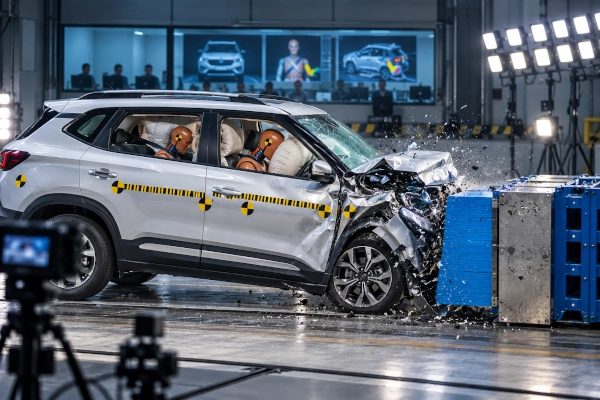
Bharat NCAP is India’s own New Car Assessment Programme, created to help buyers understand how well passenger vehicles protect their occupants in a crash. Instead of relying only on whether a car meets the minimum legal requirements for sale, Bharat NCAP gives participating vehicles a star-based safety rating, allowing consumers to compare the crash performance of different models before making a purchase.
The programme was launched by Union Minister for Road Transport and Highways Nitin Gadkari on August 22, 2023, and formally came into operation on October 1, 2023. It is administered under the Ministry of Road Transport and Highways and is based on the Automotive Industry Standard AIS-197.
Bharat NCAP was developed with two closely connected objectives. The first is to give Indian consumers clearer information about vehicle safety. The second is to encourage automobile manufacturers to compete not only on price, mileage, design and features but also on the ability of their cars to protect people during serious accidents.
Before Bharat NCAP, Indian buyers frequently looked to overseas or independent assessment programmes such as Global NCAP for crash-test information on locally sold cars. Bharat NCAP created a domestic framework in which cars sold in India could be tested according to an Indian government-backed protocol and awarded standardised safety ratings.
The present programme applies to type-approved M1 category passenger vehicles with a gross vehicle weight below 3.5 tonnes. M1 broadly refers to vehicles designed to carry passengers with no more than eight seats in addition to the driver’s seat. Both vehicles manufactured in India and imported vehicles can be assessed under the programme.
An important point is that Bharat NCAP is voluntary. A manufacturer or importer can submit an eligible model for assessment rather than every new car being automatically required to undergo Bharat NCAP testing. The programme is therefore different from the mandatory homologation and type-approval regulations that a vehicle must satisfy before it can legally be sold in India.
A car can therefore comply with India’s mandatory vehicle-safety regulations and legally enter the market without automatically receiving a Bharat NCAP five-star rating. Bharat NCAP goes further by providing a comparative indication of how the vehicle performs when subjected to specified crash conditions.
The programme was created partly because minimum regulation and comparative safety ratings serve different purposes. Government regulations establish the baseline that vehicles must meet. NCAP testing then allows manufacturers to demonstrate performance beyond that baseline and gives customers another factor to consider when choosing between vehicles.
Under the existing Bharat NCAP framework, vehicles receive separate ratings for Adult Occupant Protection, or AOP, and Child Occupant Protection, or COP. These ratings are based primarily on instrumented crash tests using specially designed anthropomorphic test devices, commonly known as crash-test dummies.
The adult rating reflects how effectively the vehicle protects adult occupants during specified impacts. Sensors inside the test dummies measure forces and accelerations affecting areas such as the head, neck, chest, pelvis and legs. The results are then converted into scores according to the AIS-197 assessment methodology.
Child Occupant Protection examines how children are protected inside the vehicle, including the performance of child-restraint systems and their interaction with the passenger compartment during crashes. Child dummies representing different age groups are installed in suitable child seats during specified tests.
This distinction is useful because a vehicle that performs well for adults does not necessarily provide equally strong protection for children. Bharat NCAP therefore gives customers separate information rather than compressing every aspect of occupant protection into one number.
The most important test under the original Bharat NCAP protocol is the Offset Deformable Barrier frontal impact test. In this assessment, the vehicle travels at 64 km/h into a deformable barrier with only part of the front of the car making contact.
This arrangement is designed to reproduce some of the forces experienced when two vehicles collide with partial overlap rather than meeting perfectly head-on. Such crashes place heavy loads on the front structure and passenger compartment and are particularly useful for assessing whether the cabin remains stable around the occupants.
During the test, adult dummies occupy the front seats while child dummies are positioned in the rear using appropriate child-restraint systems. Measurements from the dummies help determine the risk of injury to different parts of the body.
The current programme also includes a side-impact test at 50 km/h. In this test, a moving deformable barrier strikes the side of the stationary vehicle, simulating a severe lateral collision.
Side impacts present a different engineering challenge from frontal crashes because there is much less distance between the outside of the vehicle and the occupants. The doors, pillars, side structures and airbags must absorb energy within a comparatively narrow space.
Bharat NCAP also uses a side pole-impact test at 29 km/h under the original protocol. This simulates an accident in which the side of a vehicle strikes a narrow rigid object such as a pole or tree.
Pole impacts can be particularly severe because the force is concentrated over a small section of the vehicle rather than spread across a broad area. Side and curtain airbags therefore become especially important in protecting the head and torso.
Crash performance is converted into points, which in turn determine the star rating. Under the current system, a vehicle needs at least 27 Adult Occupant Protection points for a five-star AOP rating, while 41 points are required for a five-star Child Occupant Protection rating. Lower thresholds correspond to four, three, two and one-star ratings.
The programme also considers specified Safety Assist Technologies as qualifying requirements for certain star levels. This means structural crash performance is important, but manufacturers may also need to provide particular safety systems to qualify for the highest ratings.
One of the most important aspects of Bharat NCAP is that the base variant of a model is intended to be tested under the programme. The government highlighted this when Bharat NCAP was launched because testing only an expensive top variant loaded with additional airbags and safety technology could otherwise give buyers a misleading impression of the entire model range.
This principle encourages manufacturers to make important safety equipment available more widely rather than limiting it to premium versions.
The vehicle selection and testing process is governed by AIS-197. The selected vehicle is tested through authorised testing agencies recognised under the Central Motor Vehicles Rules, after which the results are submitted to the designated Bharat NCAP agency. Once the assessment has been examined and approved, the vehicle’s rating can be published for consumers.
The programme is anchored by the Central Institute of Road Transport, with the Ministry of Road Transport and Highways overseeing the broader framework.
A five-star rating should not be interpreted as meaning that occupants are guaranteed to survive every accident. Real crashes occur at different speeds, angles and road conditions and can involve vehicles of very different sizes and masses.
A star rating instead tells consumers how a particular vehicle performed under standardised and repeatable laboratory conditions. This makes comparison possible. Two vehicles subjected to the same test conditions can be evaluated against the same injury criteria and structural requirements.
The difference between a one-star and five-star vehicle can therefore reveal meaningful differences in the ability of the passenger compartment, restraint systems, airbags and other safety equipment to manage crash forces.
However, a five-star rating does not make seat belts, responsible driving or speed limits unnecessary. Crash forces rise dramatically with speed, and even the safest vehicle can be overwhelmed in a sufficiently severe collision.
The broader purpose of Bharat NCAP is to create what the government has described as a safety-sensitive automobile market. If consumers begin preferring vehicles with higher safety scores, manufacturers gain a commercial incentive to improve structures, airbags, restraint systems and electronic safety technology.
This can create a cycle in which stronger safety becomes an increasingly important selling point rather than merely a regulatory requirement.
There is also an industrial dimension. The government has argued that higher safety standards can help Indian-manufactured vehicles compete more effectively in export markets, where crash ratings and advanced safety technologies increasingly influence customer expectations.
Bharat NCAP therefore sits at the intersection of road safety, consumer information and automobile engineering.
The programme is also designed to evolve rather than remain fixed permanently. The first phase, which began on October 1, 2023, is scheduled to remain in force until September 30, 2027. The Ministry of Road Transport and Highways subsequently developed a draft AIS-197 Revision 1 for the second phase, commonly described as Bharat NCAP 2.0.
Bharat NCAP 2.0 represents a much more ambitious approach. Instead of focusing mainly on protecting people after a collision has occurred, the proposed new programme looks at the entire chain of vehicle safety.
Under the draft framework, vehicles would be assessed across five main areas: Crash Protection, Vulnerable Road User Protection, Safe Driving, Accident Avoidance and Post-Crash Protection. Together these categories would produce an overall score out of 100 points.
Crash Protection would remain the largest component, contributing 55% of the total score. Pedestrian and vulnerable-road-user protection would contribute 20%, while Safe Driving and Accident Avoidance would each contribute 10%. Post-Crash Protection would account for the remaining 5%.
This would fundamentally change the meaning of a Bharat NCAP star rating.
A vehicle seeking a high score would not only need to protect passengers when metal begins to deform. It would increasingly need to demonstrate that it can help the driver avoid a collision in the first place, reduce injuries to pedestrians and cyclists and remain safer for occupants and rescuers after a crash.
The proposed second phase also expands the number of crash tests from three to five. The existing 64-km/h offset frontal test and 50-km/h side-impact test would remain, while additional assessments would include a 50-km/h full-width frontal test, a 32-km/h oblique pole test and a 50-km/h rear-impact test.
The expanded system would examine more occupant positions and a wider range of crash scenarios, including rear-impact and whiplash performance.
The proposed five-star threshold would also become progressively tougher. Under the November 2025 draft, a five-star vehicle would require an overall weighted score of at least 70 points between 2027 and 2029, with the threshold increasing to 80 points from 2029.
The proposed Bharat NCAP 2.0 system therefore moves Indian vehicle assessment closer to the direction followed by advanced international NCAP programmes, where active safety technology and protection for pedestrians increasingly matter alongside conventional crashworthiness.
For consumers, however, the basic idea behind Bharat NCAP remains straightforward.
When two cars appear similar in price, size and features, Bharat NCAP provides another way of asking a crucial question: how effectively has each vehicle been engineered to protect people when something goes wrong?
That makes the programme more than a collection of dramatic crash-test videos.
Bharat NCAP creates a common Indian standard through which vehicle structures, airbags, restraint systems, child protection and increasingly electronic safety technology can be compared.
Its first phase established India’s own national car safety-rating system. The planned second phase will take that idea further by examining not only whether a vehicle survives a crash well, but whether it can help prevent the crash, protect people outside the vehicle and improve safety after the collision.
As these standards become tougher, the familiar one-to-five-star symbol could increasingly influence how Indian cars are designed, equipped and purchased.
The simplest way to understand Bharat NCAP is therefore this: it is India’s government-backed system for turning complex vehicle-safety engineering into a rating that ordinary car buyers can understand and compare.
You may also like
-
ICAR Scientists Develop Indigenous Protective Gloves for Cotton Farmers, Sign Commercial Manufacturing Agreement
-
BHEL–Coal India Joint Venture Begins Construction of ₹25,016 Crore Indigenous Coal Gasification Project in Odisha
-
PM Modi to Inaugurate RBI’s Tier IV Data Centre and Cybersecurity Training Institute in Bhubaneswar
-
India Creates 11 Crore Digital Farmer IDs Five Months Ahead of Target, Strengthening AgriStack Infrastructure
-
Chak-Hao Black Rice of Manipur and Nagaland: The Aromatic Purple Heritage Grain with GI Recognition
