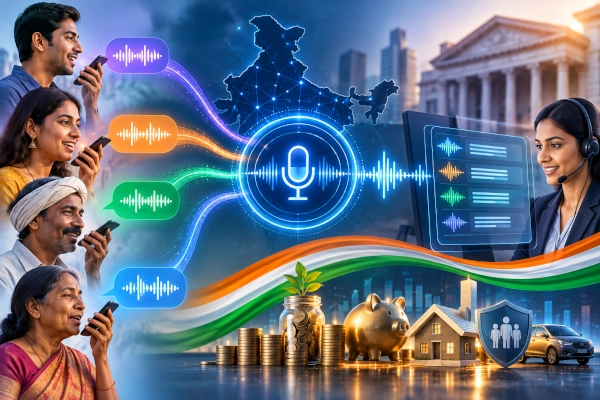
Indian enterprise artificial intelligence company Blue Machines AI has launched Aurora, a multilingual speech-to-text model developed specifically for India’s banking, financial services and insurance sector, targeting one of the most difficult challenges in voice AI: accurately understanding financial conversations in which customers frequently switch between English, Hindi and other Indian languages.
Launched on September 7, 2026, Aurora has been designed for real-time financial conversations conducted over telephone networks, where background noise, regional accents, inconsistent audio quality and frequent code-switching can make conventional speech-recognition systems unreliable. The model is intended for applications including customer service, collections, lending, insurance, banking operations and other enterprise workflows where spoken conversations need to be converted accurately into text.
India’s financial conversations often combine several linguistic patterns within a single interaction. A customer may speak primarily in Hindi or another Indian language while using English financial terms such as EMI, KYC, SIP, NAV, premium, foreclosure charge or transaction ID. Aurora has been developed specifically around these kinds of conversations rather than being adapted from a general-purpose global speech-recognition model.
According to Blue Machines AI, the model has been trained to recognise terminology and entities that frequently appear in banking and insurance interactions. These include monetary values, interest rates, policy numbers, transaction identifiers, account references, repayment commitments, premiums, disbursals and outstanding amounts. Accurately recognising such information is particularly important because even a small transcription error involving a number or financial term can materially change the meaning of a customer conversation.
In internal benchmarking conducted by the company on representative BFSI datasets, Aurora recorded a Semantic Word Error Rate of 1.51% for English conversations and 2.43% for Hindi BFSI conversations. Across multilingual speech, the reported Semantic Word Error Rate was 5.52%. Blue Machines AI also reported a BFSI Entity Error Rate of 4.23% when evaluating information such as monetary amounts, policy numbers, interest rates, account references and transaction IDs. These figures are company-reported internal benchmarks rather than independently verified results, but they indicate the performance targets around which the platform has been developed.
The datasets used during evaluation covered banking, lending, insurance, collections and customer-servicing conversations. They included Indian English, Hindi, Hinglish and multilingual or code-mixed speech, along with regional pronunciation patterns, background noise and telephone-quality audio. This focus differentiates Aurora from general speech-to-text systems that may perform well on clean recordings but struggle when deployed in real-world Indian call-centre environments.
Blue Machines AI says Aurora has also been optimised for real-time deployment at scale. Internal throughput tests showed the model handling around 960 simultaneous real-time streams on an Nvidia H100 GPU at a 320-millisecond operating point, while a configuration operating at approximately 1.12 seconds supported up to 2,400 concurrent streams per H100 GPU. Actual performance will depend on infrastructure, workload and deployment configuration.
The ability to support large numbers of simultaneous conversations is important for banks, insurers and financial institutions that operate high-volume contact centres. Speech-recognition technology in such environments must not only understand language accurately but also process thousands of conversations reliably without introducing delays that disrupt customer interactions.
Aurora can also be customised using data authorised by an individual financial institution. This allows the model to learn organisation-specific product names, terminology, geographical references, customer accents and other linguistic patterns. Blue Machines AI says internal testing showed that institution-specific adaptation produced a 40–45% relative reduction in recognition errors compared with the base model on customised datasets.
The model has been designed with flexible deployment options because data security and regulatory compliance are major concerns for financial institutions. Banks and insurers can use Aurora through managed cloud infrastructure, deploy it within their own virtual private cloud, or operate it entirely on-premises. This allows institutions handling sensitive financial and personal data to maintain greater control over where information is processed and stored.
That architecture also fits into Blue Machines AI’s broader push toward what it describes as sovereign enterprise AI, where customers retain control over data, models, workflows and deployment environments rather than relying exclusively on external public AI services.
The company recently expanded that strategy through Project Icebreaker, a co-innovation programme aimed at helping five Indian banks, NBFCs, insurers or fintech companies move AI projects from proof-of-concept stages into full production. Under the initiative, Blue Machines AI is offering selected institutions access to its technology, engineering support, enterprise integration capabilities and deployment infrastructure.
Aurora could become an important component of such deployments because speech recognition acts as the foundation for many voice-based AI applications. Once a conversation has been accurately converted into structured text, AI systems can analyse customer intent, identify relevant financial information, generate summaries, trigger workflows, monitor compliance or assist human agents.
For instance, a collections system could identify repayment commitments during a telephone conversation, while an insurance platform could extract policy numbers and claim information. Customer-service platforms could automatically classify requests, generate conversation summaries or route customers to appropriate departments. Similar systems could also support auditing and compliance by making large volumes of voice interactions searchable and analysable.
The challenge is particularly significant in India because of the country’s linguistic diversity. Conventional speech-recognition systems trained primarily on American or European English can struggle with Indian pronunciation, mixed-language sentences and the rapid transition between local languages and specialised English terminology.
Aurora represents an attempt to build this capability specifically around Indian enterprise conditions rather than treating multilingual speech as an additional feature added later.
Blue Machines AI founder and CEO Nirmit Parikh has emphasised that financial conversations in India rarely follow a single language or standard script. The company’s approach is therefore focused on recognising the information that determines financial outcomes, not simply producing a broadly understandable transcript.
The model forms part of a wider wave of Indian companies developing AI systems around local languages and specialised industry requirements. Rather than competing exclusively to create very large general-purpose foundation models, a growing group of Indian AI companies is targeting sectors where domain-specific data, regulatory requirements and local linguistic knowledge can provide an advantage.
Banking and financial services could become one of the largest markets for such systems because the sector processes enormous volumes of customer conversations while operating under strict requirements for security, compliance and accuracy.
Aurora’s significance therefore extends beyond basic voice transcription. By combining multilingual speech recognition with financial terminology, entity extraction, scalable inference and institution-specific customisation, Blue Machines AI is attempting to build a speech layer specifically suited to India’s financial infrastructure.
If the technology performs reliably at commercial scale, systems such as Aurora could make it easier for Indian banks and insurers to automate customer interactions without forcing customers to communicate in a single language or adapt their natural speech to machines.
The September 7 launch consequently represents another step toward an emerging generation of India-built, domain-specific artificial intelligence systems designed around the country’s own languages, industries and operating conditions rather than relying entirely on general-purpose models developed for overseas markets.
You may also like
-
HSTDV: The Mach 6 Technology Demonstrator That Laid the Foundation for India’s Hypersonic Cruise Missile Programme
-
Bengaluru Startup Luxid Launches AR Glasses for Surgical Counselling and Hospital Workflows
-
Indian Startup Alteon Tests Autonomous Aircraft Designed to Stay Aloft for Months Using Ocean Winds
-
Mysuru Deep-Tech Firm Vigyanlabs Launches Waterless FEMTO Sovereign AI Platform
-
Indian Startup Ziroh Labs Globally Launches Kompact AI to Run Large AI Models Without Dedicated GPUs
