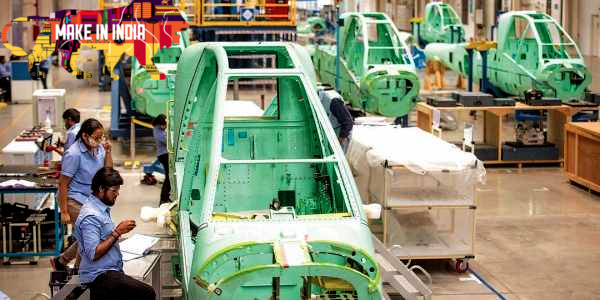
India has crossed another significant milestone in global aerospace manufacturing, with Tata Boeing Aerospace Limited rolling out the 400th AH-64E Apache attack-helicopter fuselage from its Hyderabad facility.
The milestone was announced on September 7, 2026, by Boeing. Tata Boeing Aerospace Limited, or TBAL, is a joint venture between Tata Advanced Systems Limited and Boeing and has developed Hyderabad into an important manufacturing centre for one of the world’s most widely operated attack helicopters.
The 400th fuselage was manufactured at TBAL’s 52,000-square-metre aerospace facility in Hyderabad. The structures produced there are incorporated into complete Apache helicopters supplied to customers around the world, including the United States Army.
Indian-operated Apaches are also part of this production story. Boeing confirmed that fuselages manufactured at Hyderabad were used for the six AH-64E helicopters delivered to the Indian Army in 2025. The Indian Air Force separately operates 22 AH-64E Apache helicopters.
The achievement gives India an unusually important position within the global supply chain for the Apache programme. Rather than manufacturing components solely for aircraft purchased by India, the Tata-Boeing venture produces major aerostructures that enter Boeing’s international production network.
TBAL was established in 2016, and its Hyderabad operation now employs more than 750 engineers and technicians. Boeing says the facility uses advanced robotics, automation and modern aerospace manufacturing technologies for the production of Apache fuselage aerostructures.
The programme has developed considerably from its initial footprint. When the dedicated Apache fuselage facility was inaugurated in Hyderabad in 2018, Boeing described it as the sole global producer of AH-64 Apache fuselages for its customers, including the US Army. At that stage, the production facility covered around 14,000 square metres and employed approximately 350 skilled workers.
The subsequent expansion to the much larger manufacturing footprint announced today illustrates how the Tata-Boeing partnership has moved from establishing an Indian aerostructures capability to supporting sustained international production.
The first Apache fuselage manufactured by the venture was delivered in 2018. By January 2023, TBAL had also delivered the first fuselage intended for the Indian Army’s six-aircraft Apache programme. Boeing said at the time that the Hyderabad operation was producing complex aerostructures not only for the Apache but also components associated with other Boeing aircraft programmes.
The latest 400-airframe milestone therefore represents cumulative manufacturing experience built over several years rather than a one-off localisation programme.
The AH-64E Apache remains one of the world’s most established attack-helicopter platforms. According to Boeing, approximately 1,300 Apache helicopters are currently operating with 19 countries, giving the Hyderabad facility a role in supporting an aircraft fleet extending far beyond India’s own armed forces.
For India, the significance lies particularly in the nature of the manufacturing work being carried out. An aircraft fuselage is a major structural assembly requiring tight dimensional tolerances, manufacturing repeatability, quality assurance and integration with numerous mechanical and electrical systems. Sustaining production across hundreds of aircraft demonstrates a considerably deeper aerospace capability than simple component assembly.
It also highlights the gradual integration of Indian companies into international defence supply chains. The fuselages manufactured in Hyderabad do not remain confined to domestic military procurement. They form part of aircraft ultimately operated by foreign armed forces, making Indian manufacturing an integral element of the Apache’s global production system.
Tata Advanced Systems has steadily built a larger position in aerospace and defence manufacturing through partnerships with international original equipment manufacturers while simultaneously expanding its own Indian defence capabilities. The Apache programme has become one of the clearest examples of this model.
Boeing describes TBAL’s Hyderabad operation as a global manufacturing hub for Apache fuselages and other critical aerostructures, alongside production of vertical-fin structures for the Boeing 737 programme. The company also links the partnership with the broader Make in India and Aatmanirbhar Bharat initiatives and with expanding India-US defence-industrial cooperation.
The 400th fuselage milestone comes as Tata Advanced Systems is simultaneously expanding into additional high-value defence manufacturing programmes.
Only days earlier, Tata Advanced Systems and the Javelin Joint Venture of Raytheon and Lockheed Martin announced an agreement to explore production of Javelin missiles in India. While that is a separate programme, it reinforces a wider trend in which Indian industry is moving from supplying individual parts toward undertaking major structural manufacturing, integration and potentially complete weapon-system production.
The Apache programme already demonstrates what such long-term industrial partnerships can achieve. India began as an important customer for the attack helicopter, but Indian industry has subsequently become part of the supply chain supporting Apache fleets around the world.
The Hyderabad operation also carries implications for India’s aerospace workforce. More than 750 engineers and technicians are now involved in manufacturing that depends on automated production systems, precision tooling, robotics and aerospace-grade quality processes. Skills developed through sustained global production programmes can subsequently support other military and civil aerospace projects.
This becomes increasingly relevant as India seeks to expand indigenous aircraft, helicopter, unmanned-system and aero-engine programmes while simultaneously attracting a larger share of global aerospace manufacturing.
There is also an important distinction between indigenous design and manufacturing localisation. The AH-64E remains a Boeing-designed American attack helicopter, and the 400th fuselage milestone should not be portrayed as India developing an indigenous Apache. Its significance instead lies in India becoming a deeply embedded manufacturing location for a sophisticated international combat-aircraft programme.
That achievement is substantial in its own right.
From the inauguration of the Hyderabad facility to production of hundreds of airframes for customers around the world, Tata Boeing Aerospace has demonstrated that major combat-aircraft structures can be manufactured in India at sustained international production standards.
The rollout of the 400th Made-in-India Apache fuselage therefore represents more than a numerical manufacturing milestone. It reflects India’s continuing transition from being primarily a purchaser of foreign aerospace platforms toward becoming an increasingly important engineering, manufacturing and supply-chain partner for global defence programmes.
With hundreds of Apache fuselages now emerging from Hyderabad and entering operational fleets across the world, India’s role in the international aerospace manufacturing ecosystem is becoming progressively harder to overlook.
Reference
Boeing India — “Tata Boeing Aerospace Delivers 400 ‘Made in India’ Apache Fuselages”
Published: September 7, 2026
Reference : Boeing India
https://www.boeing.co.in/news/2026/tata-boeing-aerospace-delivers-india-apache-fuselages
You may also like
-
India Clears ₹1.10-Lakh-Crore Defence Acquisition Push, With 98% of Procurement to Come From Indian Industry
-
India Gives Armed Forces Greater Operational Freedom as Defence Push Accelerates Toward Advanced Technology and Self-Reliance
-
India Launches Nationwide FTA Utilisation Drive as April-July Exports Reach $317 Billion
-
India’s Counter-Space Programme Expands Into Space-Based High-Power Lasers and Satellite Jamming
-
Indian Paratroopers Conduct Multinational Airborne Assault in Indonesia During Super Garuda Shield 2026
