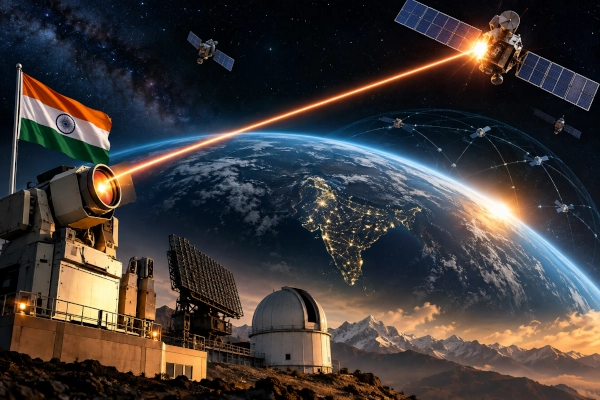
India’s work on protecting and contesting the space domain is moving beyond the kinetic anti-satellite capability demonstrated by Mission Shakti, with the Defence Research and Development Organisation now officially identifying space-based high-power lasers and space-asset jamming among the technologies it intends to develop.
DRDO’s current Space Technologies roadmap lists “Space based High Power Laser” under the category of Directed Energy Weapons. The same official roadmap separately identifies “Space Asset Jamming” under Electronic Warfare. Although DRDO has not disclosed detailed specifications, development schedules or intended operational concepts for either technology, their inclusion provides a rare official indication of the areas India is exploring as military competition increasingly extends into space.
The development is significant because India’s publicly demonstrated counter-space capability has so far been associated most prominently with Mission Shakti, the anti-satellite missile test conducted on March 27, 2019. During that mission, a DRDO-developed ballistic-missile-defence interceptor struck an Indian satellite travelling in Low Earth Orbit in a direct hit-to-kill engagement. The Ministry of Defence said the test demonstrated India’s ability to defend its assets in outer space and made the country one of a small group possessing such a capability.
Mission Shakti represented a kinetic approach to counter-space operations because the target satellite was physically destroyed. High-power lasers and electronic jamming belong to a very different category. Depending on their design and intended application, such systems could potentially interfere with sensors, communications or other satellite functions without relying on a physical interceptor.
DRDO’s public roadmap does not say that the proposed space-based high-power laser is specifically intended to blind or damage satellites. It also does not identify the laser’s power, wavelength, orbital platform or target set. It would therefore be inaccurate to describe the project at this stage as an operational anti-satellite laser. What can be stated with confidence is that space-based high-power laser technology now appears explicitly within DRDO’s directed-energy research priorities.
The second development area, Space Asset Jamming, is more directly associated with electronic warfare. Military satellites depend on radio-frequency links for functions ranging from command and control to communications and transmission of collected data. Electronic countermeasures can potentially interfere with these links without physically damaging the spacecraft itself.
Again, DRDO has not publicly explained whether its Space Asset Jamming work is aimed at satellite communications, navigation signals, payload links or another part of the space architecture. Nor has it disclosed whether the envisaged equipment would operate from the ground, air or space. The roadmap nevertheless confirms that electronic warfare against space assets is an acknowledged Indian defence-technology development area.
This shift toward non-kinetic technologies reflects a broader transformation in military space operations. Satellites now support communications, navigation, intelligence gathering, missile warning, weather monitoring and battlefield coordination. Disrupting an adversary’s access to these services can create major operational effects even without destroying the satellite itself.
Non-kinetic counter-space systems can also offer advantages over destructive anti-satellite weapons. A kinetic intercept can generate orbital debris that may threaten friendly, neutral and civilian spacecraft for years. Jamming, dazzling or temporarily interfering with a satellite can potentially produce a military effect without creating the same debris environment, although such systems introduce their own technical, strategic and legal complexities.
India has already developed a substantial technological foundation in high-power laser systems on Earth. DRDO’s Centre for High Energy Systems and Sciences, or CHESS, has developed the Mk-II(A) Laser Directed Energy Weapon. DRDO described the prototype in 2025 as the result of prolonged research in directed-energy technology undertaken by CHESS together with several other DRDO laboratories and Indian partners.
The terrestrial laser programme has progressed beyond laboratory experimentation. During DRDO’s maiden trials of the Integrated Air Defence Weapon System in August 2025, a high-power laser-based Directed Energy Weapon operated alongside the indigenous QRSAM and VSHORADS missile systems. Three aerial targets, including high-speed fixed-wing UAVs and a multicopter drone, were simultaneously engaged by different components of the layered air-defence architecture.
DRDO has also moved toward transferring mature laser technology to Indian industry. In 2025, CHESS sought industrial partners for a 10 kW-class multi-channel Laser Directed Energy Weapon with a stated hard-kill range of up to two kilometres, demonstrating that parts of India’s high-energy-laser programme are progressing toward production and wider deployment.
These terrestrial systems should not be confused with the space-based laser listed in DRDO’s roadmap. Operating a high-power laser from space presents a different set of engineering challenges, including power generation, thermal management, beam control, pointing accuracy, spacecraft stability and the need to package the entire system within the mass and volume constraints of an orbital platform.
The roadmap nevertheless suggests that DRDO wants to extend India’s directed-energy expertise into the space domain. The same Space Technologies page contains other developments that would support a more sophisticated military space architecture, including high-gain beam-steering antennas for Low Earth Orbit platforms, artificial-intelligence-based multi-sensor data fusion for space surveillance, rendezvous and proximity operations technology, infrared payloads for hypersonic-missile detection and advanced spaceborne sensors.
Some of these technologies are defensive or dual-use rather than weapons. Rendezvous and proximity operations, for example, can support servicing, inspection, docking and other peaceful spacecraft activities. The same capability can also have military relevance because precise manoeuvring around another spacecraft is fundamental to any close-proximity space operation.
India is simultaneously strengthening its ability to detect and track objects in orbit. ISRO’s Network for Space Objects Tracking and Analysis, or NETRA, forms part of the country’s indigenous Space Situational Awareness infrastructure. ISRO’s 2025 Space Situational Awareness report says work is underway to establish an optical telescope at Hanle in Ladakh, while the design of an indigenous phased-array space-object tracking radar was completed and work toward establishing the radar in northeastern India is progressing.
ISRO publicly describes NETRA and its wider IS4OM architecture as systems intended to safeguard Indian spacecraft from orbital debris and other hazards. They should therefore not be described as counter-space weapons. However, accurate detection, identification and tracking of objects in orbit are foundational capabilities for any country seeking greater awareness of activities around its satellites.
The combination of improved space surveillance, electronic-warfare research, directed-energy technology and the demonstrated Mission Shakti capability shows that India’s approach to space security is becoming increasingly diverse. Instead of relying on a single method of countering hostile space systems, the country is developing expertise across several technological areas.
The progression also mirrors changes taking place internationally. Advanced military powers are increasingly examining reversible or non-destructive counter-space measures because modern armed forces depend heavily on satellites while the consequences of generating orbital debris have become more widely recognised. Electronic interference and directed-energy systems potentially offer ways to deny or degrade an adversary’s capabilities without necessarily destroying the spacecraft.
At the same time, considerably more remains unknown than is publicly disclosed about India’s newest programmes. DRDO has not announced a flight demonstration of a space-based high-power laser, nor has it publicly demonstrated a Space Asset Jamming system against an orbital target. There is also no official confirmation of an Indian ground-based satellite-blinding laser equivalent to systems reported to be under development elsewhere.
The correct interpretation of DRDO’s roadmap is therefore that India is developing or investigating the technologies required for a broader future counter-space architecture, rather than that all of these systems are already operational.
Even with that qualification, the official acknowledgement is important. Mission Shakti established India’s ability to physically intercept a satellite in Low Earth Orbit. DRDO’s current roadmap now points toward additional approaches involving directed energy and electronic warfare, while ISRO continues expanding the tracking infrastructure needed to maintain awareness of an increasingly congested orbital environment.
India’s counter-space capability is consequently evolving from a demonstrated anti-satellite missile into a wider technological ecosystem. If DRDO’s space-based laser and space-asset jamming programmes mature successfully, India could eventually possess a more varied set of options for protecting its own orbital infrastructure and responding to threats in space without relying exclusively on destructive kinetic interception.
You may also like
-
Indian Paratroopers Conduct Multinational Airborne Assault in Indonesia During Super Garuda Shield 2026
-
DRDO Launches SHIELD Programme to Develop Indigenous S-Band High-Power Microwave Technology
-
Adani Defence to Supply Indigenous Ammunition for AK-203 Rifles Under Five-Year Pact
-
Indian Air Force Indigenises Critical Hydraulic Booster Pump for Su-30MKI Fighter Fleet
-
Indian Air Force Showcases Do-228 Fleet Readiness in Elephant Walk at Yelahanka
