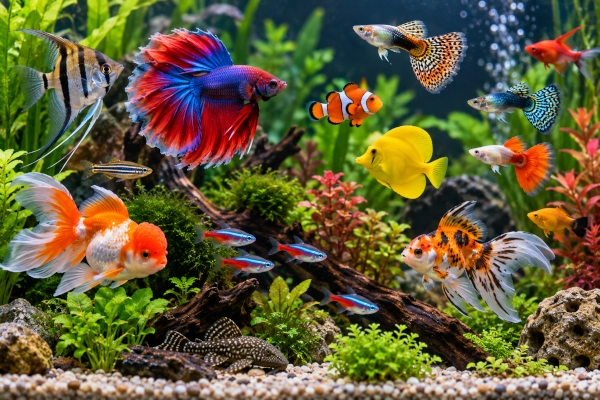
India has launched Mission Rangeen Machhli 2031, a national strategic action plan aimed at transforming ornamental fisheries into a more scientific, organised and globally competitive sector. Vice President C. P. Radhakrishnan formally released the mission at Agatti in Lakshadweep on August 31, 2026, during a fisheries outreach programme organised by the Department of Fisheries under the Ministry of Fisheries, Animal Husbandry and Dairying.
The mission seeks to create a common national framework covering breeding, hatchery management, fish health, quarantine, traceability, aquarium operations, transport and trade. By introducing standard operating procedures across the value chain, the government aims to improve quality, strengthen biosecurity and prepare Indian ornamental-fish producers for certification and wider market access.
Building Standards Across the Ornamental Fish Industry
India’s ornamental-fish industry includes freshwater and marine species bred or reared primarily for aquariums rather than food. Although the country has substantial biodiversity and favourable climatic conditions, production remains fragmented across hatcheries, small enterprises, farmers and traders.
Mission Rangeen Machhli 2031 is intended to bring greater consistency to this ecosystem. The strategic action plan provides a uniform framework for scientific management, regulatory compliance, quality assurance and biosecurity across the ornamental-fisheries value chain.
The accompanying standard operating procedures cover broodstock management, breeding, hatchery operations, production systems, quarantine, health management, traceability, aquarium management, handling, transportation and trade. The aim is to ensure that producers in different parts of the country follow comparable best practices rather than operating under widely varying standards.
Such standardisation could become particularly important as Indian producers seek access to organised domestic markets and international buyers, where disease control, traceability and quality certification increasingly influence purchasing decisions.
Biosecurity Becomes a Central Priority
Ornamental-fish trade can involve movement of live animals across long distances and between different aquatic environments. This creates risks associated with disease transmission, invasive species and poor handling practices.
Mission Rangeen Machhli therefore places biosecurity alongside production growth. Quarantine protocols, health management and traceability are included within the national framework so that fish can be monitored through breeding, rearing, transport and trade.
Strengthening these systems could help protect hatcheries and natural aquatic ecosystems while also improving confidence among buyers. The Department of Fisheries says the plan is intended to raise product quality and biosecurity standards while facilitating certification and market access.
Lakshadweep Provides a Natural Launch Platform
The choice of Lakshadweep for the mission’s launch reflects the islands’ considerable marine ornamental biodiversity.
The government says the archipelago is home to more than 300 ornamental fish species. An ornamental-fish hatchery has already been established at Agatti, while three ornamental-fish rearing units have been approved under the Pradhan Mantri Matsya Sampada Yojana.
Lakshadweep also possesses a lagoon area of about 4,200 square kilometres and an Exclusive Economic Zone approaching 4 lakh square kilometres, giving the islands considerable potential across ornamental fisheries, tuna fishing, seaweed cultivation and other forms of mariculture.
The government’s approach is therefore not simply to increase extraction from the marine environment. Scientific management and conservation are intended to remain central to the development of high-value fisheries resources.
From Collection to Sustainable Rearing
The long-term opportunity in ornamental fisheries increasingly lies in developing controlled breeding and rearing systems rather than relying excessively on collection from the wild.
Scientific hatcheries can help produce popular ornamental species under managed conditions while reducing pressure on natural populations. They can also provide better control over fish health, size, quality and supply consistency.
Mission Rangeen Machhli’s emphasis on broodstock management, breeding and hatchery practices indicates an effort to build exactly this type of production system.
For island regions such as Lakshadweep, the challenge will be to combine livelihood opportunities with protection of coral reefs and other sensitive marine habitats. A scientifically managed ornamental-fisheries industry could allow local communities to derive higher value from relatively small production volumes while maintaining stricter controls over harvesting.
Certification Could Help Indian Producers Reach Global Markets
Ornamental fish are traded internationally as live animals, making quality and survival during transport particularly important. Exporters must manage water quality, disease risk, packaging, temperature and travel time carefully.
India’s new strategic plan aims to improve consistency in these areas through standardised handling, transport and trade procedures. It also specifically seeks to facilitate certification and improve market access.
This could help Indian enterprises move from fragmented local sales toward organised domestic supply chains and eventually higher-value international markets.
The opportunity extends beyond fish themselves. A stronger ornamental-fisheries ecosystem can support hatcheries, aquarium businesses, specialised feed, aquatic plants, equipment suppliers, logistics providers and technical services.
Opportunities for Small Farmers and Entrepreneurs
Unlike many forms of large-scale marine fishing, ornamental-fish breeding can be undertaken in relatively compact production systems. This gives the sector potential for participation by small entrepreneurs, women, youth, cooperatives and fisheries producer organisations.
The wider Agatti outreach programme included fish farmers and fishers, including women participants, as well as fisheries cooperatives and government officials. The government is also strengthening Fish Farmer Producer Organisations and fisheries cooperatives through financial, technical and capacity-building assistance.
If backed by reliable hatchery technology, disease-management support and organised marketing networks, ornamental fisheries could provide a supplementary income source in coastal, island and inland regions.
Part of a Wider Blue Economy Push
Mission Rangeen Machhli was launched as part of a broader effort to increase the economic value generated from India’s aquatic resources.
India has approximately 11,099 kilometres of coastline and an Exclusive Economic Zone of about 24 lakh square kilometres. Government estimates place marine fisheries potential within the EEZ at around 58.6 lakh tonnes. India’s seafood exports reached about ₹73,890 crore in FY2025-26.
Lakshadweep itself has estimated fisheries potential exceeding 1 lakh tonnes, including around 94,000 tonnes of tuna and tuna-like species. Fisheries projects worth more than ₹62 crore have been approved for the islands under PMMSY.
The government has consequently begun developing several specialised fisheries activities simultaneously rather than relying only on conventional coastal fishing.
Seaweed, Tuna and Ornamental Fisheries Develop Together
Lakshadweep has already been notified as a dedicated Seaweed Cluster, while a Seaweed Bank has been approved in collaboration with ICAR-CMFRI. Around 575 seaweed cultivation units, backed by investment of roughly ₹2 crore, are being promoted for women, young people and self-help groups.
The government is also pursuing sustainability certification and development of a “Lakshadweep Sustainable Tuna” brand. In addition, 16 deep-sea fishing vessels costing approximately ₹1.2 crore each have been sanctioned with full financial assistance and are under construction.
These initiatives illustrate a larger strategy in which different parts of the marine economy are being developed according to their commercial potential rather than treated as a single fisheries activity.
A Five-Year Roadmap for Ornamental Fisheries
The significance of Mission Rangeen Machhli 2031 lies in its attempt to develop the ornamental-fish sector as an organised industry rather than simply encouraging higher production.
Its framework addresses the entire chain from broodstock and breeding to quarantine, health management, aquarium operation, traceability, transportation and eventual trade. That makes quality control and market readiness as important as production itself.
The government expects these standards to strengthen stakeholder capacity, improve biosecurity and enable greater certification and market access while supporting sustainable development of the sector.
For India, the opportunity is considerable. The country combines extensive aquatic biodiversity, established fisheries expertise, a large domestic aquarium market and access to tropical marine and freshwater species.
The launch at Agatti therefore represents more than a programme for colourful aquarium fish. It marks an attempt to build a national industry around biodiversity, science, livelihoods and carefully regulated trade while ensuring that growth remains compatible with conservation of India’s aquatic ecosystems.
You may also like
-
India Demonstrates 60% Recycled Asphalt Technology on Chennai–Tirupati Highway
-
German Cable Major LAPP Makes Bhopal Its Largest Manufacturing Facility Worldwide
-
Syrma SGS and Italy’s Elemaster Open Advanced Electronics Manufacturing Hub in Bengaluru
-
Novonesis Bets €600 Million on India With Advanced Enzyme Manufacturing Hub in Maharashtra
-
BRICS Currency: How the Bloc Is Building a New Cross-Border Payment Architecture Without a Common Currency
