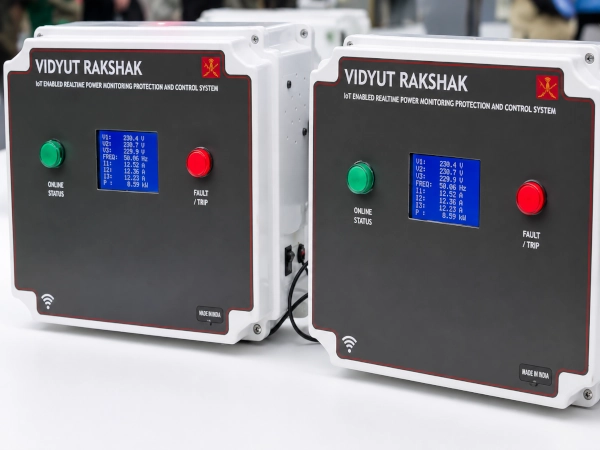
An innovation developed by an Indian Army officer has turned an everyday logistical requirement into a smart military-support system. Vidyut Rakshak, conceived by Major Rajprasad R.S. of the Corps of Engineers, is an Internet of Things-enabled platform capable of monitoring, protecting and controlling generators deployed across the Army, irrespective of their make, capacity or age.
The system addresses an operational problem that is particularly important in remote military locations. Generator sets provide essential electricity for communications equipment, accommodation, surveillance systems, workshops, medical facilities and other infrastructure at posts where grid power may be unreliable or unavailable. Maintaining large numbers of generators of different generations and manufacturers creates a substantial manpower and maintenance burden.
Vidyut Rakshak was designed to bring these different machines onto a common digital monitoring and control architecture.
One System for Generators of Different Makes and Ages
One of the most important features of Vidyut Rakshak is its ability to work with existing generators without requiring the Army to replace them with a single standard model.
The Indian Army describes the platform as agnostic to generator type, make, rating and vintage. This allows older machines and newer generator sets from different manufacturers to be brought under the same monitoring framework.
That flexibility is particularly valuable for a military organisation whose equipment inventory has been accumulated over many years.
Instead of building separate monitoring arrangements for every model, Vidyut Rakshak provides a common system capable of reading operating parameters and presenting them through a unified interface.
Real-Time Monitoring of Electrical and Mechanical Parameters
Vidyut Rakshak continuously monitors both electrical and mechanical parameters associated with generator operation.
The data is displayed through a user-friendly graphical dashboard, allowing operators to view the condition of multiple systems without continuously inspecting each generator physically.
The Army has highlighted the system’s modular, compact and lightweight configuration, making it suitable for deployment in operational areas where space, transport and manpower are constrained.
During its production rollout in June 2024, then Vice Chief of the Army Staff Lt Gen Upendra Dwivedi demonstrated the technology by remotely switching on generators located in Srinagar and viewing their operating parameters from another location.
The demonstration illustrated the central principle behind the system: generator fleets no longer have to be managed entirely through local manual supervision.
Predicting Faults Before Equipment Fails
The system goes beyond simple remote monitoring.
Vidyut Rakshak has been designed to identify operating abnormalities and support the prediction and prevention of electrical and mechanical faults.
This predictive element is important in military logistics.
A generator failure at a remote location can interrupt power to communications, sensors or other essential infrastructure. Repair personnel and replacement equipment may then have to be transported over difficult terrain.
Monitoring changes in operating parameters can provide maintenance teams with warning before a fault develops into a complete failure.
This shifts maintenance from a largely reactive model towards a more preventive approach.
Automation Reduces the Manpower Burden
Generator operation traditionally requires personnel to start and stop machines, record readings and repeatedly inspect equipment.
Vidyut Rakshak automates a significant part of this process.
The Army says the system can automate previously manual operations through its graphical interface, reducing the number of personnel required for routine generator supervision.
This is particularly relevant at forward posts, where every soldier or technician assigned to routine infrastructure duties represents manpower that could potentially be used for other operational tasks.
The value of the system therefore lies not only in better generator maintenance but also in optimising manpower and resources.
Developed From a Soldier’s Understanding of Field Requirements
Vidyut Rakshak is part of the Indian Army’s growing effort to turn solutions developed by its own personnel into deployable military technologies.
Major Rajprasad R.S., an officer of the Corps of Engineers, developed the system through the Army’s internal innovation ecosystem.
The platform was showcased during Exercise Bharat Shakti, witnessed by Prime Minister Narendra Modi, before progressing towards production and induction.
Its development illustrates an important advantage of soldier-led innovation: the person designing the system understands the operational problem from direct military experience.
Instead of beginning with a technology and searching for an application, the development process begins with an identifiable field requirement and builds a practical engineering solution around it.
From Innovation to Production
The Army also created an industrial pathway to prevent useful prototypes from remaining limited to demonstrations.
During Aero India 2023, the Indian Army signed an MoU with the Foundation for Innovation and Technology Transfer at IIT Delhi to facilitate the production of military innovations.
Vidyut Rakshak became the first innovation progressed through this arrangement.
Its Transfer of Technology to a production agency was formally concluded during the Indian Army Ideas and Innovation Competition in New Delhi on December 5, 2023, enabling the system to move towards larger-scale production.
The programme therefore followed a complete pathway from soldier-generated concept to engineering development, technology transfer, production and operational induction.
Inducted in Northern Command
The Ministry of Defence subsequently confirmed that Vidyut Rakshak had been inducted in Northern Command.
Northern Command operates across some of the most demanding military environments in India, including remote and high-altitude locations where dependable power generation is essential and equipment maintenance can be difficult.
The Ministry’s Annual Report for 2024-25 specifically listed Vidyut Rakshak among innovations developed by service personnel that had progressed from innovation to induction.
Its deployment in such areas provides a practical test of the technology under conditions considerably more demanding than a laboratory environment.
By October 2025, the Indian Army stated that the system was being widely employed, particularly in remote and high-altitude areas.
Patent Marks the Next Milestone
Vidyut Rakshak achieved another milestone in October 2025 when the Government of India granted a patent covering the technology.
The patent certificate identifies the invention as an “Integrated Generator Monitoring Protection and Control System.”
According to the certificate released by the Army, patent protection runs for 20 years from June 13, 2023, in accordance with the Patents Act, 1970.
Patent protection gives formal recognition to the intellectual property created within the Army while also demonstrating that in-house military innovation can progress beyond prototype development into legally protected technology.
Part of a Wider Series of Innovations by Major Rajprasad
Vidyut Rakshak is not Major Rajprasad’s only military innovation.
He has also developed systems including the Portable Multi-Target Detonation Device, later associated with the Agniastra family of remote demolition technologies, and has worked on other equipment intended for combat engineering and counter-IED operations.
In June 2025, he received the NSG Counter IED Innovator Award for innovations including Agniastra and the Shatrunash handheld electromagnetic-pulse system.
His work reflects a wider Indian Army effort to encourage personnel to identify operational problems and develop indigenous technological solutions rather than depending entirely on conventional procurement channels.
A Small System With Significant Operational Value
Vidyut Rakshak may appear less dramatic than a missile, drone or armoured vehicle, but military effectiveness depends heavily on technologies that keep essential infrastructure functioning.
Reliable electrical power supports communications, command systems, surveillance equipment, maintenance facilities and living infrastructure. A failure in that support chain can affect far more sophisticated equipment.
By connecting different generations of generators to a common monitoring and control platform, Vidyut Rakshak improves equipment availability while reducing manual supervision and enabling preventive maintenance.
Its value lies precisely in solving an ordinary but persistent operational problem through a relatively simple indigenous technology.
The journey of Vidyut Rakshak—from an idea developed by an Army engineer to production, Northern Command induction and finally a patented system—also demonstrates how India’s military innovation ecosystem is beginning to convert soldier-led inventions into deployable technologies.
For Major Rajprasad R.S., the achievement represents another example of engineering emerging directly from battlefield and field-support requirements. For the Indian Army, it demonstrates that self-reliance does not depend only on developing major weapon platforms; it also requires indigenous solutions for the countless supporting systems that keep military formations functioning every day.
You may also like
-
India’s Serendipity Space Tests ‘Alchemy’ as It Builds Satellites to Manufacture Medicines in Orbit
-
Offgrid Energy Labs: India-Developed ZincGel Batteries Target the Long-Duration Energy Storage Market
-
India and Japan Prepare Next Phase of Defence and Maritime Cooperation
-
India and Vietnam Move to Deepen Army-to-Army and Defence Cooperation
-
Munitions India and Drogo Aerospace Partner on Long-Range Indigenous Loitering Munition
