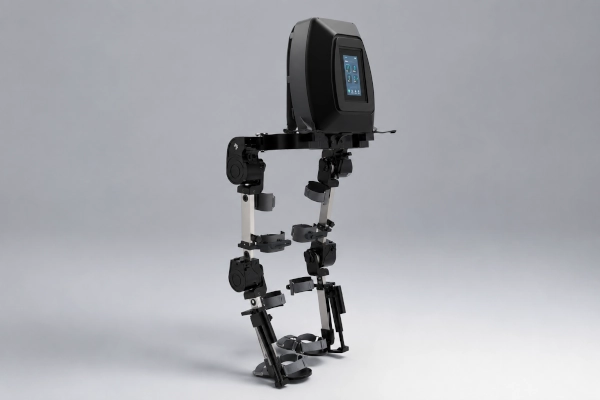
Kochi-based deep-tech company Astrek Innovations has developed UnikExo, an indigenous lower-limb robotic exoskeleton designed to assist patients undergoing gait rehabilitation. The wearable system combines powered robotics, motion tracking, sensors and machine-learning-based control to support repeated sitting, standing and walking movements during therapy.
UnikExo is designed primarily for hospitals, rehabilitation centres and assisted-mobility applications involving people with lower-limb movement impairments. Motors positioned around the lower body provide mechanical assistance to the legs, while sensors collect information about movement and gait. Astrek uses robotics, motion-capture data and machine-learning techniques to help the system deliver more adaptive rehabilitation support.
The company’s technology has been developed using several years of movement data collected from healthy individuals performing actions such as sitting, standing and walking. These data help train algorithms that recognise movement patterns and assist the exoskeleton in supporting a user’s gait during rehabilitation. The objective is not to replace physiotherapy, but to enable repeated and controlled gait training under professional supervision.
A major feature of UnikExo is its modular design. BIRAC officially describes the platform as a modular wearable robotic exoskeleton combining robotics, sensor-based motion tracking and intelligent control. The configuration is intended to reduce infrastructure requirements and make robotic rehabilitation more accessible than many imported systems, some of which can cost ₹1.5–2 crore.
The system is also designed to reduce dependence on upper-body strength. Conventional rehabilitation exoskeletons can require patients to support themselves with crutches or other equipment, which may limit usability for people with weak upper bodies. Astrek has worked on mechanical and support systems intended to reduce this burden while improving stability during assisted movement.
The technology has already progressed into clinical and rehabilitation-centre use. NITI Aayog’s Frontier Tech platform reported in July 2026 that more than 69 patients with stroke and spinal-cord injuries had undergone rehabilitation using Astrek’s robotic exoskeleton, while the technology had been adopted by around 18–19 rehabilitation centres, including facilities outside India. Astrek has also reported successful pilot trials of UnikExo at Rajagiri Hospital in Kochi.
Astrek’s broader development programme combines robotics with artificial intelligence and continuous data collection. The company says rehabilitation sessions can generate motion data that may be used to monitor patient progress and support increasingly personalised treatment protocols. Astrek has also joined the NVIDIA Inception programme as it works to integrate more advanced AI capabilities into future rehabilitation and assistive devices.
The development is significant for India because advanced rehabilitation robotics remains a relatively expensive area of medical technology, with much of the high-end equipment historically imported. An indigenous platform could lower costs, improve service availability and support the development of a domestic ecosystem combining robotics, biomechanics, AI and healthcare engineering.
You may also like
-
India Launches Indigenous iNDiC Underwater Systems for Military and Professional Diving
-
How India Built Its Own Rubidium Atomic Clock to Fix NavIC’s Most Critical Weakness
-
VEDA Aeronautics Develops Indigenous APAS Underwater Target and Decoy Vehicle
-
Enord Develops Indigenous AI Drones for GPS-Denied Environments
-
India Targets ₹3 Lakh Crore Defence Production and ₹50,000 Crore Exports by 2029
