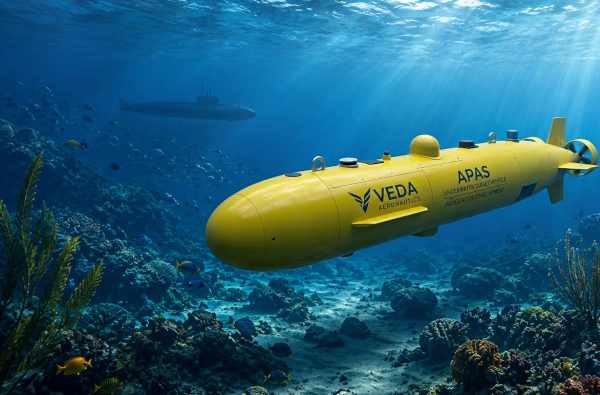
Indian defence technology company VEDA Aeronautics is expanding beyond aerial unmanned systems into the underwater domain with the development of an indigenous target and decoy vehicle intended for naval applications. Fresh reporting on September 1, 2026 identifies the platform as APAS, although detailed company specifications and formal nomenclature have not yet been published publicly.
The underwater programme itself predates the latest disclosure. VEDA Aeronautics Managing Director Dipesh Gupta confirmed during Milipol India 2025 that the company was designing an underwater decoy for the Navy, with the longer-term objective of evolving the technology into a miniature underwater attack drone. The September 2026 update therefore provides fresh visibility to an existing development programme rather than marking its original launch.
The initial platform is intended to function as an underwater target or decoy that could support naval training, anti-submarine warfare exercises and evaluation of underwater detection systems. Such vehicles can recreate aspects of a hostile subsurface threat without requiring an operational submarine to perform every training role, allowing sonar operators and naval platforms to practise detection, tracking and engagement procedures more economically.
The more significant long-term objective is VEDA’s plan to evolve the technology into a compact autonomous underwater attack platform. Such a transition would require considerably more sophisticated capabilities, including reliable underwater navigation, autonomous mission management, propulsion, energy storage and potentially terminal guidance or payload integration. The company has not yet disclosed the configuration, endurance, operating depth, speed or payload capacity of the proposed system.
Operating autonomously beneath the surface presents challenges very different from those faced by aerial drones. Conventional GPS and radio-frequency communications do not propagate effectively through seawater, requiring underwater vehicles to rely on technologies such as inertial navigation, acoustic communications, pre-programmed routes and other positioning methods. These constraints make autonomous underwater systems a demanding area of defence engineering.
VEDA has indicated that its underwater work draws on technologies developed through its broader experience with unmanned aircraft, swarm systems and long-range communications. The company is already active in aerial defence programmes, including the Sureshastra Mk-1 system associated with the Indian Air Force’s Meher Baba programme, canister-launched loitering munitions and hard-kill counter-drone technologies.
The move into underwater systems reflects a wider expansion of India’s private defence industry into autonomous maritime technologies. The Ministry of Defence’s iDEX programme itself has identified unmanned surface and underwater vehicles as an important technology area, including requirements for autonomous platforms capable of reconnaissance, defensive and offensive missions. Separate iDEX challenges have also sought intelligent underwater drone swarms capable of detecting mines and delivering payloads on the seabed.
For the Indian Navy, autonomous underwater vehicles could eventually support missions ranging from training and mine countermeasures to seabed surveillance, intelligence gathering and persistent monitoring of strategically important maritime areas. Their ability to undertake dangerous missions without putting crews at risk also makes them increasingly attractive as naval warfare becomes more autonomous and distributed.
Even at this early stage, the project is noteworthy because it demonstrates VEDA Aeronautics’ transition from predominantly airborne unmanned technologies toward a multidomain portfolio spanning aerial and underwater systems.
You may also like
-
BHEL Approves ₹500 Crore Expansion of Thermal and Nuclear Power Equipment Manufacturing at Haridwar
-
Reliance Building One of World’s Largest Battery Gigafactories in Jamnagar with 120 GWh Annual Capacity
-
HAL’s Indigenous Light Utility Helicopter Nears Final Certification, First 12 Deliveries Targeted for FY 2027–28
-
Tata Advanced Systems Reportedly Considering LAMV 4×4 Production in Morocco
-
Indian Navy Initiates Communication Systems Upgrade for Kamorta-Class Anti-Submarine Warfare Corvettes
