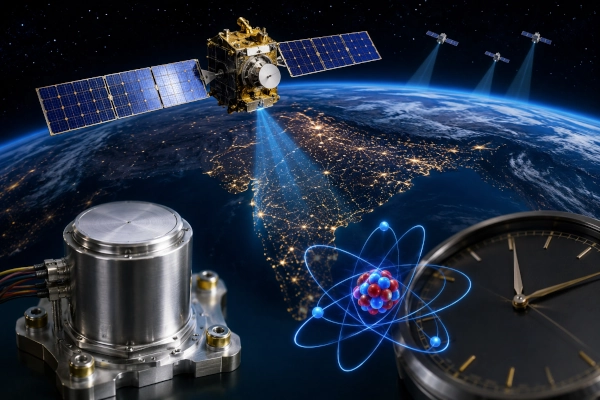
India’s NavIC satellite navigation system was conceived to give the country an independent source of positioning, navigation and precise timing without relying entirely on foreign constellations such as the American GPS. Yet, during the early years of the programme, one of the most important components inside the Indian satellites remained foreign: the extraordinarily precise rubidium atomic clocks that generate the timing reference on which satellite navigation fundamentally depends.
That dependence became a serious technological vulnerability when all three imported rubidium clocks aboard India’s first navigation satellite, IRNSS-1A, failed. The failures eventually forced ISRO to launch a replacement spacecraft and helped accelerate a much more difficult programme—developing a space-qualified atomic clock within India.
Years of research at ISRO’s Space Applications Centre in Ahmedabad eventually produced an indigenous rubidium atomic clock capable of operating aboard a navigation satellite. The technology reached its decisive milestone on May 29, 2023, when NVS-01, the first second-generation NavIC satellite, was launched carrying an Indian atomic clock for the first time. Subsequent in-orbit analysis showed that the indigenous clock’s performance was comparable with the imported clocks previously used by the programme.
The achievement represented far more than replacing an imported component. It gave India domestic control over one of the most specialised technologies required to operate an independent satellite-navigation system.
Why an Atomic Clock Is the Heart of a Navigation Satellite
Satellite navigation is fundamentally a measurement of time.
A NavIC satellite continuously broadcasts a navigation signal carrying extraordinarily precise information about when the signal was transmitted and where the satellite was located at that moment. A receiver compares the transmission time with the arrival time and uses the difference to estimate its distance from the satellite.
Because radio signals travel at the speed of light, even extremely small timing errors can translate into significant ranging errors. Navigation satellites therefore require clocks whose frequency remains exceptionally stable over long periods.
This is why rubidium atomic frequency standards are built into NavIC’s navigation payloads. Instead of depending simply on the mechanical or electronic oscillations used in ordinary clocks, an atomic clock uses the highly stable frequency associated with transitions in atoms as its reference. ISRO describes atomic frequency standards as the backbone of satellite-navigation technology and notes that their development requires expertise spanning atomic spectroscopy, microwave electronics, optics, microwave cavities, low-noise detection and digital electronics.
For a country seeking an independent navigation system, control of the atomic clock is therefore strategically comparable to control over the satellite’s navigation signal, propulsion or communication technologies.
NavIC Began With Imported Swiss Atomic Clocks
India’s first-generation IRNSS satellites were equipped with rubidium atomic clocks obtained from a Swiss supplier. Multiple clocks were carried aboard each satellite to provide redundancy because navigation timing is too important to depend upon a single unit.
The redundancy worked as intended when an individual clock encountered a problem: another could take over. The situation became much more serious when all available atomic clocks aboard the same spacecraft failed.
That is what happened to IRNSS-1A, launched on July 1, 2013 as the first satellite of the original Indian Regional Navigation Satellite System constellation.
All three rubidium atomic clocks aboard IRNSS-1A failed, leaving the spacecraft unable to perform its full navigation role even though many of its other systems remained functional. The satellite could still be used for one-way messaging applications, but it was effectively lost as a normal positioning satellite. The Department of Space officially confirmed the failure of all three clocks in 2018.
This demonstrated an important feature of satellite navigation: a spacecraft can remain alive in orbit while losing much of its usefulness for positioning if its precision timing system becomes unavailable.
ISRO Traced the Failure to a Tiny Electrical Component
The subsequent investigation produced an unusually specific explanation.
According to the Department of Space, detailed analysis and simulation traced the failures to a feed-through capacitor carrying DC electrical power to the clock’s physics package. The capacitor developed problems associated with an excessive increase in temperature.
The problem was therefore not simply a vague failure of “atomic-clock technology”. A comparatively small supporting component in the power path to the sensitive physics package undermined one of the most sophisticated instruments aboard the satellite.
ISRO introduced corrective measures into the refurbished clocks subsequently used for IRNSS-1I, which was launched on April 12, 2018 to replace IRNSS-1A. The government also noted that similar problems had occurred in atomic clocks supplied by the same company for Europe’s Galileo satellite-navigation constellation.
IRNSS-1I restored an important element of the constellation, but fixing an imported clock design did not eliminate India’s underlying dependence on foreign technology.
The more strategically important solution was to develop the clock itself.
Space Applications Centre Takes On the Challenge
ISRO’s Space Applications Centre, or SAC, in Ahmedabad became central to the indigenous atomic-clock programme.
Developing a rubidium atomic clock suitable for space is considerably harder than building a precision clock that works inside a laboratory. The complete unit must survive launch vibration, temperature variations, radiation and years of continuous operation in orbit while maintaining the frequency stability required for navigation.
The clock’s physics package must interact with radio-frequency and microwave electronics, optical components, heaters, detectors and extremely low-noise electronics. The output must then be integrated into the satellite’s timing and navigation payload without introducing instability capable of degrading positioning accuracy.
India therefore had to master not simply rubidium spectroscopy, but an entire chain of precision technologies required to transform an atomic transition into a reliable spacecraft timing reference.
ISRO has since identified atomic-clock technology as a continuing research field at SAC, including work on chip-scale atomic clocks, clock-frequency jumps, light-shift effects and even future trapped-ion clocks offering potentially greater stability for advanced navigation and deep-space applications.
India Also Developed the ‘Brain’ Managing the Atomic Clocks
The indigenous effort did not stop with the rubidium clock itself.
SAC also developed and qualified an indigenous Atomic Clock Monitoring Unit, or ACMU, which ISRO describes as the “brain” of the navigation satellite’s timing system.
The ACMU takes the output from the atomic clocks and generates the 10.23 MHz onboard master timing reference used by the navigation payload. It also monitors redundant clocks, allows switching between them and makes extremely fine corrections for frequency drift.
ISRO’s indigenous ACMU incorporates a high-isolation switching matrix, hybrid phase-locked-loop architecture, FPGA-based direct digital synthesis and an extremely sensitive phase-measurement system. According to ISRO, its phase meter has a noise floor of about three picoseconds at one second.
This means India was not merely replacing one imported box with another Indian box. It was progressively indigenising the broader precision-timing architecture that allows multiple onboard atomic clocks to function as a reliable navigation timing system.
ISRO estimates that the indigenous ACMU alone saves approximately ₹3 crore per navigation satellite. More importantly, it gives the organisation greater control over design changes, upgrades, qualification and long-term availability of a strategically sensitive subsystem.
NVS-01 Put the Indian Atomic Clock Into Space
The decisive test came with NVS-01, the first spacecraft in NavIC’s second-generation NVS series.
NVS-01 was launched aboard GSLV-F12 from Sriharikota on May 29, 2023. In addition to introducing an L1 navigation signal intended to improve compatibility with widely used civilian navigation receivers, the spacecraft carried an indigenously developed atomic clock for the first time in the history of NavIC.
Launching the clock was only the beginning. A laboratory-qualified component still had to prove that it could maintain the required stability after launch and continue functioning in the actual radiation and thermal environment of space.
ISRO subsequently subjected NVS-01’s atomic clock to extensive in-orbit characterisation. The agency’s 2024-25 Annual Report records that detailed analysis found the performance of the indigenous atomic clock to be comparable with the procured clocks.
That finding was arguably the most important technical validation of the entire programme.
India had moved from depending on imported space-qualified atomic clocks to demonstrating an indigenous alternative in orbit whose performance met the demanding requirements of satellite navigation.
The Move to Indigenous Clocks Is Gradual
India has not immediately eliminated all imported atomic clocks from NavIC.
The second NVS-series spacecraft, NVS-02, was designed with a combination of indigenous and procured atomic clocks. ISRO explicitly described this mixed configuration as being used for precise time estimation.
A gradual transition is understandable in a system where timing reliability is mission-critical. Maintaining diverse and redundant clocks during the transition provides additional operational assurance while the indigenous technology builds a longer flight heritage.
The broader direction, however, is clear. A Parliamentary Committee reviewing NavIC in 2026 welcomed ISRO’s indigenous atomic-clock achievement and recommended a complete transition to indigenous atomic clocks at the earliest possible stage in order to minimise dependence on foreign suppliers.
The Department of Space has likewise identified the induction of indigenous space-grade atomic clocks as part of its roadmap for strengthening NavIC and increasing technological self-reliance.
IRNSS-1F Shows Why Clock Reliability is Important
The importance of the programme was demonstrated again in March 2026.
IRNSS-1F, launched on March 10, 2016, completed its designed ten-year mission life on March 10, 2026. Three days later, ISRO announced that its procured onboard atomic clock had stopped functioning.
The spacecraft itself remained operational and could continue supporting one-way broadcast messaging services, but it could no longer contribute normally to NavIC’s positioning, navigation and timing constellation.
The circumstances differ significantly from IRNSS-1A. IRNSS-1F’s clock stopped only after the spacecraft had completed its planned ten-year mission life, while IRNSS-1A suffered premature failures. Nevertheless, the event again illustrated how the condition of an atomic clock can determine whether an otherwise functioning satellite remains useful for precision navigation.
Why Indigenous Timing Technology Matters Strategically
Navigation satellite systems have both civilian and strategic importance.
NavIC supports or is being integrated into applications including real-time train tracking, fishing-vessel communication, transportation, telecommunications, power-grid synchronisation and mobile devices. The Armed Forces also use NavIC as part of multi-constellation GNSS solutions.
Dependence on a foreign supplier for a component as critical as an atomic clock therefore creates more than a procurement inconvenience. Export restrictions, geopolitical tensions, manufacturer decisions or supply-chain disruption could potentially affect the ability to replace or expand a sovereign navigation constellation.
Domestic clock technology gives India control over production, modification, qualification and future development.
It also creates a technological foundation for applications beyond NavIC. Highly stable atomic frequency standards have relevance to national timekeeping, telecommunications, scientific measurement, financial networks and future deep-space navigation.
ISRO is already researching more advanced clock technologies, including chip-scale atomic clocks and trapped mercury-ion concepts that could eventually offer significantly better stability than conventional rubidium systems.
From Imported Clocks to an Indian Timing Ecosystem
The story of NavIC’s atomic clocks illustrates how technological self-reliance often develops in practice.
India did not begin NavIC with every critical subsystem already indigenous. It built the constellation using the best technologies available, including imported rubidium clocks, and then encountered a failure that exposed an important strategic vulnerability.
The immediate response was engineering: investigate the failure, identify the problematic component, modify the clocks and launch a replacement satellite.
The longer-term response was technological: develop India’s own atomic frequency standard and the electronics required to monitor and control it.
That effort culminated in NVS-01 carrying an indigenous atomic clock into orbit in 2023. Subsequent in-orbit testing showed that its performance was comparable with the foreign clocks it was intended eventually to replace.
The achievement is especially important because atomic clocks belong to a class of technologies where reliability is measured over years rather than during a single demonstration. The real success of India’s programme will consequently be determined as indigenous clocks accumulate longer operational histories across successive NVS satellites.
Turning a Failure Into Strategic Capability
The premature atomic-clock failures aboard IRNSS-1A represented one of the most serious setbacks during NavIC’s early development. All three clocks were lost, a replacement launch was required and the weakness of depending on a foreign supplier for one of the constellation’s most critical components became impossible to ignore.
Yet the failure also created a powerful incentive for indigenisation.
ISRO’s Space Applications Centre subsequently mastered the complex combination of atomic physics, microwave engineering, optics, precision electronics and spacecraft qualification required to build a rubidium atomic clock in India. It also developed the indigenous Atomic Clock Monitoring Unit that controls and disciplines the timing system aboard the satellite.
When NVS-01 entered orbit with an Indian atomic clock, NavIC crossed an important technological threshold. India was no longer merely operating an indigenous navigation constellation using imported precision timing at its core; it had demonstrated the ability to manufacture one of the fundamental technologies on which the constellation depends.
NavIC still faces the immediate challenge of rebuilding enough operational satellites to restore robust standalone positioning. The indigenous clock does not by itself solve that constellation-level problem. What it does solve is equally important for the long term: India now possesses its own space-qualified atomic-clock technology instead of remaining completely dependent on foreign suppliers for the heartbeat of its navigation satellites.
That transformation—from an imported component whose failure weakened the constellation to an indigenous technology proven in orbit—is one of the less visible but strategically important achievements of India’s space programme.
You may also like
-
TDB Backs Panacea Medical Technologies to Develop Indigenous 32-Slice CT Scanner in Karnataka
-
India Reportedly Offers Mine-Protected Vehicles to Kenya to Strengthen Defence Cooperation
-
Sigma Advanced Systems and Munitions India Sign MoU for Indigenous 155mm Course-Correction Fuzes
-
Rolls-Royce and Reliance Advance Indigenous 120 kN AMCA Engine Plans with Focus on Indian Design and Manufacturing
-
Ministry of Defence Signs ₹4,106 Crore Contracts for GSAT-7C Satellite and Varunastra Torpedoes
