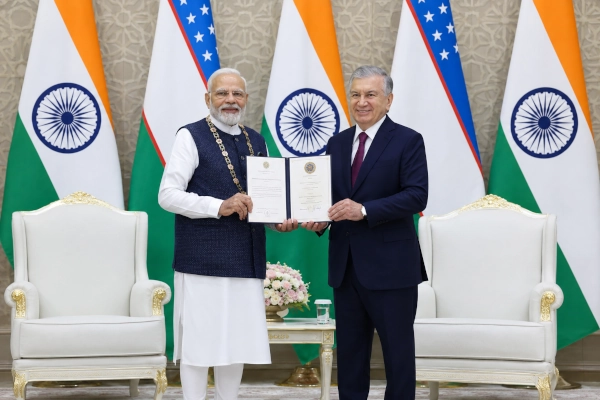
Prime Minister Narendra Modi has been conferred the “Oliy Darajali Do’stlik” Order, or Order of Highest Friendship, Uzbekistan’s highest honour for foreign leaders, in recognition of his contribution to strengthening friendship and cooperation between India and Uzbekistan.
The prestigious decoration was presented by Uzbekistan President Shavkat Mirziyoyev on 30 August 2026 during Prime Minister Modi’s State Visit to the Central Asian country. The honour comes at a significant moment in bilateral relations, with India and Uzbekistan also elevating their ties to a Comprehensive Strategic Partnership during the visit.
Accepting the decoration, Prime Minister Modi dedicated the honour to the 1.4 billion people of India, describing it as a symbol of the enduring friendship between the peoples and civilisations of India and Uzbekistan.
Uzbekistan’s Highest Honour for Foreign Leaders
The “Oliy Darajali Do’stlik” Order represents the highest Uzbek honour bestowed on foreign leaders and recognises outstanding contributions towards strengthening friendship, cooperation and relations with Uzbekistan.
The conferment on Prime Minister Modi reflects the considerable expansion of India-Uzbekistan engagement in recent years and the close political understanding that has developed between New Delhi and Tashkent.
President Mirziyoyev presented the award in recognition of the Prime Minister’s contribution to strengthening the friendship between the two nations, giving the honour significance beyond the individual decoration itself. It serves as a formal acknowledgement of the increasingly close relationship between India and one of Central Asia’s most important countries.
Modi Dedicates Honour to 1.4 Billion Indians
Prime Minister Modi dedicated the award to India’s 1.4 billion people and said it represented the enduring friendship between India and Uzbekistan and their respective civilisations.
Referring to President Mirziyoyev’s words of appreciation, Modi said they should be seen as a tribute to the age-old friendship between India and Uzbekistan and their shared heritage.
The Prime Minister also placed the honour within a wider international context, saying it brought an additional responsibility for India to work together with Uzbekistan as partners of the Global South for the betterment of humanity.
The remarks highlighted an increasingly prominent theme in India’s foreign policy: building stronger partnerships among developing countries while seeking greater representation and influence for the Global South within international institutions and decision-making structures.
Honour Comes as Bilateral Relationship Is Upgraded
The award assumes additional significance because it was presented during a visit in which India and Uzbekistan decided to elevate their relationship from a Strategic Partnership to a Comprehensive Strategic Partnership.
The upgrade represents a major political milestone and signals the intention of both governments to deepen cooperation across a much wider range of areas.
Prime Minister Modi’s visit produced agreements and initiatives covering geology and mineral resources, economic and financial cooperation, higher education, scientific research, Ayurveda and traditional medicine, environmental protection, tourism, cultural exchanges, archival cooperation and diplomatic training.
India also announced a USD 1 million grant for afforestation in the Aral Sea region, while the two sides moved forward with digital-payments connectivity through an agreement enabling Indian UPI applications to interact with Uzbekistan’s national UZQR merchant-payment network.
The visit therefore combines high-level political symbolism with practical mechanisms intended to deepen economic, technological and people-to-people ties.
An Ancient Relationship Across Central Asia
India and Uzbekistan share connections extending far beyond the establishment of modern diplomatic relations.
For centuries, Central Asia formed an important bridge between the Indian subcontinent and the wider Eurasian world. Merchants, scholars, monks, travellers and political communities moved across the routes connecting northern India with regions corresponding to present-day Uzbekistan.
The Buddhist heritage of ancient Termez, the historic Silk Road cities of Samarkand and Bukhara, and centuries of cultural exchanges demonstrate the depth of these interactions.
This civilisational dimension was reflected during Modi’s visit through India’s decision to cooperate in the conservation and restoration of the ancient Buddhist sites of Fayaz Tepa and Kara Tepa in Termez.
The two countries also agreed on cultural and archival cooperation, while India announced an ICCR Sanskrit Chair at the Tashkent State University of Oriental Studies and 100 Lal Bahadur Shastri Scholarships for Hindi-language studies.
Together, these initiatives reinforce the historical and cultural foundations underlying the modern strategic partnership.
Lal Bahadur Shastri and the Special Tashkent Connection
Uzbekistan occupies a particularly distinctive place in India’s modern diplomatic history because of former Prime Minister Lal Bahadur Shastri’s association with Tashkent.
Shastri travelled to the then-Soviet Uzbek capital for negotiations following the 1965 India-Pakistan war and signed the Tashkent Declaration in January 1966. He died in Tashkent shortly afterwards.
His memory continues to form an important emotional link between India and Uzbekistan. Prime Minister Modi’s visit therefore carries not only contemporary diplomatic significance but also echoes one of the defining episodes of India’s twentieth-century foreign relations.
The announcement of 100 scholarships bearing Lal Bahadur Shastri’s name further connects this historical legacy with future generations of Uzbek students studying Hindi and Indian culture.
Uzbekistan Central to India’s Engagement with Central Asia
Uzbekistan occupies a pivotal geographical and political position in Central Asia. It is the region’s most populous country and shares borders with all four other Central Asian republics as well as Afghanistan.
For India, stronger relations with Uzbekistan form part of the broader effort to deepen engagement with Central Asia through political dialogue, economic partnerships, energy and mineral cooperation, capacity building, education, culture and connectivity.
India and Uzbekistan also share interests in regional stability and in strengthening cooperation among countries of the Global South.
The expansion of bilateral engagement into areas such as critical minerals, digital payments, environmental restoration and scientific research demonstrates how the relationship is gradually acquiring a more contemporary economic and technological dimension alongside its historical foundations.
Symbol of a Deepening India-Uzbekistan Partnership
The conferment of the “Oliy Darajali Do’stlik” Order represents both a personal honour for Prime Minister Modi and a broader diplomatic gesture towards India.
Coming alongside the establishment of the India-Uzbekistan Comprehensive Strategic Partnership, the award reflects the political importance Tashkent attaches to its relationship with New Delhi and the growing institutional depth of bilateral cooperation.
India and Uzbekistan are increasingly combining their centuries-old cultural links with new partnerships in trade, technology, minerals, education, digital infrastructure and sustainable development.
By dedicating Uzbekistan’s highest honour for foreign leaders to the people of India, Prime Minister Modi framed the decoration not merely as an individual recognition but as a symbol of the friendship between two countries whose connections stretch from the ancient routes of Central Asia to a rapidly expanding twenty-first-century strategic partnership.
Source: PIB: https://www.pib.gov.in/PressReleaseDetail.aspx?PRID=2304717®=48&lang=1
You may also like
-
India–Chile CEPA Negotiations Advance as Both Sides Target Conclusion by Year-End
-
India and Uzbekistan Forge Comprehensive Strategic Partnership, Expand Cooperation In Multiple Sectors
-
India and Uzbekistan Elevate Ties to Comprehensive Strategic Partnership, Sign Wide-Ranging Agreements
-
India Advances Overseas Lithium Strategy as KABIL Completes Phase-II Drilling in Argentina
-
India and Denmark Deepen MSME Cooperation With Focus on Innovation, Technology and Startups
