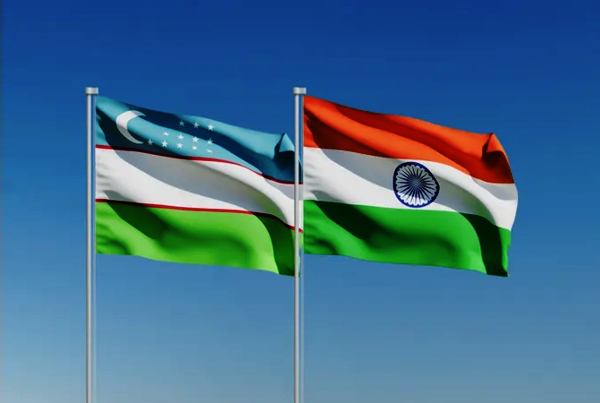
India and Uzbekistan have elevated their bilateral relationship to a Comprehensive Strategic Partnership, marking a significant expansion of cooperation across economic, cultural, technological, educational, environmental and people-to-people domains.
The announcement came during Prime Minister Narendra Modi’s State Visit to Uzbekistan, with the two countries concluding a broad package of agreements covering critical minerals, economic and financial cooperation, higher education, Ayurveda, tourism, cultural heritage, archives, environmental protection and diplomatic training.
The visit also produced several important announcements, including a USD 1 million Indian grant for afforestation in the Aral Sea region, 100 scholarships for the study of Hindi, the establishment of an ICCR Sanskrit Chair in Tashkent, and a commercial arrangement that will enable Indian UPI applications to make merchant payments through Uzbekistan’s national QR infrastructure.
Together, the outcomes underline the steadily widening scope of the India-Uzbekistan partnership, which is moving beyond traditional diplomatic engagement towards deeper economic integration, institutional cooperation, cultural connectivity and technology-enabled links between the two countries.
Partnership Elevated to Comprehensive Strategic Level
The most politically significant outcome of the visit was the decision to elevate the existing India-Uzbekistan Strategic Partnership to a Comprehensive Strategic Partnership.
The upgraded framework reflects the expanding depth of bilateral engagement and is expected to provide greater political momentum to cooperation in trade, investment, connectivity, defence, energy, technology, education and regional affairs.
India and Uzbekistan have traditionally maintained close historical and cultural links, reinforced in recent years by regular high-level exchanges and growing engagement between government institutions, businesses and academic organisations. The latest elevation signals an intention by both sides to develop a more structured and multidimensional relationship.
India and Uzbekistan Expand Cooperation in Geology and Mineral Resources
One of the strategically important agreements signed during the visit concerns cooperation in geology and mineral resources.
India’s Ministry of Mines and Uzbekistan’s Ministry of Mining Industry and Geology concluded a Memorandum of Understanding aimed at strengthening collaboration in the geological and mineral sectors.
Uzbekistan possesses substantial reserves of minerals including gold, copper, uranium and several other resources of industrial importance. India, meanwhile, is seeking to diversify overseas mineral partnerships as domestic demand rises for materials required by the manufacturing, energy, infrastructure, electronics and clean-technology sectors.
The agreement creates an institutional framework through which the two countries can explore cooperation in geological studies, mineral exploration, resource assessment, mining technologies and associated technical capabilities.
Economic and Financial Dialogue Institutionalised
India and Uzbekistan also signed an MoU establishing an Economic and Financial Dialogue between India’s Ministry of Finance and Uzbekistan’s Ministry of Economy and Finance.
The mechanism is expected to strengthen regular engagement between the financial and economic authorities of both countries and could support closer discussions on investment, financial cooperation, economic policy and bilateral commercial opportunities.
Institutionalising such a dialogue is particularly significant as both governments seek to expand economic ties beyond conventional merchandise trade and create stronger links involving investment, financial services, infrastructure and private-sector participation.
UPI Connectivity Takes a Major Step Forward in Uzbekistan
A major digital-payments outcome of the visit was a commercial agreement between NPCI International Payments Limited and Uzbekistan’s National Interbank Processing Centre JSC.
The arrangement will allow Indian UPI applications to scan Uzbekistan’s national UZQR codes for merchant payments.
Once operational, the system could enable Indian travellers to use supported UPI applications at participating Uzbek merchants without relying exclusively on cash or conventional payment cards.
The development extends India’s growing international digital-payments footprint and demonstrates how India’s domestic public digital infrastructure is increasingly being connected with payment ecosystems overseas.
Uzbekistan is also becoming an increasingly important tourism and business destination for Indians, making interoperability between UPI applications and the country’s national QR infrastructure especially relevant for travellers.
Ayurveda and Traditional Medicine Enter Bilateral Cooperation Framework
India and Uzbekistan signed an MoU on cooperation in Ayurveda and other traditional systems of medicine, opening another area of institutional engagement between the two countries.
The agreement could support collaboration in education, research, training, knowledge exchanges and the wider promotion of traditional medical systems.
Ayurveda has increasingly become part of India’s international cultural and healthcare outreach, with New Delhi establishing cooperation mechanisms with several countries involving traditional medicine, wellness, training and research.
For Uzbekistan, where historical exchanges with India stretch back through centuries of Central Asian cultural interaction, the agreement adds a contemporary institutional dimension to those connections.
Higher Education and Scientific Research Cooperation Strengthened
Another MoU establishes cooperation between India and Uzbekistan in the field of higher education and scientific research.
The agreement could facilitate stronger links between universities, research institutions, students and academic communities in both countries.
India and Uzbekistan have already developed growing educational ties, particularly in fields including medicine, technology and professional education. A formal higher-education framework provides greater scope for academic exchanges, joint research, institutional partnerships and potentially greater mobility for students and researchers.
The agreement is particularly relevant as both countries seek to build stronger knowledge economies and expand cooperation in science, technology and innovation.
Sanskrit Chair to Be Established in Tashkent
India announced the establishment of an Indian Council for Cultural Relations Sanskrit Chair at the Tashkent State University of Oriental Studies.
The initiative will strengthen academic study of Sanskrit and Indian civilisation in Uzbekistan, which has a long tradition of scholarship relating to South Asia, languages and Oriental studies.
The Sanskrit Chair adds an important civilisational dimension to bilateral relations and complements wider efforts to strengthen academic and cultural links.
It also places Sanskrit alongside other areas of Indian studies that have developed considerable interest in Central Asian academic institutions.
100 Lal Bahadur Shastri Scholarships for Hindi
India also announced 100 Lal Bahadur Shastri Scholarships for the Hindi language, providing another significant boost to educational and cultural exchanges.
The scholarship programme carries particular symbolism in Uzbekistan because former Indian Prime Minister Lal Bahadur Shastri died in Tashkent in January 1966, shortly after signing the Tashkent Declaration.
His association with the city remains an important part of India-Uzbekistan historical relations, and the scholarships link that legacy with the promotion of Hindi language learning among Uzbek students.
India to Help Conserve Ancient Buddhist Sites at Termez
Cultural heritage cooperation received a major boost with the signing of a Letter of Intent for the conservation and restoration of the ancient Buddhist sites of Fayaz Tepa and Kara Tepa at Termez.
The agreement brings India’s Ministry of External Affairs together with Uzbekistan’s Cultural Heritage Agency for conservation work at two important archaeological sites associated with the ancient Buddhist heritage of Central Asia.
Termez was historically situated along important cultural and commercial routes linking India with Central Asia. The Buddhist archaeological remains in and around the region testify to the movement of monks, merchants, ideas and artistic traditions across these routes.
Indian participation in conservation efforts therefore represents more than a technical heritage project. It also reflects the deep historical connections that existed between the Indian subcontinent and Central Asia centuries before the emergence of modern nation-states.
Cultural Exchange Programme for 2026-30
India and Uzbekistan adopted a new Cultural Exchange Programme covering 2026-2030, providing a multi-year framework for cultural cooperation.
Such programmes typically facilitate exchanges involving artists, cultural institutions, exhibitions, performing arts, heritage, literature and other areas of cultural engagement.
The four-year arrangement is expected to provide greater continuity to people-to-people ties and encourage cultural organisations from both countries to establish sustained partnerships.
Archives Cooperation to Preserve Historical Connections
The National Archives under India’s Ministry of Culture and Uzbekistan’s Uzarchive Agency also signed an MoU on cooperation in archival work.
The arrangement could support exchanges relating to archival management, conservation, digitisation, historical records and professional expertise.
India and Uzbekistan share extensive historical connections involving trade, diplomacy, migration and cultural interaction, meaning that archival cooperation could also contribute to deeper academic research into the long history of Indo-Central Asian relations.
Tourism Partnership for 2026-28
The two governments concluded a 2026-28 tourism cooperation programme between India’s Ministry of Tourism and Uzbekistan’s Tourism Committee.
Tourism between the two countries has considerable potential because of improving air connectivity, historical links and growing Indian interest in Central Asian destinations such as Tashkent, Samarkand, Bukhara and Khiva.
The agreement can support tourism promotion, exchanges between industry organisations, development of travel circuits and broader cooperation between tourism authorities.
Uzbekistan’s Islamic, Persianate, Silk Road and Central Asian heritage also attracts Indian visitors, while India’s cultural, spiritual, medical and leisure tourism sectors offer opportunities for increased Uzbek travel to India.
India Announces USD 1 Million for Aral Sea Afforestation
India announced a USD 1 million grant for afforestation in the Aral Sea region, adding an environmental and climate-resilience dimension to the bilateral partnership.
The ecological degradation of the Aral Sea is one of Central Asia’s most serious environmental challenges. The dramatic contraction of the water body over several decades has left extensive exposed seabed and contributed to dust storms, soil degradation and associated environmental pressures.
Afforestation and vegetation programmes are being undertaken across parts of the former seabed to reduce wind erosion and stabilise exposed areas.
India’s financial contribution therefore represents a targeted form of environmental cooperation with direct relevance to one of Uzbekistan’s most important ecological challenges.
Environmental Protection Cooperation Formalised
India’s Ministry of Environment, Forest and Climate Change and Uzbekistan’s National Committee on Ecology and Climate Change signed an agreement on cooperation in environmental protection.
The framework complements the Aral Sea announcement and could support exchanges involving environmental management, climate action, biodiversity, pollution control, restoration and other areas of ecological policy.
Environmental cooperation is becoming an increasingly important element of India’s partnerships with Central Asian countries as they confront challenges relating to water stress, desertification, climate change and fragile ecosystems.
Gujarat and Samarkand Establish Regional Partnership
A cooperation agreement was also concluded between the Indian state of Gujarat and Uzbekistan’s Samarkand region for the establishment of partnership relations.
Sub-national cooperation can create direct connections between regional administrations and potentially support business, tourism, culture, education and investment.
Samarkand is one of Uzbekistan’s most prominent historical and economic centres, while Gujarat is one of India’s leading industrial and commercial states. A structured Gujarat-Samarkand partnership could therefore create opportunities extending beyond ceremonial cultural exchanges.
Diplomatic Training Institutions Build Direct Links
India’s Sushma Swaraj Institute of Foreign Service and the Diplomatic Academy at Uzbekistan’s University of World Economy and Diplomacy also signed an MoU.
The agreement strengthens institutional cooperation between the organisations responsible for diplomatic education and professional training in the two countries.
Such collaboration can involve exchanges of diplomats, training programmes, lectures, academic engagement and sharing of expertise on diplomacy and international affairs.
It also contributes to long-term relationship-building by creating direct professional connections between future generations of Indian and Uzbek diplomats.
A Broader India-Central Asia Partnership
The outcomes of Prime Minister Modi’s Uzbekistan visit demonstrate how India is steadily deepening its engagement with Central Asia through a combination of political dialogue, connectivity, commerce, technology, education and cultural diplomacy.
Uzbekistan occupies a particularly important position within this engagement because of its population, geographic location, economic potential and historical role at the heart of Central Asian trade and cultural networks.
The agreements announced during the visit also illustrate the changing nature of India-Uzbekistan relations. Traditional cultural and historical connections remain important, but they are increasingly being complemented by cooperation in digital payments, minerals, finance, scientific research and environmental sustainability.
The decision to elevate bilateral relations to a Comprehensive Strategic Partnership provides an overarching framework for this expansion.
With new mechanisms now covering fields ranging from UPI payments and mineral resources to Buddhist heritage conservation, Ayurveda, higher education and Aral Sea restoration, India and Uzbekistan are laying the institutional foundations for a relationship that is broader, more practical and more closely connected to the economic and technological priorities of both countries.
You may also like
-
India and Ethiopia Move to Strengthen Strategic Partnership as Jaishankar Arrives in Addis Ababa
-
India and Russia Explore New Defence Co-Production and Joint Technology Development Opportunities
-
India and Côte d’Ivoire Move to Strengthen Defence, Counterterrorism and Economic Cooperation
-
India and Ghana Expand Agricultural Partnership Through New ICAR–CSIR-CRI Agreement
-
India Hands Over Three Tonnes of Anti-Tuberculosis Medicines to Sri Lanka
