GI Produce of India — 15
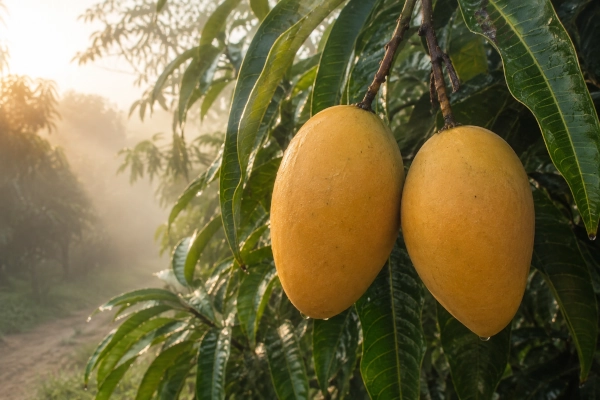
In the historic landscape of Govindgarh near Rewa, where the Vindhyan country opens across the Kymore Plateau, grows one of central India’s most distinctive mangoes. Rewa Sunderja Mango is celebrated for its attractive golden-yellow appearance, rich aroma, sweet and nearly fibreless pulp, substantial fruit size and an eating quality that has made it one of Madhya Pradesh’s most valued indigenous mango cultivars.
For generations, Sunderja remained particularly associated with Govindgarh and the former princely state of Rewa. The Rewa Divisional administration continues to describe Govindgarh, historically the summer capital of Rewa’s rulers and popularly known as “Mini Vrindavan,” as a place famous for its Sunderja mangoes.
The mango entered India’s protected geographical-indication system when Rewa Sunderja Mango received GI registration on 31 January 2023. The registration formally connected the celebrated cultivar with Madhya Pradesh and provided growers with a legal framework through which its geographical reputation could be protected and developed.
Govindgarh — The Historic Home of Sunderja
The geographical heart of the Sunderja story is Govindgarh, situated a short distance from Rewa city. The town was historically associated with the rulers of Rewa and served as their summer capital, while the surrounding landscape developed a strong reputation for mango cultivation that eventually became inseparable from the Sunderja name.
Govindgarh lies within the broader Kymore or Kaimur Plateau region, an eastern extension of the Vindhyan landscape. The combination of plateau soils, hot summers, comparatively cool winters and a pronounced seasonal rainfall cycle created conditions under which mango cultivation became well established, while generations of growers learned how individual cultivars responded to this central Indian environment.
GI-related documentation describes Sunderja as a local mango of the Kymore Plateau originating at Govindgarh. Although the cultivar is now recognised under the broader geographical indication “Rewa Sunderja Mango,” Govindgarh remains the place most strongly associated with its historical identity and reputation.
A Mango Connected With the Royal House of Rewa
The origin of Sunderja is closely linked in regional horticultural tradition with the royal establishment of Rewa. Documentation prepared on Madhya Pradesh’s geographical indications associates its development with Maharaja Venkat Raman Singh of Rewa, describing the cultivar as the result of selection or crossing of mango material at Govindgarh during the princely period.
Different popular accounts occasionally assign slightly different dates or royal personalities to the mango’s origin, so an exact year should be treated cautiously unless supported by archival evidence. What is much more securely established is that Sunderja has been associated with the Govindgarh-Rewa landscape since the late nineteenth-century princely era and subsequently became one of the region’s recognised horticultural treasures.
The royal connection also helps explain why an exceptional local mango could be preserved and multiplied rather than disappearing with one individual tree. Princely gardens and estate orchards historically maintained collections of superior fruit trees, while grafting allowed desirable selections to be carried into additional orchards and eventually into ordinary farmer production.
How Sunderja Got Its Beautiful Name
The name Sunderja is traditionally connected with the Hindi word sundar, meaning beautiful. This interpretation is consistent with one of the cultivar’s most immediately recognisable characteristics: ripe fruit develops an attractive golden-yellow appearance, sometimes accompanied by a reddish or warm-coloured shoulder.
The name therefore reflects more than sweetness alone. Mango cultivars were often remembered through an outstanding characteristic, a person, a locality or a story, and Sunderja appears to have acquired its identity partly from the visual impression made by a well-ripened fruit.
That attractiveness remains commercially important today because mango purchasing begins with appearance long before the consumer tastes the pulp. Sunderja combines visual distinction with strong internal fruit quality, allowing the name “beautiful” to remain appropriate more than a century after the cultivar first acquired its reputation.
The Golden Mango of Rewa
At maturity, Sunderja develops a striking transition from the greener appearance of an immature mango towards bright yellow or golden coloration. Research and horticultural descriptions also record reddish colouring around the shoulder in well-developed fruit, giving premium specimens an especially attractive presentation.
The fruit is comparatively large. Long-term evaluation at the Fruit Research Station at Rewa recorded an average Sunderja fruit weight of approximately 298.6 grams, placing it above many conventional medium-sized table cultivars examined in the same trial.
Other morphological assessments describe the fruit at roughly 12 centimetres in length and about 8 centimetres in width, giving it a substantial elongated-oval profile. The combination of attractive colour, generous size and pronounced aroma helps explain why Sunderja became a successful exhibition mango as well as a locally prized table fruit.
Rich Pulp With Very Little Fibre
Sunderja’s strongest quality appears after the fruit is opened. NABARD’s current Rewa planning documentation describes the variety as particularly desirable because of its distinctive aroma, sweetness and absence of fibrous strands, characteristics that give the pulp a smooth eating texture.
Horticultural evaluation has placed the edible pulp proportion at roughly 72 to 73 per cent of the fruit, with the remainder distributed between peel and stone. Research comparing cultivars in the Kymore Plateau recorded Sunderja pulp at about 72.52 per cent, reinforcing its reputation as a mango with a generous quantity of edible flesh.
The relatively smooth pulp makes Sunderja particularly suitable for fresh consumption because the consumer is not left with the coarse fibres found in some seedling and processing varieties. The same characteristic also gives the fruit potential for beverages, desserts and pulp-based products where a smooth texture is commercially desirable.
Sweetness, Aroma and the Sunderja Flavour
Scientific evaluation gives useful context to Sunderja’s celebrated sweetness. Research conducted in Rewa recorded total soluble solids of about 22.23° Brix, placing the cultivar among the sweeter mangoes evaluated under Kymore Plateau conditions and very close to Langra in the same comparative study.
Brix does not describe mango flavour completely because sweetness interacts with acidity, aroma compounds and texture. Sunderja’s reputation comes from the way these characteristics combine, producing a mango that is sweet yet aromatic rather than tasting simply of concentrated sugar.
The lingering fragrance is particularly important to experienced consumers. A good Sunderja develops an aroma strong enough to distinguish it from ordinary market mangoes, while its smooth pulp and balanced sweetness complete the sensory character for which Govindgarh became famous.
The “Low-Sugar Mango” Claim Needs Caution
Sunderja is frequently promoted in popular and regional material as a low-sugar or diabetes-friendly mango, and this claim has become part of the modern publicity surrounding the variety. However, it should not be interpreted to mean that Sunderja is sugar-free or that people with diabetes can consume unlimited quantities without considering their overall carbohydrate intake.
Scientific fruit-quality studies have recorded Sunderja at around 22.23° Brix, demonstrating that ripe fruit contains substantial soluble sugars along with other dissolved solids. The cultivar may possess a particular sugar-acid profile, but available horticultural data do not justify treating it as a medically “sugar-free mango.”
The more defensible description is that Sunderja possesses a distinctive sweetness and sugar profile that has generated a traditional reputation for being comparatively suitable for some consumers. Any dietary recommendation for diabetes, however, belongs within individual nutritional or medical guidance rather than geographical-indication marketing.
The Fruit Research Station at Rewa
Sunderja benefits from something many traditional mango cultivars lack: decades of scientific evaluation within its home region. The Fruit Research Station at Kuthulia, College of Agriculture, Rewa, has maintained Sunderja trees and used the cultivar in studies examining growth, yield, fruit quality and nutrient management.
A long-term trial covering seasons from 2010–11 to 2019–20 compared Sunderja with commercial cultivars and hybrids under Kymore Plateau conditions. Sunderja recorded the highest mean fruit yield in the trial at approximately 56.44 kilograms per tree, while average fruit weight reached around 298.6 grams and TSS measured 22.23° Brix.
These results are important because they show that Sunderja is not merely a heritage mango valued for nostalgia. Under appropriate management, it combines desirable eating quality with commercially meaningful productivity, giving the cultivar potential for wider organised cultivation within its recognised geographical landscape.
Nutrient Management Can Improve the Crop
Research at Rewa has also investigated how orchard nutrition influences Sunderja. A study on mature trees found that integrated nutrient-management treatments affected fruit yield, soluble solids and storage life, demonstrating that even a traditional cultivar can respond significantly to improved scientific management.
The research found that certain combinations involving organic manures, beneficial microorganisms and balanced nutrients improved aspects of fruit performance. Some treatments also extended room-temperature storage beyond fifteen days, compared with substantially shorter storage in the conventional control treatment.
This creates an important opportunity for GI growers. The objective does not need to be replacing traditional orchard knowledge with intensive chemical production; instead, soil testing, organic matter, balanced nutrition and carefully chosen biological inputs can improve productivity while preserving the characteristics associated with Sunderja.
The Kymore Plateau Climate
The Sunderja mango is adapted to the subtropical conditions of the Rewa region. GI-related documentation describes favourable growth temperatures broadly in the low-to-upper twenties Celsius and emphasises the importance of suitable soil drainage, organic matter and seasonal rainfall.
Winter conditions influence flowering, while the increasingly hot months of spring drive fruit development. Excessive frost can damage mango trees, particularly young plants, while severe heat and moisture stress can affect fruit set and final quality if trees cannot access sufficient soil moisture.
Rainfall near maturity can sometimes help fruit size and development, although heavy or untimely rain can also create disease and harvesting problems. Sunderja therefore reflects the seasonal rhythm of central India, where winter, summer and monsoon conditions interact strongly with the annual mango cycle.
Soil Beneath the Govindgarh Orchards
GI-related material describes well-drained alluvial or fertile loamy soils with organic matter and a moderately neutral pH as particularly suitable for Sunderja cultivation. Govindgarh and the wider Vindhyan-Kymore landscape contain local variations in soil depth and composition, meaning successful orchards depend upon drainage and site selection as much as broad regional geography.
Mature mango trees develop extensive root systems capable of exploring a considerable volume of soil. Once established, they can tolerate seasonal dryness much better than young grafts, but prolonged waterlogging remains damaging because mango roots require aerated soil.
Organic matter is especially useful because it improves soil structure, moisture retention and biological activity. Modern nutrient research on Sunderja reinforces the value of combining mineral nutrition with farmyard manure, vermicompost or beneficial microorganisms rather than depending upon a single nutrient source.
The Mango Season at Rewa
Horticultural descriptions generally place Sunderja maturity around the late-May to early-summer period, although local weather can shift the harvest from one season to another. Scientific literature describing the cultivar notes maturity during the closing part of May, while regional accounts often associate the best fruit with the period around the first summer rains.
Harvest maturity is important because mangoes continue ripening after they leave the tree. Fruit picked too early may soften without developing the full golden colour, sweetness and aroma expected from a premium Sunderja, while fruit harvested excessively late becomes more difficult to transport without bruising.
Growers therefore combine experience with visual and physical indicators such as shoulder development, fruit size, skin maturity and the number of days since fruit set. For a GI mango, correct harvesting is particularly important because every poorly ripened fruit sold under the geographical name can weaken the reputation built by genuine producers.
Grafting Preserves the Sunderja Line
Sunderja must be maintained through vegetative propagation if farmers wish to reproduce its recognised fruit characteristics consistently. Mango trees raised from ordinary seeds are highly variable, and a seed taken from an excellent Sunderja fruit cannot be assumed to produce an identical Sunderja tree.
Grafting solves this problem by joining scion material from a selected Sunderja mother tree with an appropriate mango rootstock. The scion produces the fruit-bearing canopy, thereby retaining the cultivar’s desired genetic characteristics, while the rootstock provides the root system supporting the new tree.
The National Horticulture Board’s nursery system continues to recognise Sunderja as a named mango variety, reflecting its established status within Indian horticulture. Reliable nursery material will become increasingly important if GI recognition encourages farmers around Rewa to establish new orchards or replace ageing trees.
Authentic Mother Trees Matter
A geographical indication can protect a name, but it cannot correct an orchard planted with the wrong variety. Because young mango grafts may look extremely similar, a farmer purchasing mislabelled planting material could invest several years before discovering that the resulting fruit is not genuine Sunderja.
Maintaining documented mother trees and dependable scion sources is therefore essential. Producer organisations, nurseries and horticultural institutions can work together to ensure that new plantings originate from trees that express the recognised Sunderja characteristics of fruit size, aroma, colour, pulp quality and season.
This biological traceability should eventually connect with commercial traceability. Ideally, a consumer buying premium Rewa Sunderja should be able to trace not merely the carton to Rewa but the production system back towards registered growers using genuine planting material.
Sunderja Selection-2 and the Scientific Future of the Mango
The Sunderja story is continuing through modern horticultural selection. The Government of India’s notified horticultural-variety listings include Sunderja Selection-2 for Madhya Pradesh, and ICAR’s 2024–25 annual report includes it among recently recognised fruit and nut crop varieties.
Selection within a traditional cultivar can identify trees possessing improved productivity, consistency, fruit quality or other desirable characteristics while remaining connected with the original genetic resource. Such work provides a pathway through which Sunderja cultivation can become more commercially reliable without abandoning the regional germplasm that created its identity.
The development also highlights the scientific importance of conserving multiple Sunderja trees rather than narrowing the population too quickly. Traditional orchard diversity may contain useful variations in yield, bearing behaviour, fruit quality and resilience that can support future improvement programmes.
A Mango That Has Performed Well in Competitions
Sunderja’s reputation has been reinforced by mango exhibitions and horticultural competitions. Madhya Pradesh GI documentation records that the cultivar has repeatedly been recognised at mango festivals, while horticultural literature reports that Sunderja received first prize at an All India Mango Show organised by ICAR-Central Institute for Subtropical Horticulture in Lucknow in 2007.
Such awards matter because mango exhibitions bring cultivars from different regions into direct comparison. Appearance, size, flavour and fruit quality can be evaluated outside the immediate producing area, giving local varieties an opportunity to establish reputations beyond their home markets.
For Rewa growers, these recognitions helped demonstrate that Sunderja could compete with nationally famous mangoes. The GI registration later converted that reputation into a protected geographical identity.
A Strong Table Mango With Processing Potential
The smooth, sweet pulp makes Sunderja primarily an excellent table mango, and premium fruit is best appreciated fresh. Its aroma and low fibre also make it useful for desserts and pulp-based preparations where smooth texture and strong mango flavour are desirable.
Researchers at Rewa have experimented with Sunderja in processed beverages, including ready-to-serve mango drinks. A 2019 study at the Fruit Research Station evaluated Sunderja alongside Amrapali in different formulations, showing that the cultivar can retain desirable sensory qualities in value-added products.
Processing could become particularly useful during high-yield seasons when fresh-market supply exceeds immediate demand. Fruit that remains sound internally but does not meet premium appearance grades can be converted into pulp, beverages or other products rather than losing its entire commercial value.
The Role of Gofarm Producer Company
The organisation at the centre of Sunderja’s GI registration is Gofarm Producer Company Limited, based in Semariya in Rewa district. Intellectual Property India and APEDA identify the producer company as the applicant and registered proprietor of Rewa Sunderja Mango.
This producer-company model is particularly valuable for regional fruits because individual growers frequently lack the scale required for branding, certification, organised packing or distant marketing. Collective organisation can aggregate fruit from multiple farms while establishing standards that protect the geographical reputation.
The longer-term opportunity extends beyond registration paperwork. Gofarm and other local producer networks can help develop authorised users, traceability, nurseries, common packaging, grading systems and direct relationships with premium buyers so that the commercial benefit of the GI reaches the orchard community.
The Road to Geographical Indication Recognition
The formal GI application for Rewa Sunderja Mango was filed on 28 September 2020 by Gofarm Producer Company Limited. Intellectual Property India assigned it Application No. 707 under Class 31 for agricultural goods, with Madhya Pradesh recorded as the geographical area.
The application was subsequently advertised in Geographical Indications Journal No. 163, which became available on 30 September 2022. After completion of the statutory process, the product was registered on 31 January 2023, when Certificate No. 437 was issued.
The registration is currently valid through 27 September 2030 and may subsequently be renewed according to India’s GI framework. APEDA independently records the same proprietor, application number, filing date, certificate and validity period in its current Madhya Pradesh GI listing.
GI Details at a Glance
- Geographical Indication: Rewa Sunderja Mango
- State: Madhya Pradesh
- Product: Agricultural
- Class: 31
- Application Number: 707
- Date of Filing: 28 September 2020
- GI Journal: No. 163
- Journal Availability Date: 30 September 2022
- Certificate Number: 437
- GI Certificate Date: 31 January 2023
- Registered Proprietor: Gofarm Producer Company Limited
- Geographical Area: Madhya Pradesh
- Registration Valid Until: 27 September 2030
What the GI Tag Protects
The GI does not mean that a Sunderja graft becomes biologically incapable of growing outside Rewa. Plant material can be transported, and horticultural collections may maintain the cultivar elsewhere for research, conservation or cultivation.
What geographical protection secures is the Rewa Sunderja Mango identity, connecting the protected name with the recognised producing region and the reputation developed there. A mango tree elsewhere may belong to the same cultivar, but that does not automatically recreate the geographical relationship represented by Rewa Sunderja.
This distinction becomes more important as consumers begin paying premiums for origin-specific fruit. Without authentication, ordinary mangoes or Sunderja grown outside the recognised geographical system could be marketed using Rewa’s reputation, weakening both consumer trust and the economic position of genuine growers.
An Important First for Madhya Pradesh’s Mango Heritage
Rewa Sunderja became the first mango from Madhya Pradesh to receive a GI registration, giving the state a distinctive place within India’s expanding portfolio of geographically protected mango cultivars. The registration placed the central Indian mango landscape alongside better-known GI regions associated with Alphonso, Kesar, Dusseheri, Himsagar, Fazli, Banaganapalle and other famous varieties.
This recognition matters because India’s mango identity is frequently dominated by a comparatively small number of nationally famous cultivars. Sunderja demonstrates that the Vindhyan and Kymore regions possess their own horticultural heritage capable of competing on flavour, fruit quality and historical identity.
The GI can therefore serve as both an economic instrument and a conservation mechanism. Stronger demand for authentic Sunderja creates incentives to maintain old orchards, establish genuine new grafts and preserve the regional cultivar rather than replacing it entirely with nationally standardised varieties.
Govindgarh’s Mango and the Wider Identity of Rewa
Govindgarh is famous in Rewa’s cultural landscape for more than mangoes, but Sunderja has become one of the most accessible agricultural symbols connected with the town. The Rewa administration continues to highlight the mango when describing Govindgarh, demonstrating how strongly a fruit cultivar can become associated with the identity of a place.
This connection offers opportunities for regional tourism as well as horticulture. Mango festivals, orchard visits, heritage interpretation and direct farmer sales could connect Govindgarh’s princely history with its living agricultural tradition, giving visitors a reason to understand the landscape through food as well as monuments.
Such promotion works best when it remains centred on authenticity. The objective should not simply be attaching the Sunderja name to generic tourism merchandise, but helping consumers encounter genuine fruit, growers and the orchard environment from which the reputation emerged.
Climate Variability and the Future Sunderja Crop
Sunderja’s production cycle depends strongly upon seasonal temperature and moisture. Winter conditions influence flower initiation, while abnormal warmth, frost or untimely rainfall can alter flowering and fruit set before farmers know how large the eventual crop will be.
Later in the season, intense heat can increase water stress and fruit drop, while rainfall near harvest can either support final fruit development or create handling and disease problems depending upon its timing and intensity. A perennial orchard cannot respond to these changes as quickly as an annual crop because trees remain rooted in the same location for decades.
Improved irrigation efficiency, organic-matter management, canopy care, weather advisories and integrated pest management will therefore become increasingly important. The challenge is to strengthen orchard resilience while preserving the colour, aroma, sweetness and texture that define the GI fruit.
Conserving the Original Sunderja Germplasm
The future of Rewa Sunderja ultimately depends upon living trees rather than legal certificates. Old mother plants, recognised superior selections and research-station germplasm must remain available so that genuine scion material can continue supplying future orchards.
This conservation becomes especially important as scientific selections such as Sunderja Selection-2 enter horticultural systems. Improved selections can strengthen production, but the wider traditional population should also be maintained because its genetic variation may contain traits valuable for future breeding, climate adaptation or disease tolerance.
A well-designed conservation strategy would therefore preserve the heritage cultivar while supporting carefully evaluated improvements. GI protection and plant breeding need not compete; together they can help ensure that Sunderja remains both historically authentic and economically viable.
Turning GI Recognition Into a Premium Market
The greatest challenge after GI registration is ensuring that the protected identity becomes visible to the consumer. If authentic Sunderja fruit enters wholesale markets without labels or traceability, it may be sold simply as another mango and the grower receives little benefit from geographical recognition.
Producer registration, GI logos, orchard-level traceability and distinctive packaging can help change this situation. Premium fruit could be marketed specifically as Rewa Sunderja from the Govindgarh-Kymore tradition, allowing origin to become part of the purchasing decision rather than an invisible fact known only to growers.
Better post-harvest handling also matters because Sunderja possesses reasonable storage potential when managed correctly. Research showing that nutrient and orchard management can improve shelf life suggests that scientific production, careful harvesting and appropriate packaging could help the fruit reach farther markets without sacrificing eating quality.
The Golden Mango of Govindgarh
A ripe Sunderja contains much of the agricultural story of Rewa in a single fruit. Its golden skin recalls the quality that gave the mango its name, while the smooth, aromatic pulp represents generations of selection and cultivation within the Kymore Plateau.
Behind that fruit lies Govindgarh’s history as the summer seat of Rewa’s rulers, the later expansion of the cultivar into farmer orchards, decades of research at Kuthulia and the recent organisation of growers around a legally protected geographical identity. The mango has moved from royal and local reputation towards scientific evaluation and national GI recognition without losing its essential connection with its place of origin.
The 31 January 2023 GI registration gives Rewa Sunderja a powerful tool for the future, but the certificate is only the beginning. Genuine planting material, farmer participation, traceable marketing, scientific orchard care and conservation of historic germplasm will determine whether the GI becomes a meaningful economic advantage for the region.
Rewa Sunderja Mango is therefore more than Madhya Pradesh’s first GI-protected mango. It is Govindgarh’s golden royal heirloom—a beautiful, aromatic and smooth-fleshed fruit shaped by the Kymore Plateau, preserved through generations of cultivation and now carrying the agricultural identity of Rewa into a new era of geographical recognition.
You may also like
-
India to Auction Two Offshore Mineral Blocks in Andaman Sea
-
Cabinet Approves ₹1.86 Lakh Crore Green Energy Corridor Phase III With 50 GWh Battery Storage
-
Robin Sharma Calls for Human-Centred Leadership in the Age of AI
-
Indian Spacetech Startup SatLeo Labs Readies TAPAS-1 Thermal Imaging Mission for October 1 Launch
-
Puralink Builds Autonomous Ferret Robot for Underground Pipe Inspection and Mapping
