GI Produce of India — 07
Among the celebrated mangoes of West Bengal, Malda Laxman Bhog Mango occupies a particularly distinctive position. It combines an attractive yellow-green exterior with orange-yellow flesh, pronounced sweetness, a pleasant aroma and a texture that is firm enough to travel yet sufficiently soft to melt on the palate. In a district where mango cultivation is woven deeply into agriculture, trade and seasonal life, Laxman Bhog has emerged as one of the fruits most strongly associated with Malda’s identity.
The official Geographical Indications Registry recognises Malda Laxman Bhog Mango as a protected agricultural product of West Bengal. The application was filed in September 2007, and registration was granted on 9 September 2008, placing Laxman Bhog alongside Malda Khirsapati or Himsagar and Malda Fazli as one of the district’s three celebrated GI-protected mango identities.
Yet the significance of Laxman Bhog cannot be understood through registration alone. Its story belongs to the river-shaped plains of Malda, generations of mango orchards, the intense heat and rainfall cycle of northern Bengal, and a rural economy in which hundreds of thousands of people depend directly or indirectly on the annual mango harvest.
Malda — Bengal’s Mango Country
Malda lies at an extraordinary geographical crossroads in northern West Bengal. The district stretches across approximately 3,733 square kilometres, with Bihar and Uttar Dinajpur to the north, Murshidabad to the south, Bangladesh to the east, and Jharkhand and Bihar to the west. The Ganga enters West Bengal near Manikchak in Malda, while the Mahananda, Kalindi and other rivers have helped shape the district’s agricultural landscape over centuries.
This riverine setting has produced a complex mosaic of old and newer alluvial soils. West Bengal’s official agro-climatic classification places Malda within the old alluvial zone, characterised broadly by deep loamy soils that are mostly neutral, summer temperatures rising above 35°C and annual rainfall of roughly 1,600–1,800 mm. Mango and banana are specifically identified among the important plantation crops suited to this zone.
The importance of mango cultivation is visible even in the district administration’s description of Malda, which identifies mango, jute and silk among its most notable products and notes that mango orchards occupy substantial areas of the district. Mango trade has long formed part of the agricultural economy around English Bazar, Old Malda and the surrounding rural blocks.
Today that legacy exists on a remarkable scale. The Malda district administration’s Aamar Malda initiative records approximately 31,958 hectares under mango cultivation during the 2025–26 season, producing about 380,776 metric tonnes of fruit. The district estimates that nearly 480,000 people are directly or indirectly connected with the mango economy and records more than 96,000 orchard owners.
Within this enormous orchard landscape, Laxman Bhog is one of the varieties through which Malda has built a premium regional reputation.
A Mango Recognised by Its Colour and Flesh
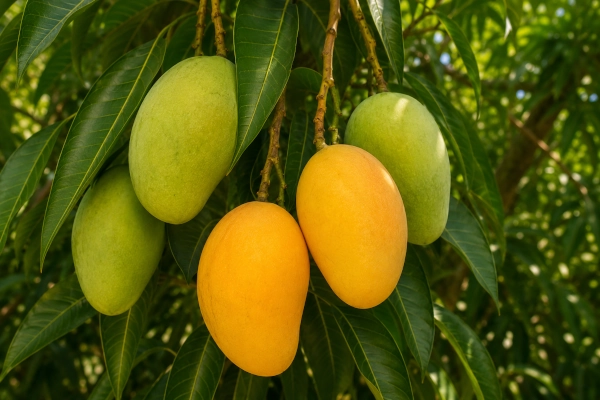
The external appearance of a good Laxman Bhog provides the first indication of its identity. APEDA describes the fruit as having thick, yellow-green skin and orange-yellow flesh, with a very sweet taste and a characteristically pleasant flavour.
The thick skin is commercially important. Premium mangoes must survive harvesting, grading, packing and transportation before reaching the consumer. A fruit that possesses excellent flavour but bruises immediately after picking can be difficult to move beyond nearby markets. Laxman Bhog combines desirable eating quality with enough structural firmness to make it attractive for commercial distribution.
Its flesh provides the stronger reason for its popularity. The pulp is fine-textured, firm but melting, with very little fibre. The eating experience is therefore smooth rather than stringy, while the orange-yellow colour gives the sliced fruit an attractive appearance.
This combination of sweetness, colour, aroma and limited fibre has made Laxman Bhog primarily a premium table mango. It can be eaten fresh, incorporated into desserts or used for beverages, but its greatest value lies in the fruit itself rather than in industrial processing.
A Fruit That Announces Itself Through Aroma
Malda’s official mango guide places Laxman Bhog among the district’s strongly aromatic varieties. Its advice to consumers specifically notes that mangoes such as Himsagar, Lakshmanbhog and Gopalbhog can often be recognised by their aroma at the stem end as ripening progresses.
This is significant because mango quality cannot be judged by colour alone. Different cultivars ripen in very different ways. Some remain substantially green, while others become brilliant yellow or orange.
With Laxman Bhog, colour becomes only one component of maturity. The development of aroma, slight softness beneath gentle pressure and the swelling of the fruit shoulders around the stem all provide useful clues that the mango is approaching eating ripeness.
The fragrance is especially important in a market such as Malda, where several varieties arrive within overlapping weeks. Mango consumers often distinguish cultivars not simply through visual appearance but through combinations of scent, mouthfeel, sweetness and acidity that become familiar over years of seasonal eating.
The Mango Season Begins Long Before Harvest
For consumers, mango season may begin when boxes of fruit arrive in markets. For the orchardist, the process began months earlier.
Mango flowering typically occurs during the cooler and comparatively dry portion of the year. Trees produce enormous numbers of flowers, but only a small percentage ultimately develop into mature fruit. Successful fruit set depends upon tree health, temperature, humidity, pollinating activity and the absence of damaging rain or disease during critical periods.
Once fruit set has occurred, the young mangoes develop through the increasingly hot months of spring and early summer. Irrigation, nutrition, pest management and orchard sanitation become increasingly important as fruit size and value rise.
In Malda, this biological cycle unfolds against the district’s strongly seasonal climate. Summer temperatures can become intense before monsoon rainfall transforms soil moisture conditions. These fluctuations influence flowering, fruit development and the timing of harvest.
The celebrated sweetness of Laxman Bhog therefore emerges from a long interaction between cultivar genetics, weather, soil, tree condition and human management.
When Laxman Bhog Reaches the Market
Laxman Bhog is principally associated with the early-to-middle portion of Malda’s mango season, with the district’s current mango guide placing it around the late-May-to-June period. Seasonal variation means that harvest timing can shift depending on flowering conditions, temperature and rainfall in a particular year.
This timing places the variety within one of the most competitive phases of Bengal’s mango calendar. Gopalbhog and Himsagar may also be entering or occupying the market, while Langra follows as the season develops.
The result is not a single mango season but a succession of cultivars.
Each variety arrives with a slightly different appearance, flavour profile and ripening window. For consumers familiar with Malda’s fruit culture, these changes form an agricultural calendar as recognisable as the progression of ordinary seasons.
Laxman Bhog occupies a particularly valuable position because its sweetness, attractive flesh and transport qualities allow it to compete both in premium domestic markets and in export-oriented supply chains.
The Orchard Tree Behind the Fruit
Like other established mango cultivars, Laxman Bhog must be maintained through vegetative propagation if its defining characteristics are to remain consistent.
Planting the stone from an excellent mango does not guarantee that the resulting tree will reproduce the same fruit. Mango seedlings contain new genetic combinations and can differ greatly from their parent trees.
Growers therefore rely on grafting. A scion taken from an authentic Laxman Bhog mother tree is joined to a suitable rootstock. The canopy that develops from the scion retains the fruit-producing characteristics of the selected cultivar, while the rootstock supports the tree beneath the soil.
This process allows a successful mango variety to survive for generations.
It also gives nurseries enormous responsibility.
If planting material is misidentified, the farmer may maintain a young mango tree for several years before discovering the mistake. Orchard establishment therefore depends not simply on buying mango plants but on obtaining reliable grafts derived from authentic mother material.
In regions built around geographically recognised varieties, the integrity of nursery systems ultimately becomes part of protecting the GI itself.
Malda’s Orchard Tradition Is Older Than the GI Certificate
The Laxman Bhog GI registration dates from 2008, but mango cultivation in Malda is vastly older.
The district includes the historic landscapes of Gaur and Pandua, cities that served as major political and commercial centres of Bengal during different periods. Rivers including the Ganga, Mahananda, Fulahar and Kalindi shaped both settlement and agriculture across the region.
Over generations, local orchardists preserved numerous mango cultivars selected for particular characteristics. Malda became famous not for a single mango but for diversity.
Himsagar, Fazli, Laxman Bhog, Gopalbhog, Langra, Ashwina, Brindabani, Rakhal Bhog and numerous lesser-known local varieties together created one of India’s richest mango landscapes.
West Bengal government material continues to identify Fazli, Aswina, Himsagar, Laxmanbhog, Gulabkhas, Langra and Rani Pasand among the important mango varieties of the state’s producing districts.
Laxman Bhog therefore belongs to a living tradition of cultivar selection and orchard diversity rather than to a modern monoculture created around one commercially fashionable fruit.
The Name Laxman Bhog
As with several old mango cultivars, popular stories circulate about the origin of the name Laxman Bhog. However, reliable official documentation does not provide a sufficiently definitive historical account to connect the cultivar’s name with a single person or event.
It is therefore better to distinguish the documented agricultural identity from later explanations that may belong to oral tradition.
What is firmly established is the variety’s longstanding association with Malda district, its recognition as a distinct mango cultivar and the geographical reputation strong enough to support formal GI protection.
This caution is important when documenting traditional Indian fruit varieties. Mango trees and grafting lineages can survive for generations while written records remain incomplete. A compelling local story may preserve genuine memory, but unless documentary evidence supports it, such accounts should be presented as tradition rather than historical certainty.
The geographical history of Laxman Bhog is strong enough without forcing an unsupported origin legend.
Harvesting at the Correct Stage
One of the most important decisions in mango production occurs at harvest.
A mango intended for distant markets usually cannot be left on the tree until it becomes fully soft. By that stage it may have superb flavour, but the fruit could bruise or deteriorate before reaching the consumer.
Instead, growers harvest at physiological maturity, when the fruit has completed enough internal development to ripen normally after picking.
The distinction between mature and merely large is essential.
An immature mango may soften after harvest without ever developing the sweetness, aroma or texture associated with a properly ripened fruit. Harvesting too late presents the opposite problem, particularly when consignments must travel long distances.
Growers therefore judge maturity through fruit age, shoulder development, surface appearance, firmness and years of practical experience.
For export-oriented orchards, these traditional observations are increasingly supplemented by scientific grading and post-harvest protocols.
From Orchard to Pack House
The commercial life of a Laxman Bhog mango continues long after it leaves the tree.
Harvested fruit must first be protected from impact damage. Mango skin can conceal internal bruising caused by rough handling, so fruit collected for premium markets requires substantially greater care than ordinary bulk produce.
The mangoes are then sorted and graded according to size, maturity, appearance and physical condition. Diseased, damaged or improperly developed fruit is removed from the premium supply chain.
Post-harvest practices may include de-sapping, washing, treatment, drying and packaging depending upon the intended destination.
Fruit bound for regulated export markets must satisfy additional conditions concerning pesticide residues, traceability, phytosanitary status and pack-house procedures.
This is why the value of a premium mango depends not solely on the farmer who grows it. Export quality requires coordination between orchardists, technicians, pack houses, laboratories, transport companies, exporters and overseas buyers.
Malda’s Mango Economy Today
The economic scale of mango cultivation in Malda makes this supply chain particularly significant.
With almost 32,000 hectares of orchards and more than 380,000 tonnes of annual production in the 2025–26 season, mango cultivation supports an enormous network of labour and commerce across the district.
Workers manage orchards throughout the year. Additional labour is needed during harvesting, sorting and packing. Traders purchase fruit from growers or orchard contractors. Trucks move consignments towards Kolkata and other major cities, while exporters identify fruit that can satisfy overseas quality requirements.
Processing provides another economic layer. Mangoes unsuitable for premium fresh sale because of size or cosmetic defects can still be used in pulp, beverages, preserves, chutneys and other products where appropriate.
For a district with such a large mango harvest concentrated into a comparatively short season, strengthening cold chains, storage, processing and market access becomes essential to limiting wastage and protecting farmer income.
The Road to Geographical Indication Recognition
The formal process of protecting the variety began when the Patent Information Centre of the West Bengal State Council of Science & Technology filed the application for Malda Laxman Bhog Mango on 19 September 2007.
The application was assigned GI Application No. 111 under Class 31 for agricultural goods. It was published in Supplementary GI Journal No. 2, with an availability date of 26 May 2008.
Registration followed only a few months later.
Certificate No. 94 was issued on 9 September 2008, formally recognising Malda Laxman Bhog Mango as a geographical indication associated with West Bengal. The registration has subsequently been renewed and is currently recorded as valid until 18 September 2027.
The timing is notable because Laxman Bhog, Khirsapati or Himsagar and Fazli were all taken through the GI process during the same period, giving Malda a group of geographically protected mangoes rather than a single flagship variety.
GI Details at a Glance
- Geographical Indication: Malda Laxman Bhog Mango
- State: West Bengal
- Product: Agricultural
- Class: 31
- Application Number: 111
- Date of Filing: 19 September 2007
- GI Journal: Supplementary 2
- Journal Availability Date: 26 May 2008
- Certificate Number: 94
- GI Certificate Date: 9 September 2008
- Registered Proprietor: Patent Information Centre, West Bengal State Council of Science & Technology, Department of Science & Technology, Government of West Bengal
- Geographical Area: West Bengal
- Registration Valid Until: 18 September 2027
What the GI Tag Protects
A geographical indication does not mean that the biological variety can exist only inside one political boundary.
Mango grafts can travel. If suitable planting material is taken elsewhere and environmental conditions permit, a Laxman Bhog tree can potentially grow outside Malda.
The GI protects something more specific: the geographical identity and reputation of Malda Laxman Bhog Mango.
This difference between cultivar and geographical origin is fundamental.
A cultivar describes inherited biological characteristics. A GI associates a recognised product with a place, the environmental conditions of that region, established production practices and the reputation developed by producers there.
The geographical indication therefore helps distinguish genuine fruit linked with the protected origin from mangoes that may share similar genetics but do not come from the recognised producing landscape.
Malda’s Three GI Mangoes
Laxman Bhog occupies an especially interesting position because it shares the Malda landscape with two other GI-protected mango varieties: Malda Khirsapati or Himsagar and Malda Fazli.
Together, these mangoes illustrate the diversity possible within one horticultural region.
Himsagar is prized particularly for its intense sweetness and fibreless pulp. Fazli is a much larger and later-season fruit. Laxman Bhog occupies a different sensory and seasonal space, combining attractive yellow-green skin, orange-yellow flesh, sweetness and firm-but-melting texture.
This diversity allows the district to extend its mango economy across a broader harvest period rather than depending entirely upon one cultivar.
It also strengthens Malda’s identity in premium markets. Instead of marketing simply “Malda mangoes,” growers and exporters can increasingly build separate geographical identities around distinct varieties.
From Malda to Bahrain and Qatar
Laxman Bhog has already demonstrated its potential beyond the domestic market.
In June 2021, APEDA facilitated an Indian mango promotion programme in Bahrain featuring sixteen varieties sourced from West Bengal and Bihar. Among the GI-certified mangoes presented were Khirsapati and Lakshmanbhog from West Bengal, alongside Bihar’s Zardalu. The fruit was sold through thirteen stores during the promotion.
The following month, APEDA also reported Lakkhanbhog among the GI-certified varieties displayed during a mango promotion programme in Doha, Qatar, alongside Khirsapati, Fazli and other Indian cultivars.
These initiatives are significant because eastern India has historically accounted for a relatively small share of India’s premium fresh-mango export trade compared with established western and southern export belts.
Laxman Bhog gives West Bengal a fruit with the sensory and physical qualities required to challenge that pattern.
Export Quality Begins in the Orchard
Reaching overseas consumers requires a different standard of orchard management from supplying an ordinary local market.
In May 2026, ICAR-KVK, Malda, working with APEDA, brought together mango growers, exporters, farmer organisations and scientists specifically to improve export-quality production. The programme emphasised Good Agricultural Practices, residue-free fruit, traceability, post-harvest management and international compliance.
ICAR has also highlighted orchard technologies such as fruit bagging, improved mango harvesters, integrated pest management, sticky traps and pheromone traps in programmes involving Malda growers. Special attention has been given to the GI varieties Lakshmanbhog, Fazli and Himsagar because stronger export demand could translate directly into higher farmer returns.
These developments represent an important transition.
The traditional orchard remains fundamental, but the premium mango of the twenty-first century increasingly requires traceability, scientific plant protection and carefully managed post-harvest systems.
Fruit Bagging and the Search for Perfect Mangoes
One of the newer practices being encouraged for export-oriented Malda orchards is fruit bagging.
The district’s Aamar Malda advisory programme recommends individual bags around developing GI-quality mangoes, including Lakshmanbhog, because physical protection can reduce fruit-fly damage and improve exterior quality.
Bagging serves several purposes. It reduces direct insect contact, helps protect the skin from physical blemishes and can decrease dependence on late-stage pesticide applications when properly incorporated into an integrated management programme.
The technique is labour-intensive because individual fruits must be covered at the appropriate stage, but premium export markets reward visual quality far more heavily than ordinary wholesale markets.
A mango may taste exceptional while receiving a lower commercial grade because of surface damage. Protecting the fruit while it is still on the tree therefore becomes part of increasing its final value.
A New Global Branding Effort for Malda
Malda is now attempting to transform its enormous mango economy into a more coordinated regional brand.
In June 2026, the district administration and ICAR-KVK launched a focused effort under the AMAR Malda initiative to improve production standards, post-harvest management, entrepreneurship, export facilitation and market diversification. The programme brought together growers, APEDA, exporters, government departments and horticultural scientists.
This is particularly relevant for GI products.
A GI certificate gives a region legal recognition, but international buyers require consistency. Fruit must arrive in predictable grades, residue standards must be met, packaging must withstand transport and exporters need sufficient volumes to fulfil commercial contracts.
GI protection and modern value-chain development therefore have to operate together.
For Laxman Bhog, the opportunity is to transform a mango already famous within Bengal into a fruit whose Malda origin itself becomes a premium selling point.
The Challenge of Climate Variability
Malda’s mango heritage is deeply dependent upon climate, and that creates vulnerability.
Mango flowering can be affected by unusually warm winter conditions, sudden rainfall, fog and high humidity. Once fruit has set, extreme heat, thunderstorms, hail and irregular moisture can affect fruit retention and quality.
Climate variability becomes particularly difficult for perennial crops because orchardists cannot simply change the crop every season.
The tree remains.
Future resilience will therefore depend increasingly upon better weather forecasting, soil-moisture management, efficient irrigation, canopy management, integrated pest control and orchard sanitation.
Scientific advisory systems can strengthen traditional knowledge rather than replace it. A farmer who has observed the same orchard for decades possesses valuable experience, while modern weather data and pest monitoring can provide additional warning when conditions depart from historical patterns.
Conserving a District of Mango Diversity
The commercial success of Himsagar, Laxman Bhog and Fazli should not obscure the extraordinary diversity of Malda’s broader mango landscape.
The district administration currently documents numerous cultivars, including Gopalbhog, Langra, Brindabani, Ashwina, Rakhal Bhog, Mohanbhog, Amrapali and Mallika alongside the GI varieties.
Some are important commercial mangoes. Others survive in smaller quantities.
Together they represent a genetic resource of considerable value.
Different cultivars carry different combinations of flowering time, fruit size, fibre content, sweetness, acidity, shelf life and environmental tolerance. Traits that appear commercially unimportant today may prove valuable in future breeding programmes responding to climate change, disease or changing consumer demand.
Protecting Laxman Bhog should therefore form part of a wider effort to conserve the mango diversity of Malda rather than narrowing orchards entirely around a handful of market leaders.
Protecting the Orchard Behind the Name
The GI certificate protects the words Malda Laxman Bhog Mango, but the true heritage survives in living trees and the people who maintain them.
Authentic mother plants have to be preserved. Nurseries must supply correctly identified grafts. Orchardists need sufficient income to maintain trees and replace ageing plantations. Younger generations must see economic opportunity in mango cultivation rather than regarding orchards as land waiting for conversion to another use.
Traceability is equally important.
If consumers are willing to pay more for geographically authentic fruit, growers must be able to demonstrate that origin. Authorised producers, identifiable packaging and reliable supply chains can turn the GI from a legal registration into an economic asset.
The strength of the geographical indication ultimately depends upon whether the farmers maintaining the geography benefit from the reputation attached to it.
The Golden Mango of Malda’s Early Summer
Malda Laxman Bhog does not need the enormous size of Fazli or the exceptional fame of Himsagar to establish its place among Bengal’s great mangoes.
Its appeal is a balance of qualities.
The skin is thick enough to protect the fruit yet attractive as ripening progresses. The flesh develops a rich orange-yellow colour. Fibre is minimal. The texture remains firm before melting on the palate, and sweetness is accompanied by the characteristic pleasant aroma that makes the variety recognisable to experienced consumers.
Behind those qualities lies the geography of Malda.
The rivers that shaped its alluvial plains, the hot summers and monsoon rains, the extensive orchard economy and generations of grafting and cultivation all form part of the environment from which the mango acquired its reputation.
The 9 September 2008 GI registration placed legal protection around that identity, but Malda’s association with mangoes is considerably older than any certificate.
Today, Laxman Bhog stands at the meeting point between those two worlds.
It remains a fruit of traditional Bengal orchards, harvested during the brief abundance of mango season. At the same time, it is entering a more modern system of GI traceability, fruit bagging, export-grade production, pack houses and international promotion.
That combination gives the variety its deeper significance.
Malda Laxman Bhog Mango is not merely a sweet fruit from West Bengal. It is one expression of Malda itself—a district where river-made soil, generations of orchard knowledge and the fragrance of mango season have become inseparable from the landscape.
You may also like
-
India and OPEC Deepen Energy Cooperation as New Delhi Hosts Seventh High-Level Dialogue
-
India Ranks First Among 41 Markets in Swedish Global Business Climate Survey 2026
-
India’s Semiconductor Market Could Cross US$200 Billion by 2035 as Domestic Demand Accelerates
-
Pace Robotics Moves Construction Automation From Pilot Stage to Commercial Deployment
-
Hindustan Shipyard Docks Three Vessels Simultaneously in Precision Engineering Milestone
