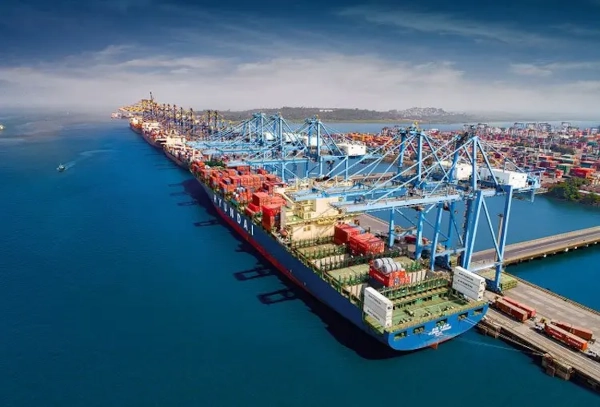
India’s largest container gateway has recorded another major international milestone, with the Jawaharlal Nehru Port Authority rising to 21st position among the world’s leading container ports while recording 13.6 percent container-throughput growth during the first half of 2026.
The performance has made JNPA the fastest-growing port among the world’s top 30 container ports during the period, marking a significant advance for India’s maritime infrastructure at a time when the country is investing heavily in ports, freight corridors, logistics parks and manufacturing-linked trade infrastructure.
Located at Nhava Sheva in Navi Mumbai, JNPA is already the dominant container gateway among India’s major ports. Its latest rise in the global rankings shows how improvements in terminal capacity, private participation, hinterland connectivity, digitalisation and cargo evacuation are beginning to translate into higher volumes and greater international competitiveness.
The latest achievement also follows a record-breaking financial year for the port. JNPA handled 8.17 million Twenty-foot Equivalent Units, or TEUs, during FY2025-26, representing growth of 11.94 percent over the previous year and the highest annual container throughput in its history.
From India’s Container Gateway to a Global Port
JNPA was commissioned on 26 May 1989 and has evolved from a facility initially handling bulk cargo into India’s premier container port.
Its importance to the Indian economy extends well beyond the Mumbai metropolitan region. The port serves a vast industrial and commercial hinterland and provides Indian manufacturers and traders with maritime connections to more than 200 ports around the world.
JNPA currently handles more than half of the container traffic processed by India’s major ports. In FY2025-26, the port handled 8.17 million TEUs out of the combined container traffic handled by the country’s major ports, giving it a share of approximately 53.9 percent.
Containers are the backbone of modern manufactured-goods trade. Everything from automotive components and machinery to textiles, pharmaceuticals, chemicals, electronics and processed foods moves through container networks.
The ability of a port to process rapidly increasing volumes is therefore closely linked to the competitiveness of the manufacturing economy it serves.
13.6 Percent Growth Puts JNPA Ahead of Global Top-30 Peers
The latest H1 2026 review places JNPA at 21st globally, with container throughput expanding by 13.6 percent during the first half of the year.
Union Minister for Ports, Shipping and Waterways Sarbananda Sonowal said the rate of expansion was higher than that recorded by any other port within the global top 30 during the period.
The achievement is particularly noteworthy because many of the world’s largest container ports already operate at enormous scale. Rapid percentage growth becomes increasingly difficult as throughput rises, making double-digit expansion at a large established port significant.
For JNPA, the latest result is not an isolated spike. It follows several periods of strong container growth and a record FY2025-26.
The underlying traffic figures for the current financial year indicate that this momentum has continued.
Nearly Three Million TEUs in Just Four Months
JNPA’s own operating figures show that from April to July 2026, the port handled approximately 2.995 million TEUs, compared with 2.619 million TEUs during the same period a year earlier.
That represents growth of 14.37 percent.
July alone saw JNPA handle 745,059 TEUs, an increase of 11.48 percent compared with July 2025.
Containerised cargo by weight reached 34.13 million tonnes during April-July 2026, up 14.37 percent year-on-year, while total cargo reached 36.62 million tonnes, representing growth of 11.95 percent.
These numbers show that the H1 international ranking is supported by sustained underlying cargo growth rather than a statistical anomaly.
Record 8.17 Million TEUs in FY2025-26
The foundation for the latest performance was laid during a record FY2025-26.
JNPA handled 8.173 million TEUs during the financial year, compared with approximately 7.302 million TEUs in FY2024-25.
The increase of nearly 872,000 TEUs in a single year translated into annual growth of 11.94 percent.
Overall cargo throughput also crossed a historic threshold. JNPA handled 102.01 million tonnes of cargo in FY2025-26, up 10.74 percent from 92.12 million tonnes the previous year.
Containerised cargo alone accounted for approximately 92.46 million tonnes, demonstrating just how central container operations have become to the port’s economic role.
Five Major Container Terminals Drive the Port
One of JNPA’s strengths is that its container-handling ecosystem is distributed across multiple large terminals operated with participation from some of the world’s leading port companies.
The port currently incorporates the Nhava Sheva Free Port Terminal, Nhava Sheva International Container Terminal, Gateway Terminals India, Nhava Sheva International Gateway Terminal and Bharat Mumbai Container Terminal.
This structure has introduced substantial private investment, modern equipment and operational competition into India’s largest container port.
The terminals collectively provide extensive quay infrastructure, container yards, rail facilities, reefer connections and high-capacity container-handling equipment.
JNPA’s continuing expansion has been designed to raise total container capacity towards approximately 10 million TEUs annually, creating room for further traffic growth as India’s foreign trade expands.
Bharat Mumbai Container Terminal Adds Major Capacity
One of the most important elements in JNPA’s capacity expansion has been the development of the Bharat Mumbai Container Terminal, or BMCT.
The project was designed in two phases, each capable of handling approximately 2.4 million TEUs annually, creating total design capacity of roughly 4.8 million TEUs.
The scale of BMCT gives JNPA the physical infrastructure required to accommodate larger vessels and increasing container volumes while reducing the danger of capacity constraints as trade grows.
The terminal has already become JNPA’s largest individual contributor by container volume.
During FY2025-26, BMCT handled approximately 2.69 million TEUs, accounting for nearly one-third of JNPA’s total container traffic.
This demonstrates the importance of capacity creation ahead of demand. Container ports cannot increase throughput indefinitely simply by improving operational efficiency; at some stage they require additional berths, cranes, storage areas and evacuation infrastructure.
JNPA has been expanding all four simultaneously.
Port Efficiency Is About More Than Cranes and Berths
A container port succeeds only when cargo can move efficiently both through the terminal and beyond its gates.
A vessel may be unloaded quickly, but if containers remain trapped in yards because trucks, trains or customs processes cannot clear them, congestion rapidly develops.
JNPA has therefore increasingly focused on the entire logistics chain.
The port is connected with dozens of Container Freight Stations and Inland Container Depot destinations, while extensive road and rail networks connect the harbour with industrial regions across western, central and northern India.
JNPA has 13 railway sidings with capacity for as many as 39 rakes per day and is connected with major national highway infrastructure.
During April-July 2026 alone, rail operations moved approximately 391,563 TEUs through 2,317 container rakes.
Rail-based evacuation becomes increasingly important as container volumes rise because excessive dependence on trucks can create road congestion, increase logistics costs and add to emissions.
Dedicated Freight Corridor Changes JNPA’s Hinterland Reach
One of the most strategically important developments for JNPA is improved integration with India’s freight-rail network.
The port is connected with the Western Dedicated Freight Corridor, which strengthens freight movement between western ports and major manufacturing and consumption centres deeper inside the country.
Dedicated freight infrastructure enables longer and heavier container trains to move with fewer conflicts with passenger services.
For exporters in northern and western India, better rail connectivity can reduce the time and uncertainty involved in transporting containers between factories, inland depots and seaports.
This matters because a port’s competitive hinterland can extend hundreds or even thousands of kilometres inland.
JNPA’s future growth will therefore be determined not merely by what happens at Nhava Sheva but by how efficiently factories across India can connect with its shipping services.
Around 22,000 TEUs Can Move Through JNPA Each Day
The operating scale of the port becomes clearer from its daily traffic.
JNPA has stated that it typically receives around 10 to 12 container vessels every day and handles approximately 22,000 TEUs of import and export cargo daily.
Approximately 20,000 TEUs can move through the road network and around 2,000 TEUs through rail under typical operating conditions.
Managing traffic of this magnitude requires coordination among terminal operators, shipping companies, customs authorities, freight stations, railway operators, trucking companies and thousands of workers.
Even relatively small improvements in clearance time or equipment productivity can produce substantial benefits when multiplied across millions of containers annually.
Digitalisation Is Becoming a Port Capacity Multiplier
Port modernisation is increasingly as much about data as physical infrastructure.
Digital documentation, electronic cargo tracking, automated gate processes and real-time vessel management can reduce delays without requiring proportionate increases in physical infrastructure.
JNPA has been introducing new digital systems across its operations.
In May 2026, the port launched NIVIDA, an artificial intelligence-driven tender evaluation engine, alongside an intelligent vessel traffic system.
Such technologies represent a broader shift toward digitally managed ports where vessel movements, cargo flows, terminal equipment and administrative procedures can increasingly be coordinated through integrated data systems.
Digitalisation can also improve predictability for exporters.
For manufacturing companies operating just-in-time supply chains, knowing when a container will reach or leave a port can be almost as important as the headline freight cost.
Faster Ports Can Lower the Hidden Cost of Indian Exports
Port efficiency affects the economy in ways that are often invisible to consumers.
Every additional hour a ship remains at berth imposes costs on shipping companies. Every unnecessary day a container sits inside a terminal increases inventory and storage costs. Delayed evacuation means trucks and trains spend more time waiting rather than moving cargo.
Ultimately, these expenses become part of the price of Indian exports and imports.
This is why improvements in vessel turnaround, customs processes, terminal productivity and hinterland transportation have direct implications for India’s manufacturing competitiveness.
Across India’s major ports, average vessel turnaround time improved from 52.87 hours in FY2021-22 to 48.84 hours in FY2025-26.
Even incremental improvements become economically significant when applied across thousands of vessel calls and millions of tonnes of cargo.
JNPA’s Global Rankings Need to Be Read Carefully
There are several international port rankings, and they measure different aspects of performance.
The latest H1 2026 review places JNPA at 21st among the world’s top container ports, with 13.6 percent growth making it the fastest-growing member of the top 30.
Separately, the World Bank’s Container Port Performance Index 2025, which evaluates container-port performance primarily through vessel time in port, placed Jawaharlal Nehru Port at 22nd.
In that efficiency-focused ranking, JNPA was placed close to Singapore at 21st and Shanghai at 23rd.
The two rankings therefore should not be confused. One reflects JNPA’s rising scale and growth among major global container ports, while the CPPI focuses on operational container-port performance.
Taken together, however, they indicate progress in both throughput and operating efficiency.
Why JNPA Matters to Make in India
India’s ambition to become a larger manufacturing exporter depends fundamentally on ports such as JNPA.
Factories producing automobiles, engineering goods, pharmaceuticals, chemicals, textiles, electronics and industrial machinery cannot compete globally if transporting their products from the factory gate to overseas customers remains expensive or unpredictable.
Ports form the interface between domestic production and global supply chains.
As Indian manufacturing expands, container traffic is likely to rise substantially. This creates a two-way relationship: greater manufacturing generates more cargo, while more efficient ports make manufacturing more globally competitive.
JNPA’s rapid throughput growth can therefore be viewed as one indicator of broader activity across India’s trade and manufacturing economy.
A Gateway for Western and Northern India
JNPA’s geographical advantage is particularly important.
Located near Mumbai, India’s largest financial and commercial centre, it sits close to Maharashtra’s extensive industrial base while also serving cargo originating from states much farther inland.
Its highway and rail connections link the port with manufacturing regions in Maharashtra, Gujarat, Madhya Pradesh, Rajasthan, Haryana, Delhi and other parts of the country.
The development of improved freight corridors progressively enlarges this economic hinterland.
As the cost and time required to move containers inland falls, manufacturers located farther from the coastline can gain more efficient access to international shipping networks.
This can influence industrial-location decisions over the long term, allowing export-oriented manufacturing to develop beyond traditional coastal clusters.
JNPA Is Only One Part of a Much Larger Maritime Expansion
India’s container requirements are expected to grow well beyond the capacity of its existing ports.
For this reason, JNPA’s transformation is increasingly connected with another far larger project on Maharashtra’s coast — Vadhvan Port in Palghar district.
The Union Government approved the deep-draft greenfield port at an estimated cost of approximately ₹76,220 crore.
When fully developed, Vadhvan is planned to have total cargo-handling capacity of about 298 million tonnes annually, including approximately 23.2 million TEUs of container capacity.
Its first phase, expected to provide around 15 million TEUs of container capacity, is targeted for operation around 2030.
The scale is transformational.
A 23.2-million-TEU port would provide India with container-handling capability comparable with major global maritime hubs and significantly expand the western coast’s ability to handle the country’s future trade.
Deep Draft Could Bring Larger Ships Directly to India
Vadhvan’s importance also lies in its planned natural draft of approximately 20 metres.
Container shipping has progressively shifted toward very large vessels because greater scale can lower transport costs per container.
Ports unable to accommodate such ships risk losing direct services and becoming more dependent on transshipment through foreign hubs.
Vadhvan is being designed specifically to accommodate larger vessels.
For India, increasing the share of cargo moving through direct international services could reduce dependence on overseas transshipment hubs and strengthen the country’s position within global shipping networks.
JNPA and Vadhvan should therefore increasingly be seen as complementary components of a much larger western maritime gateway.
₹2,360-Crore Expressway Will Connect Vadhvan to National Highways
Port capacity alone is insufficient unless cargo can reach the facility efficiently.
In April 2026, the National Highways Authority of India awarded a ₹2,360-crore contract for a 32.1-kilometre access-controlled expressway connecting Vadhvan Port with the national highway network.
The four-lane road will be expandable to eight lanes and will connect with NH-48 and the Delhi-Mumbai Expressway system.
The project includes a twin-tube tunnel, bridges, interchanges, flyovers and other major structures.
This reflects an important change in Indian infrastructure planning: ports are increasingly being developed together with the road, rail and logistics systems required to evacuate their cargo.
From Port Capacity to a Maritime Economic Ecosystem
JNPA itself is also developing activities beyond conventional cargo handling.
The surrounding maritime ecosystem increasingly incorporates logistics services, warehousing, industrial activity, freight stations and the JNPA Special Economic Zone.
This model turns a port from a simple point of cargo transfer into an economic cluster.
Factories located near efficient ports can import raw materials and export finished goods more easily. Warehousing and logistics companies benefit from cargo concentration. Shipping services become more attractive as volumes rise, creating a reinforcing cycle.
Major global ports such as Singapore, Rotterdam and Shanghai have long demonstrated that the economic value of a successful port extends far beyond fees collected from ships and containers.
The larger prize is the industrial and logistics ecosystem that develops around it.
India’s Maritime Infrastructure Is Entering a New Scale
JNPA’s rise to 21st position among the world’s leading container ports therefore carries significance beyond the ranking itself.
The port is expanding at a pace faster than any other member of the global top 30, after already achieving record annual throughput of 8.17 million TEUs in FY2025-26.
Container traffic has continued accelerating in FY2026-27, with almost three million TEUs handled during the first four months alone.
At the same time, terminal capacity is expanding, freight connectivity is improving, port processes are becoming more digital and an entirely new mega-port at Vadhvan is being constructed to absorb the next generation of Indian maritime trade.
Together, these developments suggest that India is beginning to build port infrastructure on a scale more closely aligned with its ambitions as a major manufacturing and trading economy.
For decades, discussions about India’s infrastructure disadvantage often focused on logistics costs, congested ports, slow cargo movement and insufficient capacity. Those challenges have not disappeared, but JNPA’s trajectory demonstrates how quickly the picture can change when physical capacity, private terminal investment, freight connectivity and digital systems develop together.
The 13.6 percent growth recorded in the first half of 2026 is therefore more than a port statistic.
It represents a visible measure of the growing volumes passing between Indian factories and the world — and a sign that the maritime infrastructure supporting India’s next phase of economic expansion is beginning to acquire genuinely global scale.
You may also like
-
India’s Economic Warfare Challenge: Strategic Autonomy, Energy Security and the Rise of a Global Power
-
India-US Trade Deal Stalemate: Why Washington’s Tariff Pressure Has Failed to Secure an Agreement
-
US Double Standards in Foreign Policy: 16 Recent Cases Involving India, Russia, China and Global Trade
-
India’s Arctic Energy Ambitions: Russian Oil, LNG and a New Sea Route to Indian Ports
-
India and Russia Explore Joint Icebreaker Construction as Maritime Industrial Cooperation Expands
