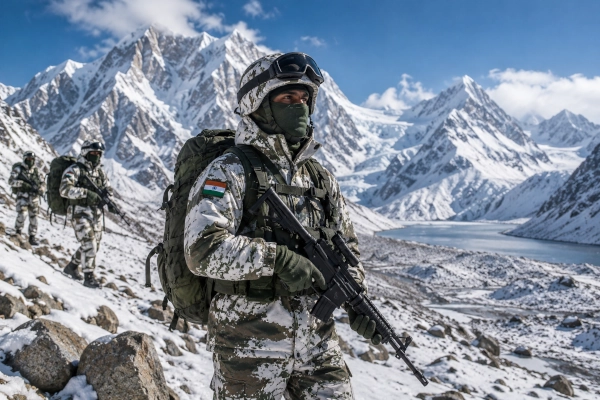
India is expanding domestic manufacturing capacity for specialised high-altitude military clothing, with the Defence Research and Development Organisation offering its indigenous Extreme Cold Weather Clothing System (ECWCS) for additional Transfer of Technology to Indian industry.
The technology, developed by the Defence Institute of Physiology and Allied Sciences (DIPAS), was added to DRDO’s current military Technology Transfer portfolio on August 12, 2026, with three industry licences presently available.
The move can help widen India’s manufacturing base for one of the least visible but most important categories of military equipment: specialised clothing that allows soldiers to remain operational for prolonged periods in glaciers and extreme Himalayan conditions.
India’s northern frontiers present conditions in which the environment itself can become a serious operational threat. Soldiers deployed at extreme altitude must contend not only with sub-zero temperatures but also strong winds, snow, moisture, reduced oxygen and rapidly changing levels of physical activity.
Conventional winter clothing is inadequate in such conditions. A soldier may generate considerable body heat while climbing or carrying equipment and then face rapid cooling once movement stops. Clothing therefore has to provide insulation while simultaneously managing sweat, moisture and ventilation.
DRDO’s ECWCS addresses these requirements through a modular three-layer architecture. Soldiers can use different combinations of the layers depending on temperature, wind conditions and the intensity of physical activity.
The system comprises an inner layer for moisture management, an insulating middle layer and a protective outer layer. Together, the three layers weigh approximately 4.5 kg while providing a thermal insulation value greater than 5.5 CLO.
The middle and outer layers provide waterproof protection, while the inner layer incorporates antimicrobial treatment. The outer garment is also reversible, allowing troops to use different camouflage appearances in snow-covered terrain and areas where snow is absent.
The design has been engineered around freedom of movement as well as thermal performance. Reinforced areas provide the ruggedness required for mountain operations without unnecessarily restricting the movements required for climbing, patrolling and other combat tasks.
ECWCS has also undergone human field evaluation for extreme-altitude military and paramilitary operations.
Replacing Dependence on Imported High-Altitude Equipment
The strategic importance of the system extends beyond clothing technology.
For many years, India depended significantly on imported Special Clothing and Mountaineering Equipment for troops deployed in high-altitude regions. Such dependence creates obvious logistical and strategic vulnerabilities when tens of thousands of personnel may require specialised clothing on a recurring basis.
Developing the equipment domestically provides India with greater control over manufacturing capacity, supply chains, replacement stocks and future design improvements.
DRDO originally transferred ECWCS technology to five Indian companies in December 2021, creating an indigenous industrial base capable of manufacturing the system.
The latest August 2026 Technology Transfer offering should therefore be viewed as an effort to broaden that production ecosystem, rather than the first commercialisation of ECWCS.
Additional manufacturers can create greater capacity and competition while reducing reliance on a limited supplier base for equipment that may be required in large quantities.
Engineering Clothing Around Human Physiology
One of the more interesting aspects of ECWCS is that it was developed by a defence physiology laboratory rather than simply as a textile product.
DIPAS specialises in understanding how the human body functions under demanding military conditions. Its work covers areas including extreme temperatures, high altitude, physical workload and other environmental stresses affecting soldier performance.
This physiology-led approach shaped the ECWCS design.
The system seeks to reduce heat and water loss while allowing sweat to be absorbed and transported away from the body. At the same time, the layers must provide wind and water protection without trapping excessive moisture inside the clothing.
DRDO’s earlier operational specification described the three-layer system as capable of providing thermal protection across approximately +15°C to −50°C, depending on the combination of garments used and the physical workload of the wearer.
This modular approach avoids forcing soldiers to wear maximum insulation at all times. Layers can instead be adjusted to match the environmental and operational situation.
That flexibility becomes particularly important during mountain operations, where a soldier can move between strenuous climbing, stationary observation and exposed positions within a relatively short period.
From ECWCS to Himkavach
DRDO has continued developing its extreme-weather clothing technology beyond the original three-layer ECWCS.
DIPAS has subsequently developed the seven-layer Himkavach system, intended for an even wider operational temperature envelope of approximately +20°C to −60°C.
Himkavach incorporates a quick-dry inner layer, grid fleece, high-loft fleece jacket, breathable combat clothing, soft-shell insulation, reversible outer clothing and a rain poncho.
The seven-layer architecture gives soldiers more combinations with which to match clothing to changing environmental conditions and physical workloads.
As of DRDO’s 2026 technical documentation, Himkavach was undergoing technical field trials, meaning it should be distinguished from the established three-layer ECWCS currently being offered to industry.
DRDO has also developed Himsuraksha, another cold-weather clothing system tailored for Central Armed Police Forces operating at temperatures down to approximately −20°C. That system has been inducted by the CRPF and SSB.
Together, ECWCS, Himkavach and Himsuraksha demonstrate an increasingly sophisticated indigenous approach to military environmental protection.
High-Altitude Clothing as Strategic Equipment
Specialised clothing rarely receives the attention given to missiles, aircraft or armoured vehicles, but its operational importance can be just as immediate for troops deployed in extreme terrain.
Cold injuries, moisture accumulation and inadequate insulation can rapidly degrade the effectiveness of personnel. Poorly designed clothing can also restrict movement, increase fatigue and add unnecessary weight to soldiers already carrying weapons, ammunition and survival equipment.
A well-designed clothing system therefore contributes directly to endurance and combat effectiveness.
This is particularly relevant for India because significant military formations remain deployed across high-altitude Himalayan regions, where large quantities of specialised equipment must be maintained, replaced and replenished continuously.
Domestic production also allows clothing to be developed specifically around Indian anthropometric data, operational experience and climatic conditions rather than adapting equipment originally designed for foreign users.
Creating an Indigenous Soldier-Systems Industry
The renewed ECWCS Technology Transfer offering illustrates a wider change taking place within India’s defence-industrial programme.
Indigenisation is increasingly moving beyond large platforms to include the equipment carried and worn by individual soldiers. Protective clothing, body armour, helmets, oxygen equipment, mountaineering systems and other personal equipment form a substantial defence manufacturing market of their own.
Expanding the number of Indian companies capable of manufacturing such equipment can create domestic expertise in specialised textiles, membranes, insulation materials, ergonomic design and advanced manufacturing.
Those technologies may also have applications beyond the military in mountaineering, disaster response, polar research and other extreme-environment activities.
For Indian manufacturers, the DRDO Technology Transfer route provides access to an already developed and evaluated military technology rather than requiring companies to begin the entire research process independently.
For the Armed Forces, a broader manufacturing ecosystem can provide increased capacity, domestic lifecycle support and greater resilience during periods when requirements suddenly increase.
From missiles and aircraft to the layers worn by soldiers at extreme altitude, self-reliance in defence ultimately depends on mastering both the highly visible weapon systems and the essential technologies that allow personnel to operate them.
You may also like
-
Exercise Tarang Shakti 2026 Concludes in Jodhpur, Showcasing India’s Air Power, Indigenous Defence Technology
-
Indian Navy Vice Chief Inspects Japan’s Mogami-Class Stealth Frigate as India-Japan Shipbuilding Cooperation Expands
-
India and Russia Explore Joint Icebreaker Construction as Maritime Industrial Cooperation Expands
-
Philippine Marine Wargames Reportedly Show BrahMos Can Penetrate Chinese Destroyer Air Defences
-
Safran Signs 18 Agreements with Indian Aerospace Suppliers, Expanding Make in India Manufacturing Partnerships
