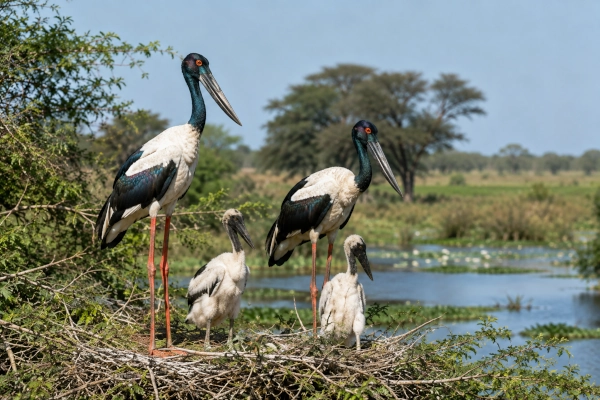
Gujarat’s Khijadiya Bird Sanctuary in Jamnagar has emerged as an important breeding stronghold for the Black-necked Stork after a detailed scientific study recorded successful reproduction across every monitored nest in the Ramsar-designated wetland.
Researchers from the Gujarat Ecological Education and Research Foundation (GEER Foundation) documented four active Black-necked Stork nests during surveys conducted between July 2024 and March 2025. Each breeding pair successfully raised two fledglings, producing eight juveniles from four nests and a 100% fledging success rate during the monitoring period.
The study, published in the peer-reviewed Journal of Threatened Taxa in July 2026, examined the population status, breeding ecology, nesting characteristics and reproductive performance of the Black-necked Stork, Ephippiorhynchus asiaticus. Researchers used 48 georeferenced sampling points across eight management zones and accumulated around 320 hours of behavioural observations.
Eight breeding adults occupied the four nests, while five non-breeding adults were regularly observed elsewhere in the sanctuary. Once the eight juveniles were included, the researchers calculated a confirmed peak seasonal population of 21 Black-necked Storks. Additional birds were occasionally seen outside the regularly monitored areas, but these were treated as transient or dispersing individuals rather than included in the confirmed count.
One of the most interesting findings concerned the birds’ choice of nesting trees. All four nests were constructed on Neltuma juliflora, formerly classified as Prosopis juliflora and locally known as gando baval, at heights ranging from approximately three to 4.5 metres. Black-necked Storks are known to use large native trees elsewhere, but the Khijadiya observations show that the species can also make use of structurally suitable non-native vegetation when appropriate nesting conditions exist.
The nesting sites shared several ecological characteristics. They were located beside shallow wetlands with water approximately 0.3 to 0.7 metres deep, surrounded by open-water patches, emergent vegetation and slightly elevated ground. Nearby wetlands supported fish, amphibians, crustaceans and aquatic invertebrates that provide an important food base for adult storks and growing chicks. Low levels of human disturbance around the occupied nesting areas also appear to have contributed to favourable breeding conditions.
Breeding activity followed a distinct seasonal pattern. Behavioural changes became apparent during August and September, while active nest construction was observed during October. Hatching occurred during the latter part of October, followed by intensive chick-rearing through November and December. By late December, all four nests had successfully produced fledged young.
The research also revealed a high degree of cooperation between breeding pairs. Across 89 nest-monitoring visits, adults remained at nests for an average of about 62 minutes per visit. In most observed departures for feeding, one parent replaced the other, demonstrating coordinated biparental care during incubation and chick development. No nest abandonment, chick mortality or predation was recorded during the monitored breeding cycle.
Even after fledging, parental care continued. Juveniles were seen following adults through feeding areas and making begging calls, while adults continued to provide food. Such prolonged dependence allows young birds to gradually develop the foraging skills needed before becoming completely independent.
The findings are significant because Black-necked Storks occur at relatively low densities across India and breeding pairs are often widely dispersed. Although the species is currently classified globally as Least Concern, its scattered breeding distribution means that wetlands capable of repeatedly supporting successful nesting remain important for long-term population stability.
Khijadiya itself possesses an unusual ecological character. Located near the Gulf of Kachchh, the approximately 6.05-square-kilometre sanctuary contains freshwater wetlands on one side and brackish-to-saline habitats influenced by the coast on the other. This combination creates a rich transition zone supporting fish, crustaceans, aquatic vegetation and large numbers of resident and migratory waterbirds. The sanctuary also lies along the Central Asian Flyway, increasing its wider importance for bird conservation.
The new findings therefore add another dimension to Khijadiya’s conservation value. The sanctuary is not merely a seasonal refuge for migratory birds; it is also functioning as a productive breeding landscape for one of India’s largest wetland birds.
Successful reproduction by all four monitored Black-necked Stork pairs demonstrates how stable water conditions, abundant prey, secure nesting structures and low disturbance can combine to create productive breeding habitat. Protecting these characteristics will be crucial if Khijadiya is to continue supporting the species in the years ahead.
The study also underlines the importance of sustained scientific monitoring at protected wetlands. Population counts can establish how many birds visit a landscape, but breeding studies reveal whether that habitat is actually capable of supporting the next generation. In Khijadiya, the emergence of eight fledglings from four monitored nests provides encouraging evidence that this Ramsar wetland is fulfilling precisely that role for the Black-necked Stork.
You may also like
-
Thousands of Butterflies Migrate Across Tamil Nadu as Northeast Monsoon Arrives
-
Indian Researcher Surveys Over 3,000 Western Ghats Frogs to Track Deadly Amphibian Fungus
-
Zoological Survey of India Discovers Three New Centipede Species in Western Ghats of Kerala and Karnataka
-
Scientists Document 3,261 Flowering Plant Species in Agasthyamalai Biosphere Reserve, Including 1,018 Indian Endemics
-
Scientists Discover Two Rare Blind Fish Species in Assam’s Underground Waters, Revealing Hidden Biodiversity
