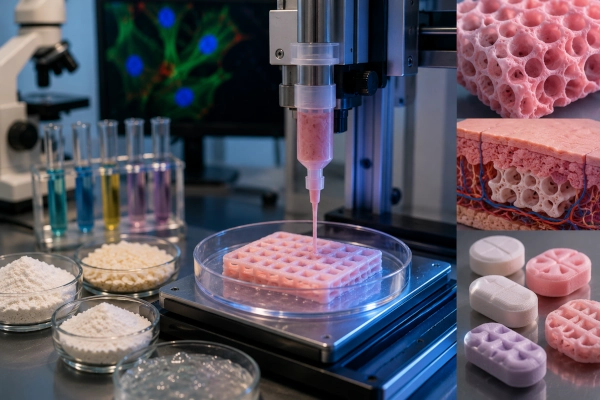
Indian researchers have developed a pharmaceutical polymer-based hydrogel that could eventually support two very different areas of personalised medicine — 3D-printed tissue scaffolds for regenerative medicine and customised oral medicines manufactured using three-dimensional printing.
The technology has been developed by researchers at the BITS Pilani K.K. Birla Goa Campus, bringing together scientists from the Departments of Biological Sciences and Chemical Engineering. Their work uses familiar pharmaceutical-grade materials rather than relying heavily on expensive or animal-derived substances traditionally explored for biological printing.
The hydrogel is based on partially pregelatinised starch, maltodextrin and sodium alginate, materials already widely used in pharmaceutical formulations. The researchers demonstrated that the formulation possesses the flow characteristics required for semisolid extrusion-based 3D bioprinting while recovering its structure after it passes through the printer nozzle.
This combination is critical for successful 3D printing. A bioink must become fluid enough to pass smoothly through a fine nozzle under pressure, but once deposited it must rapidly regain sufficient stiffness to prevent the printed structure from collapsing. The BITS Pilani formulation demonstrated an 87% viscosity recovery after the applied shear force was removed, indicating strong post-printing structural recovery.
Researchers successfully printed several structures using the hydrogel, including square-grid scaffolds, multilayer structures and spiral geometries. The material showed sufficient shape fidelity to maintain the architecture created by the printer, an essential requirement if such formulations are eventually to be used for producing complex biomedical structures.
The researchers then evaluated whether the material could potentially support applications in skin tissue engineering. Laboratory testing was conducted using L929 fibroblast cells and HaCaT keratinocyte cells, both relevant to studies involving skin and tissue compatibility.
Cell viability remained above 70%, meeting the accepted threshold used by the researchers for non-cytotoxicity. Confocal microscopy also demonstrated cell growth on the crosslinked hydrogel. Blood-compatibility testing recorded approximately 5% haemolysis, further supporting the material’s potential as a biocompatible scaffold.
The printed scaffolds were highly porous, an important characteristic for tissue engineering because pores can help provide spaces through which cells interact, nutrients move and new tissue develops. The average pore diameter in the freeze-dried structures was around 39.2 micrometres.
The scaffolds also absorbed substantial quantities of liquid, swelling by as much as 72% within 24 hours, and began showing degradation after approximately two weeks. Such behaviour can be useful for tissue-engineering materials because temporary scaffolds are ideally designed to provide physical support while biological tissue progressively develops around them.
An important feature of the BITS Pilani approach is the use of animal-free pharmaceutical polymers. Many experimental bioinks rely on materials such as collagen or gelatin derived from animal sources. These can introduce challenges involving batch-to-batch variability, potential immune responses, microbial contamination and regulatory complexity.
Using pharmaceutical-grade polymers with established manufacturing standards could potentially simplify some of these issues. The materials selected by the researchers are readily available, comparatively inexpensive and already familiar to the pharmaceutical industry.
The same hydrogel formulation was then tested for an entirely different application — 3D printing medicines customised for individual patients.
Researchers incorporated glimepiride, an oral medicine used in the management of type 2 diabetes, into the printable formulation and manufactured experimental 2-mg chewable tablets using semisolid extrusion 3D printing.
The drug-loaded formulation included starch and maltodextrin as pharmaceutical excipients, sodium alginate as the gelling material and additional ingredients to improve the properties of the chewable tablet.
Instead of compressing powders using a conventional tablet press, the medicine was produced layer by layer according to a computer-designed geometry using a bioprinter. The printed tablets were subsequently freeze-dried and evaluated for physical consistency, drug content and dissolution behaviour.
One particularly encouraging result involved dose uniformity. The experimental tablets recorded an average glimepiride content of 100.4% with a standard deviation of 2.8% across the samples tested.
Consistent dosage is especially important for low-dose medicines such as the 2-mg glimepiride formulation because relatively small variations in drug distribution can produce proportionately larger differences between individual tablets.
The hydrogel’s viscosity appears to have helped keep the drug particles evenly suspended during printing, reducing the risk that the active pharmaceutical ingredient would settle or segregate while individual tablets were being manufactured.
The researchers also found that the printed tablets released glimepiride gradually over approximately four hours. The behaviour suggests that altering the printed formulation and geometry could eventually provide a route towards medicines with customised drug-release profiles.
This is one of the major attractions of pharmaceutical 3D printing. Conventional pharmaceutical manufacturing is designed around mass production, with millions of tablets generally containing identical doses and having the same physical dimensions.
Three-dimensional printing could eventually allow doctors or pharmacists to manufacture medicines tailored more closely to an individual patient’s needs. Dose, shape, tablet size and release profile could potentially be modified digitally before printing.
Such capability could be valuable for children, elderly patients and people who have difficulty swallowing conventional tablets. Several medicines might eventually be combined into specially designed dosage forms, while dose adjustments could potentially be made without requiring a completely separate mass-manufacturing process for every variation.
However, the BITS Pilani work remains laboratory-stage research. The experimental glimepiride tablets are not approved medicines and have not been demonstrated as substitutes for commercially available diabetes drugs. The skin scaffolds similarly have not become clinically approved tissue-engineering products.
Further biological studies, formulation optimisation, stability testing, manufacturing validation, regulatory assessment and eventually clinical research would be required before either application could move towards routine medical use.
The importance of the research instead lies in demonstrating that a relatively simple pharmaceutical-grade material system can work across two very different biomedical applications.
The project also builds on earlier research at BITS Pilani Goa into pharmaceutical polymer-based bioinks. Previous work had explored the possibility of replacing conventional animal-derived bioink materials with polymers already familiar to the pharmaceutical industry. The latest research takes that concept further by demonstrating both biological scaffolding and practical drug-printing applications using a common material platform.
The work was led by Prof. Anasuya Ganguly with researchers Hemant Kumar Bankhede, Maheswari Sivaravi, Antara Poi Raiturker and Prajakta Praveen Bhende from Biological Sciences, along with Prof. Asima Shaukat, Mamta Keshav Tari and Sagar B. Kale from Chemical Engineering.
The research received support through the Blockchain for Impact BFI-BIOME programme for work on pharmaceutical polymer-based bioinks for skin tissue constructs and through BITS Pilani’s Cross Department Research Funding for research involving 3D-printed glimepiride systems.
The development represents an interesting convergence of pharmaceutical science, biomaterials, tissue engineering and additive manufacturing within an Indian university laboratory.
India already possesses one of the world’s largest pharmaceutical manufacturing industries. Technologies such as pharmaceutical 3D printing could eventually extend that capability from mass production of standard medicines towards more personalised forms of drug manufacturing.
At the same time, affordable and reproducible bioinks could help Indian researchers explore regenerative medicine without depending entirely on expensive imported biomaterials.
The BITS Pilani Goa research is therefore significant not because 3D-printed skin or personalised diabetes tablets are ready for hospitals today, but because it demonstrates a potentially practical material platform from which such technologies could evolve.
By using widely available pharmaceutical polymers to create both tissue scaffolds and customised drug formulations, the researchers have shown how familiar materials from India’s pharmaceutical industry could become building blocks for a new generation of 3D-printed biomedical technologies and personalised medicine.
You may also like
-
ISRO Plans Four Operational Launch Pads by 2029 to Expand India’s Space Capabilities
-
Indian Scientists Discover How Rapidly Spinning Black Holes Produce High-Frequency X-Ray Oscillations
-
ISRO Completes Historic SPADEX Mission as Both Satellites Re-enter Earth’s Atmosphere After Successful Space Docking Experiments
-
Indian Scientists Discover Rare Accretion Disk Around Neutron Star 24,000 Light-Years Away
-
BARC Scientists Develop Indigenous Technology to Recover 90% of Lithium from Seawater
