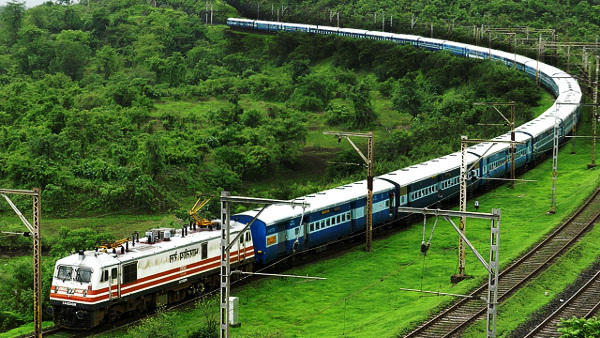
Indian Railways is preparing for a major expansion of its busiest trunk network, with plans to progressively develop four tracks across seven high-density railway corridors spanning nearly 11,000 kilometres. The programme is intended to unlock additional capacity for passenger and freight trains on routes that form the backbone of India’s national railway system.
Railway Minister Ashwini Vaishnaw outlined the programme on August 26, highlighting the extraordinary concentration of traffic on these corridors. Although the seven high-density routes constitute only about 16% of the Indian Railways network, they carry approximately 41% of the country’s total rail traffic.
The corridors identified for capacity expansion are Delhi–Howrah, Howrah–Chennai, Chennai–Mumbai, Mumbai–Delhi, Delhi–Chennai, Mumbai–Howrah and Delhi–Guwahati. Together, they connect India’s largest metropolitan regions, industrial centres, ports, manufacturing clusters and major consumption markets.
Four-tracking these corridors means progressively developing four railway lines across heavily utilised sections instead of depending mainly on the existing double-line network. This would allow Indian Railways to accommodate substantially more trains while separating different categories of traffic more effectively.
At present, passenger trains, premium services and freight trains often compete for the same railway paths on congested trunk routes. Faster passenger services can be delayed by slower freight trains, while freight movements may have to wait for passenger traffic to clear. Additional tracks give railway planners considerably greater flexibility in scheduling services and managing different operating speeds.
The scale of traffic on some corridors demonstrates the challenge. The Delhi–Howrah route, extending roughly 1,400 kilometres, handles more than 120 passenger trains and around 100 freight trains every day. The approximately 1,500-kilometre Delhi–Mumbai corridor carries more than 90 passenger trains and roughly 80 to 85 freight trains daily.
Increasing infrastructure capacity is therefore becoming essential as Indian Railways introduces more passenger services while simultaneously attempting to increase its share of national freight transportation.
The high-density corridors are particularly important to the economy because they link major production and consumption centres. Delhi, Mumbai, Chennai, Kolkata and Guwahati act as gateways to extensive regional economies, while numerous industrial clusters, logistics hubs and agricultural regions lie along the routes connecting them.
Additional railway capacity could consequently produce benefits extending beyond passenger travel. Faster and more predictable freight movement can lower logistics costs for manufacturers, reduce transit times and allow businesses to move larger volumes of raw materials and finished goods by rail.
The expansion also complements India’s Dedicated Freight Corridor programme. Dedicated freight lines have already created specialised capacity on important sections of the national network, allowing heavy freight trains to move without competing directly with passenger services. Four-tracking other high-density routes can extend similar capacity benefits across parts of the network where traffic remains exceptionally concentrated.
Passenger services could benefit equally. India is progressively introducing Vande Bharat trains, Amrit Bharat services and other modern rolling stock, but increasing train speeds and frequencies ultimately depends on sufficient track capacity. Adding new trains to already saturated corridors without expanding infrastructure would simply create additional congestion.
Four-tracking provides the physical capacity required for higher-frequency passenger operations and can potentially allow faster trains to overtake slower services more easily. It can also provide greater operational resilience when maintenance work, signalling failures or other disruptions temporarily affect one line.
The programme also has a wider environmental dimension. Railways are significantly more energy-efficient for moving large volumes of passengers and freight than road transport. Increasing railway capacity can encourage more cargo to shift from highways to rail, reducing fuel consumption, road congestion and emissions.
This becomes increasingly important as India’s economy grows and freight volumes expand. Without additional railway capacity, much of the incremental cargo demand could migrate towards road transportation, increasing pressure on highways and raising logistics and environmental costs.
The proposed four-tracking programme forms part of a broader transformation of Indian Railways involving network electrification, automatic signalling, station redevelopment, modern train manufacturing, freight-corridor construction and expansion of track capacity.
Expanding nearly 11,000 kilometres of strategic railway corridors towards four-line operation therefore represents much more than another track-construction programme. It is an attempt to strengthen the core arteries of India’s transportation system so that passenger mobility, freight movement and industrial growth are not constrained by railway congestion.
You may also like
-
Hindalco Brings Superfine PPT ATH Manufacturing to India With 30,000-Tonne Belagavi Plant
-
India Certifies First 15-Metre Multi-Axle Sleeper Bus as Domestic Coach Engineering Advances
-
Dhaksha Opens New Drone Manufacturing Facility in Tamil Nadu, Unveils Indigenous Agricultural UAVs
-
India and Morocco Target Doubling Bilateral Trade as Both Sides Explore Preferential Trade Agreement
-
DRDO Advances Plans for New Trisonic Wind Tunnel at RCI Hyderabad for Advanced Aerospace Testing
