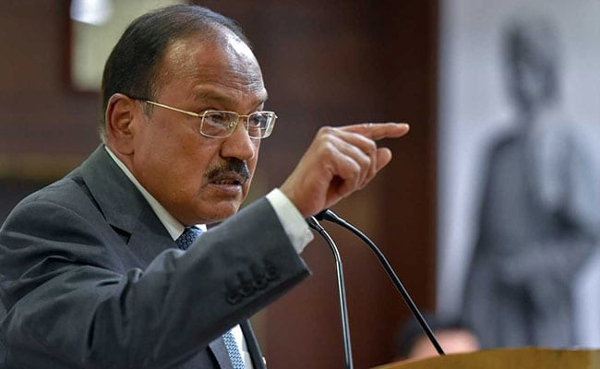
India and China have held the 25th round of Special Representatives’ Talks on the boundary question in Beijing, with National Security Advisor Ajit Doval and Chinese Foreign Minister Wang Yi leading high-level discussions aimed at preserving stability along the border while advancing the gradual improvement of bilateral relations. The meeting continued one of the most important political mechanisms available to the two countries for managing their unresolved boundary dispute.
Doval participated as India’s Special Representative on the India-China Boundary Question, while Wang represented China in the same capacity. The two sides held candid and detailed discussions on the boundary issue under the strategic direction established through recent engagements between Prime Minister Narendra Modi and Chinese President Xi Jinping. The talks also covered the wider relationship between the two Asian powers and international and regional issues of mutual interest.
A central theme of the discussions was the need to maintain peace and tranquillity in the border areas. India has consistently linked stability along the frontier with the ability of the broader bilateral relationship to develop normally. The latest round reinforced the importance of preventing differences over the boundary from generating fresh military tension while diplomatic and military mechanisms continue working on unresolved issues.
Both sides reaffirmed their commitment to continue working towards a political settlement of the boundary question. The process remains guided by the 2005 Agreement on the Political Parameters and Guiding Principles for the Settlement of the India-China Boundary Question, with the objective of eventually reaching a fair, reasonable and mutually acceptable solution. Dialogue and consultation through the Special Representatives mechanism will therefore remain central to efforts to manage the dispute and explore the conditions for a longer-term settlement.
The Beijing meeting builds on significant institutional measures agreed during the 24th round of Special Representatives’ Talks in New Delhi in August 2025. Those discussions led to the establishment of an expert-level process to examine possible early progress on boundary delimitation in appropriate sectors, a working group focused on more effective border management and additional General-Level mechanisms for the eastern and middle sectors. The two countries also agreed to continue discussing de-escalation through diplomatic and military channels.
Work on these mechanisms continued in 2026 through the Working Mechanism for Consultation and Coordination on India-China Border Affairs. At its 36th meeting in New Delhi on August 6, officials discussed boundary delimitation, border management, institutional mechanisms and cross-border cooperation while agreeing to maintain communication through both diplomatic and military channels. That meeting also served as a preparatory step for the latest Special Representatives’ dialogue.
The broader diplomatic environment has also improved compared with the period of severe strain that followed earlier border tensions. Recent engagement has included the resumption and expansion of people-to-people contacts, the Kailash Manasarovar Yatra and efforts to restore traditional cross-border exchanges. Such developments do not resolve the fundamental boundary dispute, but they indicate that both governments are attempting to rebuild functional cooperation while keeping sensitive security issues under dedicated negotiating mechanisms.
Before the Special Representatives’ meeting, Doval also met Chinese Vice President Han Zheng in Beijing. Their discussions covered ways to strengthen peace and tranquillity in the border areas while developing bilateral engagement across economic, political and multilateral forums. The meeting highlighted the increasingly broader character of the India-China dialogue, with border management being pursued alongside attempts to stabilise other areas of the relationship.
The 25th round therefore represents more than another procedural meeting on the boundary question. It reflects an effort by both countries to convert recent border stability into a more durable framework for managing differences while allowing economic, diplomatic and multilateral engagement to move forward. At the same time, the absence of a final boundary settlement means that sustained communication, confidence-building and effective border-management arrangements will remain essential.
India and China have agreed that the 26th round of Special Representatives’ Talks will be held in India in 2027, ensuring continuity in the highest-level political channel dedicated specifically to the boundary question. The next phase will show whether the expanding diplomatic mechanisms can translate sustained border tranquillity into measurable progress towards an eventual political settlement.
You may also like
-
India-Russia Strategic Partnership Deepens as Jaishankar Pushes Trade, Energy and Economic Cooperation in Moscow
-
India and Japan Push for Deeper Investment, Technology and Talent Partnership
-
India-GCC FTA Talks Gain Momentum as $178 Billion Trade Partnership Moves Toward Deeper Integration
-
India and Mauritius Move to Deepen Cooperation in Civil Service Training, Digital Governance and Capacity Building
-
India and Russia Push for $100-Billion Trade as Economic Partnership Expands Into Technology, Energy and Industry
