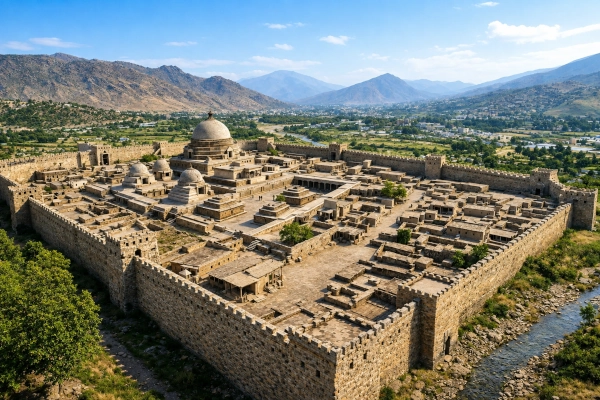
The ancient city of Bazira-Barikot in Pakistan’s Swat Valley is receiving renewed international attention after its inclusion on UNESCO’s World Heritage Tentative List, highlighting an archaeological landscape that preserves more than three millennia of settlement, urban development, religious transformation and cultural exchange in the north-western reaches of the ancient Indian subcontinent.
Located on the left bank of the Swat River in present-day Khyber Pakhtunkhwa, Barikot is identified with ancient Bazira, also known in regional traditions as Vajirasthana. Archaeological evidence indicates human occupation in the area from at least the second millennium BCE, followed by successive Early Historic, Indo-Greek, Kushan, Kushano-Sasanian, later Hindu Shahi and early Islamic phases.
Pakistan formally submitted Bazira-Barikot to UNESCO’s Tentative List on 11 May 2026 under cultural criteria relating to cultural interchange, testimony to civilisation and important examples of urban architecture. Its inclusion does not yet make Barikot a UNESCO World Heritage Site, but it is a necessary preliminary step before the property can be considered for full inscription.
What distinguishes Barikot from many archaeological sites is the extraordinary continuity of its occupation. Rather than representing a monument associated with a single dynasty or religious tradition, it preserves layer upon layer of urban life stretching across major transformations in the history of Gandhara.
The archaeological landscape consists of a fortified hill or acropolis overlooking an extensive settlement on the adjoining plain. Excavations have revealed planned streets, residential compounds, storage structures, workshops, defensive walls and religious precincts, allowing researchers to reconstruct not simply elite monuments but the workings of an ancient city.
Craft activity appears throughout the settlement. Archaeologists have recovered evidence for ceramics, bead production and metallurgy alongside large quantities of pottery, terracotta figures, glass and shell beads, metal tools, coins and other objects. These finds demonstrate that Barikot participated in regional and long-distance commercial networks connecting Gandhara with other parts of the Indian subcontinent, Central Asia and regions farther west.
Barikot occupies an especially important place in the archaeology of ancient Gandhara, the wider cultural region encompassing parts of the present-day Swat, Peshawar and Taxila landscapes. This frontier between South Asia and Central Asia became one of antiquity’s most important meeting grounds for Indian, Iranian, Central Asian and Hellenistic cultural traditions.
Classical accounts identify Bazira with a fortified settlement captured during Alexander of Macedon’s campaign in 327 BCE. Modern archaeological work has provided a chronological framework broadly consistent with occupation during this period, while excavations have also identified cultural phases associated with Achaemenid, Graeco-Bactrian and Indo-Greek influences.
Yet Barikot’s importance goes much further than its connection with Alexander. Its archaeological sequence allows scholars to study what happened after the arrival of Hellenistic political power and how foreign influences were absorbed into existing South Asian cultural traditions.
The city subsequently became part of the expanding Buddhist world of Gandhara. Among the most important recent discoveries is Shrine H, an apsidal Buddhist sanctuary whose earliest phase has been dated to approximately the middle or later third century BCE.
The sanctuary developed through several architectural phases. UNESCO documentation describes an early circular structure containing a small stupa that was later incorporated into an apsidal architectural form. Its antiquity is particularly important because it provides evidence for the development of formal Buddhist sacred architecture in an urban setting at a remarkably early date.
The discovery strengthens the importance of the Swat Valley in understanding the early architectural history of Buddhism. Gandhara is frequently associated with the spectacular Buddhist sculpture of later centuries, particularly the Kushan era, but Barikot demonstrates that organised Buddhist religious architecture in the region had considerably earlier roots.
Another important structure, known as Temple B, belongs to the Late Kushan period and represents a substantial urban temple complex with a raised platform, cella and ritual court. Together with Buddhist stupas, monasteries and other religious buildings around the city, it demonstrates how sacred institutions existed alongside residential and industrial districts.
The material remains also reveal the transformation of religious traditions over many centuries. Buddhist structures were eventually accompanied or succeeded in the wider landscape by Brahmanical monuments associated with the Hindu Shahi period, while later Islamic remains document yet another phase in the history of the settlement.
This sequence makes Bazira-Barikot particularly valuable for understanding the long cultural history of the north-western Indian subcontinent. The city was not simply replaced whenever political authority changed. Instead, communities repeatedly adapted the same landscape, rebuilding its streets, fortifications, workshops and sacred spaces while incorporating new cultural influences.
The inscriptions recovered from the wider archaeological context add another dimension. Finds associated with Barikot and the Swat archaeological collections include material written in Kharoṣṭhī, Brahmi and Greek, reflecting the multilingual environment that developed in Gandhara as Indian and trans-regional traditions interacted.
Kharoṣṭhī itself is especially characteristic of ancient north-western South Asia. Used widely for Prakrit languages in Gandhara, it provides evidence for administration, religious patronage and commercial activity during periods when the region maintained extensive contacts with Central Asia and the Hellenistic world.
Despite these external connections, describing Gandhara simply as a fusion between “Greek” and “Indian” civilisation would understate its complexity. Barikot shows a local society continuously adopting, reshaping and transmitting influences while maintaining deeply rooted South Asian religious and cultural traditions.
This becomes particularly evident in Buddhist art and architecture. Gandharan artistic traditions later travelled with Buddhist communities and merchants into Afghanistan, Central Asia and eventually toward China, helping make the region one of the great transmission zones through which Indian religious ideas spread across Asia.
The Swat Valley held a particularly important place in this process. Ancient Buddhist communities established monasteries and sacred complexes throughout its valleys and mountain approaches, transforming the region into a major centre of Buddhist learning and pilgrimage.
Barikot was therefore not an isolated fortified town. It functioned within a much wider landscape containing important archaeological sites such as Amluk-dara, Gumbat and other Buddhist complexes, many connected by ancient routes through the valley.
Archaeologists are now considering a broader heritage strategy that could integrate Barikot with neighbouring monuments and the natural setting surrounding Mount Ilam, creating a more complete archaeological landscape rather than treating individual ruins separately.
Italian archaeologists have played an important role in revealing the site. The Italian Archaeological Mission has conducted systematic investigations at Barikot for decades, developing one of the most detailed archaeological sequences available for the Swat region.
Dr Luca Maria Olivieri, who has worked extensively at Barikot, has described the site as one of South Asia’s most important archaeological locations because of its exceptional chronological depth, long excavation record and unusually well-preserved evidence of successive civilisations. He has suggested that, with proper conservation and management, the Tentative List inclusion could eventually lead toward a full UNESCO nomination.
The distinction is important. Barikot has not yet been inscribed on the UNESCO World Heritage List. Pakistan’s Tentative List currently contains 37 properties, with Bazira-Barikot among a group of sites added during 2026. A full nomination would require further documentation, conservation planning, boundary definition, management arrangements and international evaluation.
Conservation will be crucial because parts of the archaeological footprint have already experienced disturbance from both human activity and natural processes. Protecting the relationship between the acropolis, ancient urban settlement and surrounding religious monuments will be essential if the site’s archaeological integrity is to survive increasing development pressure.
For the history of the Indian subcontinent, however, Bazira-Barikot is already immensely important regardless of its future UNESCO status.
Its archaeological layers preserve the history of a region through which Bronze and Iron Age communities, ancient Indian polities, Achaemenid influences, Alexander’s armies, Indo-Greek rulers, Buddhist communities, Kushans, Hindu Shahis and later Islamic societies successively passed or established themselves.
Few archaeological sites preserve these transformations within such a continuous urban sequence.
The emerging picture is therefore not simply that of an ancient city receiving modern heritage recognition. Bazira-Barikot provides a physical archive of how the north-western frontier of ancient India interacted with the wider Eurasian world while becoming one of the principal landscapes through which Buddhism, commerce, artistic traditions and ideas travelled between the Indian subcontinent and Asia.
Its renewed recognition brings attention back to Gandhara not merely as a crossroads between civilisations, but as a civilisation-producing region in its own right — one whose cities, monasteries, craftsmen and trading communities played an important role in shaping the cultural history of South and Central Asia for more than two thousand years.
You may also like
-
Vaidisha in the Mahabharata-Era Geography: The Ancient Vidisha Region of Central Madhya Pradesh
-
Nepal Flash Flood Disaster Leaves Nearly 100 Dead as India Launches Major Relief and Rescue Response
-
How a Rock Shelter in Nagaland Is Rewriting Northeast India’s Prehistory
-
Dasharna in the Mahabharata: The Ancient Kingdom of Vidisha and Eastern Malwa
-
13th-Century Tamil Inscription Reveals Jewish Merchants Helped Build Hall at Shiva Temple in Krishnagiri
