India’s total kharif crop area has reached 1,056.70 lakh hectares as of August 21, 2026, compared with 1,072.77 lakh hectares during the corresponding period last year. The latest sowing data show a year-on-year decline of 16.07 lakh hectares, with lower rice acreage accounting for most of the overall reduction.
Rice remains the country’s largest kharif crop by area, with sowing reported across 405.10 lakh hectares, down from 418.29 lakh hectares a year earlier. This represents a decline of 13.19 lakh hectares. Karnataka recorded the largest reduction in rice acreage at 3.09 lakh hectares, followed by Telangana at 2.45 lakh hectares, Jharkhand at 1.88 lakh hectares, Madhya Pradesh at 1.75 lakh hectares and Odisha at 1.63 lakh hectares. Assam, however, reported an increase of 2.80 lakh hectares in rice coverage.
Pulses emerged as one of the stronger segments of the kharif season. Total pulse acreage increased to 113.63 lakh hectares, compared with 112.14 lakh hectares during the same period last year, marking a gain of 1.49 lakh hectares. Uttar Pradesh accounted for a substantial part of the increase, followed by Telangana, Jharkhand, Rajasthan, Andhra Pradesh and Madhya Pradesh. These gains more than offset lower sowing in Maharashtra, Karnataka and Odisha.
Within the pulses category, urad acreage increased by 2.65 lakh hectares to 24.38 lakh hectares, while tur gained 0.42 lakh hectares. Moong cultivation, however, declined by 1.25 lakh hectares to 32.68 lakh hectares.
Area under Shree Anna and coarse cereals stood at 176.36 lakh hectares, down 3.45 lakh hectares from 179.81 lakh hectares last year. Maize acreage declined by 3.79 lakh hectares to 89.51 lakh hectares, while ragi fell by 1.79 lakh hectares. Bajra moved in the opposite direction, increasing by 1.35 lakh hectares to 64.68 lakh hectares, while jowar acreage rose by 0.81 lakh hectares.
Oilseed sowing remained broadly stable at 188.37 lakh hectares, only 0.32 lakh hectares below last year’s 188.69 lakh hectares. Soybean acreage declined by 1.41 lakh hectares to 121.35 lakh hectares and castor by 1.54 lakh hectares, but higher sowing of sesame, groundnut and sunflower partially compensated for those reductions. Uttar Pradesh and Madhya Pradesh recorded notable increases in overall oilseed coverage, while Rajasthan and Gujarat reported declines.
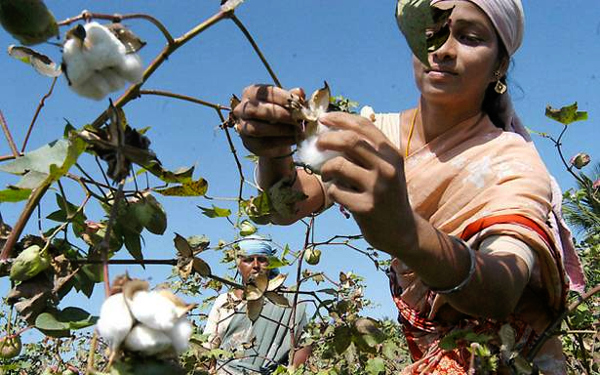
Sugarcane acreage stood at 58.44 lakh hectares, marginally below the 58.87 lakh hectares recorded during the corresponding period last year. Cotton covered 108.45 lakh hectares, against 108.73 lakh hectares a year earlier. Cotton acreage increased notably in Telangana and Gujarat, but declines in Rajasthan, Haryana and Punjab kept the national figure slightly below last year’s level.
Jute and mesta were among the crops to register an increase, with combined acreage rising to 6.34 lakh hectares from 6.23 lakh hectares. Higher cultivation in Bihar and West Bengal outweighed lower coverage in Assam.
The latest figures indicate that the 2026 kharif season is developing unevenly across crops and states. While the sharp reduction in rice acreage has pulled down the overall sowing figure, higher pulse cultivation and relatively stable oilseed, cotton and sugarcane acreage suggest a more mixed picture across the wider agricultural sector. The sowing pattern will continue to evolve as the monsoon season progresses and late planting is completed in several regions.
Source: PIB: https://www.pib.gov.in/PressReleaseDetail.aspx?PRID=2302874®=48&lang=1
You may also like
-
ICAR Scientists Develop Indigenous Protective Gloves for Cotton Farmers, Sign Commercial Manufacturing Agreement
-
BHEL–Coal India Joint Venture Begins Construction of ₹25,016 Crore Indigenous Coal Gasification Project in Odisha
-
PM Modi to Inaugurate RBI’s Tier IV Data Centre and Cybersecurity Training Institute in Bhubaneswar
-
India Creates 11 Crore Digital Farmer IDs Five Months Ahead of Target, Strengthening AgriStack Infrastructure
-
Chak-Hao Black Rice of Manipur and Nagaland: The Aromatic Purple Heritage Grain with GI Recognition
