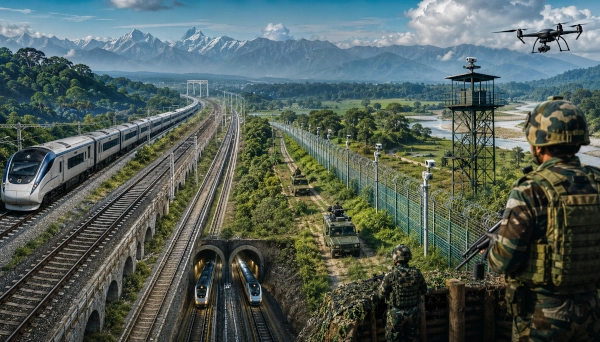
India is steadily transforming the strategically critical Siliguri Corridor through a combination of railway redundancy, expanded military presence and technology-driven border surveillance. The latest developments include approval for a fourth surface railway line, plans for two underground railway tracks, additional Army garrisons around the eastern frontier and a new security grid integrating forces responsible for protecting the narrow land bridge connecting mainland India with the Northeast.
The Centre has now approved a fourth railway line through the strategically important corridor, strengthening the Malda-New Jalpaiguri rail axis that carries a large share of passenger, freight and logistical traffic towards northeastern India. Northeast Frontier Railway officials have confirmed that an earlier third-line proposal is being supplemented by the fourth line, substantially increasing the capacity and resilience of this crucial railway connection.
The longer-term plan is even more significant from a national-security perspective. Indian Railways is working towards converting the existing surface railway infrastructure through the strategic stretch into four overground tracks while constructing another two tracks underground. Once implemented, this would give the Siliguri region a six-line railway configuration comprising four surface and two subterranean lines. The underground component has been conceived partly to provide greater protection and redundancy to Northeast connectivity during emergencies.
The proposed underground section is planned between the Tin Mile Haat and Rangapani areas, with railway officials previously outlining construction at approximately 20 to 24 metres below ground. One connection would extend towards Bagdogra, an area of considerable military importance because of the nearby air base and wider defence infrastructure. Separately, a nearly 29-km double-line underground project between Tinmai Ghat and Bagdogra has also been identified as an important strategic infrastructure initiative.
Railway redundancy is particularly important because the Siliguri Corridor remains India’s principal terrestrial gateway to the eight northeastern states. The narrow corridor lies between Nepal and Bangladesh, with Bhutan nearby and the China frontier further north. Any severe disruption to transport through this region could affect civilian supplies, commercial freight and military logistics simultaneously. Increasing rail capacity therefore serves both economic development and strategic mobility.
The infrastructure build-up is being accompanied by a stronger military posture. India established three new Army garrisons during 2025 at Bamuni near Dhubri in Assam, Kishanganj in Bihar and Chopra in West Bengal. The Lachit Borphukan Military Station at Bamuni and the forward installations at Kishanganj and Chopra are intended to strengthen surveillance, improve rapid troop deployment and close operational gaps around the corridor and the India-Bangladesh frontier.
These new positions supplement an already substantial military presence in and around North Bengal and Sikkim. The broader region supports formations responsible for the northern and eastern frontiers as well as strategically important air and missile assets. The new garrisons add another layer of dispersed response capability, reducing dependence on a small number of established military stations and allowing troops to react more rapidly to contingencies around the corridor.
The security architecture is also expanding beyond conventional military deployments. On August 21, Union Home Minister Amit Shah said the Siliguri Corridor was being secured through a triangular security grid, with greater government presence, surveillance and coordination across the densely populated region. The Centre has also received in-principle approval for land required by security agencies to strengthen their presence around the corridor.
Along the India-Bangladesh frontier, the government is simultaneously moving towards a Smart Border model that combines physical fencing with electronic surveillance. During an inspection at the Jhumagachh Border Outpost near Siliguri in July, the Home Minister reviewed an indigenous radio-based fence-breach detection system capable of automatically alerting personnel when fencing is disturbed. Infrared alarm systems are also being deployed for riverine terrain, streams and areas where conventional fencing is difficult to construct.
The visit also saw development and security projects valued at approximately ₹77 crore taken forward. These included three BSF projects worth about ₹47 crore and a new four-kilometre border fence costing approximately ₹30 crore on recently acquired land associated with two border outposts in West Bengal. The measures form part of a wider attempt to combine barriers, sensors, communications systems and troop deployment into an integrated border-management network.
The scale of the challenge is considerable. India shares a 4,096.7-km border with Bangladesh, running through West Bengal, Assam, Meghalaya, Tripura and Mizoram. Government records identify illegal cross-border movement and other illicit activity among the principal security challenges along the frontier. Difficult riverine terrain, settlements close to the boundary and stretches where physical fencing remains impractical have also encouraged the deployment of technological barriers and surveillance systems.
Taken together, the railway, military and border-security programmes indicate a broader change in India’s approach to the eastern gateway. Rather than depending solely on protecting the narrow corridor itself, the emerging strategy seeks to create redundancy in transport, dispersed military strength and layered electronic surveillance across the surrounding region.
The fourth railway line increases immediate transport capacity, while the two planned underground tracks could provide a protected alternative for strategic movement. The new Army garrisons improve rapid-response options, and Smart Border systems extend surveillance across difficult sections of the Bangladesh frontier. Together, these measures are gradually turning the Siliguri Corridor from a geographic vulnerability into a more resilient and heavily protected strategic link between the Indian mainland and the Northeast.
You may also like
-
India Moves Towards Five-Year Assured Orders for Defence Startups Under New Procurement Reforms
-
Zen Technologies Introduces Indigenous Hyper-Strike Falcon AI-Guided Counter-Drone Interceptor
-
L&T and Germany’s SCHOTTEL Expand Partnership for Controllable Pitch Propeller Systems in Indian Shipbuilding
-
PM Modi to Inaugurate RBI’s Tier IV Data Centre and Cybersecurity Training Institute in Bhubaneswar
-
India to Train 60,000 Civil Defence Volunteers Across 12 States and UTs with Indian Army Support
