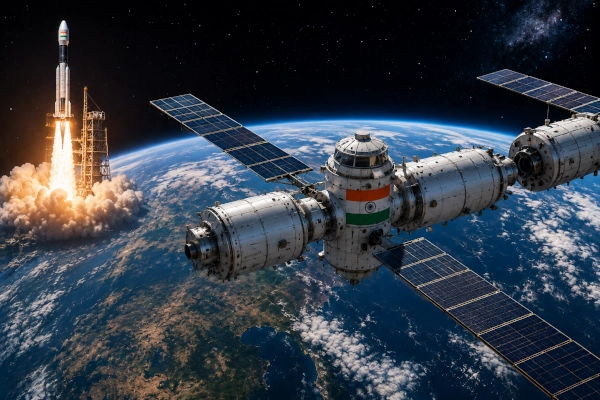
India is moving ahead with plans to establish its own orbital space station by 2035, with the first module of the proposed Bharatiya Antariksha Station (BAS) already approved. The programme will form a central pillar of India’s long-term human spaceflight strategy and is expected to build on capabilities being developed under the Gaganyaan mission.
ISRO Chairman Dr V Narayanan said the space agency is simultaneously advancing several major programmes, including Gaganyaan and the Bharatiya Antariksha Station. The approval of the first BAS module marks an important step toward creating a permanent Indian presence in low-Earth orbit and expanding the country’s role in human space exploration.
The proposed station is intended to move India beyond short-duration crewed missions and create a platform for sustained human activity in space. It would support scientific research, technology demonstrations and future human-spaceflight operations while giving India an independent orbital laboratory comparable in function to other national and international space-station programmes.
India’s space programme has expanded significantly over the past six decades, evolving from a modest launch and satellite effort into a broad national capability spanning Earth observation, communication, navigation, meteorology, disaster management, television broadcasting and remote sensing. Space-based applications are now used across dozens of civilian and strategic sectors.
The Bharatiya Antariksha Station programme is closely linked with Gaganyaan, which is designed to establish India’s ability to send astronauts into low-Earth orbit and return them safely. The technologies developed for crew transport, life support, human-rated launch systems, rendezvous, docking and orbital operations will form the foundation for more complex missions involving a permanent space station.
The first approved BAS module is expected to serve as the initial building block of the station. Subsequent modules would gradually expand its capabilities, allowing longer-duration missions and supporting a wider range of scientific and technological experiments in microgravity.
India’s long-term space roadmap also places increasing emphasis on collaboration between ISRO and the country’s rapidly expanding private space industry. Private companies are now becoming more active in satellite production, launch services, payload development, space applications and other areas that were once dominated almost entirely by the government sector.
This broader industrial participation is expected to support ISRO as it concentrates more heavily on advanced missions, human spaceflight, deep-space exploration and next-generation launch technologies. Rather than reducing ISRO’s role, the expansion of private participation is widening the overall capacity of India’s space ecosystem.
The announcement comes as India marks the third National Space Day, commemorating the success of Chandrayaan-3 and its historic landing near the lunar south polar region in August 2023. The mission significantly raised India’s global profile in planetary exploration and provided momentum for a more ambitious long-term programme extending from human spaceflight to lunar exploration and sustained orbital operations.
The Bharatiya Antariksha Station represents the next major stage in that progression. Establishing a national space station would give India an independent platform for conducting microgravity research, testing new technologies, training astronauts and preparing for more ambitious human missions beyond low-Earth orbit.
With the first module now approved and Gaganyaan moving forward, India is gradually assembling the technological and industrial base required for sustained human presence in space. The 2035 target places the Bharatiya Antariksha Station at the centre of India’s transition from a primarily satellite- and exploration-focused space programme toward a broader human-spaceflight capability with long-duration orbital operations.
You may also like
-
Bengaluru Startup Paar Autonomy Develops AI-Powered Drone Systems for GPS-Denied Environments
-
Sigma Advanced Systems Secures Fresh ₹973 Crore NATO Artillery Ammunition Order
-
India Advances Indigenous Defence and Space Technologies Through Naval Innovation, Drones and Advanced Electronics
-
ISRO Plans Four Operational Launch Pads by 2029 to Expand India’s Space Capabilities
-
Thales Seeks Indian Partnerships for Next-Generation Missiles, Radars and Electronic Warfare Systems
