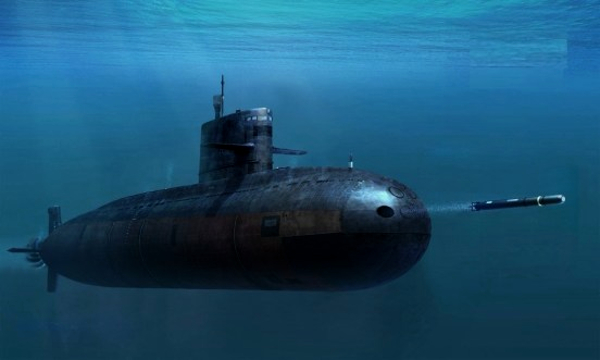
India’s Defence Research and Development Organisation is advancing a new generation of ultra-sensitive quantum magnetometers that could eventually allow aircraft and unmanned aerial vehicles to detect submerged submarines by measuring extremely small disturbances in the Earth’s magnetic field. The effort represents an important expansion of India’s anti-submarine warfare research beyond conventional acoustic detection and could provide the Indian Navy with an additional non-acoustic method of locating difficult underwater targets.
The technology is based on atomic magnetometry, which exploits quantum properties of atoms to measure extraordinarily weak magnetic fields. Unlike conventional magnetic sensors, atomic magnetometers can achieve extremely high sensitivity without necessarily requiring the cryogenic cooling associated with superconducting quantum interference devices. DRDO’s technology roadmap currently lists an Atomic Vapor Magnetometer under its Solid State Physics Laboratory and a separate magnetometer sensor package targeting femto-Tesla-range sensitivity under the DRDO Young Scientists Laboratory for Quantum Technologies, or DYSL-QT.
The basic principle behind its potential anti-submarine application is relatively straightforward. A conventional steel-hulled submarine interacts with the Earth’s magnetic field and produces a very small magnetic anomaly relative to the surrounding environment. If a sufficiently sensitive sensor can identify that disturbance against naturally occurring magnetic noise, the submarine could potentially be detected without relying exclusively on the acoustic energy used by sonar systems.
DRDO Chairman Dr Samir V. Kamat has directly linked the organisation’s quantum-sensing research to submarine detection. He explained that DRDO is working on magnetometers capable of detecting changes in magnetic fields at the picotesla level and said such sensors could eventually be carried aboard UAVs or aircraft. According to Kamat, the technology could potentially enable submarine detection at depths of around 100 to 200 metres. The figure should presently be treated as a projected capability rather than a publicly demonstrated operational detection range.
The programme has already progressed beyond a purely theoretical concept. Researchers from DYSL-QT, working with the Tata Institute of Fundamental Research in Hyderabad, have developed a compact single-axis atomic magnetometer with picotesla sensitivity. A study published in DRDO’s Defence Science Journal in 2025 described a portable sensor capable of operating within the Earth’s magnetic field and detecting small environmental magnetic-field variations caused by magnetic objects. The research specifically identified submarine detection as one of the important defence applications of highly sensitive atomic magnetometers.
The demonstrated system uses nonlinear magneto-optical resonance to measure magnetic fields through changes in the quantum states of atoms. In simple terms, carefully controlled laser light interacts with atoms inside the sensor, and changes in the surrounding magnetic field alter their behaviour. Measuring those changes allows the system to detect magnetic-field variations far smaller than those measurable by many conventional sensors.
DRDO is simultaneously looking considerably beyond the current picotesla-class demonstrator. Its official quantum-technology development roadmap includes a sensor package for an atomic magnetometer targeting femto-Tesla-range sensitivity. One femtotesla is one-thousandth of a picotesla, meaning that achieving useful femtotesla-level performance could significantly increase the ability to identify extremely weak magnetic signatures. Developing such sensitivity in laboratory conditions, however, is different from maintaining it aboard a moving aircraft or UAV operating over a magnetically complex ocean environment.
This distinction will be critical to converting the technology into an operational anti-submarine warfare sensor. An airborne magnetometer has to separate the target’s magnetic anomaly from disturbances generated by the aircraft itself, onboard electronics, geological formations, waves, infrastructure and variations in the Earth’s natural magnetic field. Accurate localisation would also require sophisticated signal processing, magnetic compensation and potentially fusion with information from other sensors.
DRDO’s underwater technology roadmap already indicates that magnetic and non-acoustic submarine detection are active areas of research. Listed technologies include a self-motion-compensated Magnetic Anomaly Detection sensor, extremely low-frequency electromagnetic sensors for ship and submarine detection, and long-range non-acoustic target detection. Quantum magnetometry could therefore become part of a broader family of complementary sensors rather than an isolated technology.
For anti-submarine warfare, the attraction of magnetic detection is that it does not depend on a submarine producing substantial acoustic noise. Modern submarines are designed to minimise machinery vibration, propeller noise and other acoustic signatures, making passive sonar detection increasingly difficult. Active sonar can reveal underwater targets but also transmits acoustic energy that may reveal the presence and approximate location of the searching platform.
A quantum magnetometer would instead search for a different physical signature. Steel cannot completely avoid interacting with the Earth’s magnetic environment, even when submarines employ degaussing systems to reduce their magnetic signatures. Detecting extremely small residual anomalies could consequently provide another method of narrowing the search area for a suspected submarine.
Such systems would not replace sonar. Their greatest value would likely emerge when combined with existing anti-submarine warfare assets including hull-mounted sonars, variable-depth sonars, towed arrays, sonobuoys, dipping sonars, maritime patrol aircraft and unmanned platforms. A quantum magnetic sensor detecting an unusual anomaly could cue other assets to investigate the area, while information from acoustic sensors could simultaneously improve confidence in the contact.
Airborne deployment could be particularly important. Magnetic Anomaly Detection equipment has traditionally been carried on maritime patrol aircraft and anti-submarine helicopters, but conventional systems generally require the aircraft to pass relatively close to the submarine. If quantum sensing can reliably detect much weaker anomalies at greater stand-off distances, it could considerably expand the usefulness of magnetic detection.
Unmanned aircraft could offer another attractive platform. UAVs carrying compact quantum magnetometers could conduct persistent searches over designated maritime areas without exposing large crewed aircraft for extended periods. Multiple unmanned sensors operating cooperatively could potentially create distributed magnetic-surveillance grids over chokepoints, coastal approaches or areas where submarine activity is suspected.
The technology could also become increasingly relevant as underwater warfare shifts toward quieter conventional submarines, nuclear-powered submarines and unmanned underwater vehicles. Detecting such platforms requires navies to combine multiple physical sensing methods rather than depending on any single technology.
DRDO has been building the institutional infrastructure required for this wider quantum effort. In May 2025, the organisation inaugurated its Quantum Technology Research Centre at Metcalfe House in Delhi. Among its areas of research is an atomic magnetometer based on optically pumped magnetometry for ultra-sensitive magnetic-field detection, alongside quantum communication, atomic clocks and other advanced quantum technologies.
The most important technological challenge will now be turning laboratory sensitivity into a rugged military sensor capable of operating reliably in real-world maritime conditions. Detection range will depend on submarine size, hull material, magnetic treatment, depth, background geological conditions, sensor altitude, platform-generated interference and the sophistication of signal-processing algorithms. For that reason, the reported 100–200 metre submarine-depth figure should not be interpreted as an established operational specification until the system undergoes representative sea and airborne trials.
Nevertheless, DRDO’s work shows that India is moving toward an indigenous capability in one of the most advanced areas of modern military sensing. The combination of picotesla-class portable atomic magnetometers already demonstrated by Indian researchers and the planned development of femtotesla-range sensors provides a pathway toward increasingly sensitive magnetic detection.
Quantum magnetometry will give the Indian Navy another layer in its anti-submarine warfare network, particularly when integrated with sonar, maritime patrol aircraft, helicopters, satellites and unmanned platforms. Rather than making submarines suddenly transparent beneath the ocean, the technology could make their already faint magnetic signatures progressively harder to hide, strengthening India’s ability to detect and track underwater threats in strategically important waters.
References
Official Reference 1 — DRDO Quantum Technologies Roadmap
Defence Research and Development Organisation (DRDO), Ministry of Defence, Government of India. Quantum Technologies — Technology Foresight. The roadmap lists an Atomic Vapor Magnetometer under SSPL and a Magnetometer Sensor Package for Atomic Magnetometer with femto-Tesla-range sensitivity under DYSL-QT. (DRDO)
DRDO Quantum Technologies Roadmap
Official Reference 2 — Defence Science Journal, DRDO
Akash Bain, George Kurian K.K., Binoy Nambiar, Rajarshi Biswas and G. Rajalakshmi. A Portable Atomic Magnetometer with Pico-Tesla Sensitivity. Defence Science Journal, Vol. 75, No. 6, November 2025, pp. 693–697. DOI: 10.14429/dsj.21346. The paper describes a compact atomic magnetometer developed by DRDO Young Scientists Laboratory–Quantum Technologies (DYSL-QT) with TIFR Hyderabad and specifically identifies submarine detection through weak magnetic signatures as a defence application. (DRDO Publications)
DRDO Defence Science Journal Paper
Official Reference 3 — DRDO Quantum Technology Research Centre
DRDO inaugurated the Quantum Technology Research Centre (QTRC) at Metcalfe House, Delhi, on May 27, 2025. The centre includes work on an Atomic Magnetometer using optically pumped magnetometry for ultra-sensitive magnetic-field detection, led by the Solid State Physics Laboratory. (DRDO)
Official Reference 4 — DRDO Technology Focus: Quantum Sensing
DRDO, Technology Focus — Quantum Sensing, June 2023. The publication describes development of miniaturised atomic magnetometers and their potential military use for detecting magnetic anomalies generated by metallic objects, vehicles and ships. It also details SSPL work on key components required for miniaturised quantum magnetometers. (DRDO)
You may also like
-
Rajnath Singh to Lead Indian Delegation at ASEAN Defence Summit in Philippines, Strengthening Indo-Pacific Security Cooperation
-
Bengaluru Startup Paar Autonomy Develops AI-Powered Drone Systems for GPS-Denied Environments
-
Sigma Advanced Systems Secures Fresh ₹973 Crore NATO Artillery Ammunition Order
-
India Advances Indigenous Defence and Space Technologies Through Naval Innovation, Drones and Advanced Electronics
-
Thales Seeks Indian Partnerships for Next-Generation Missiles, Radars and Electronic Warfare Systems
