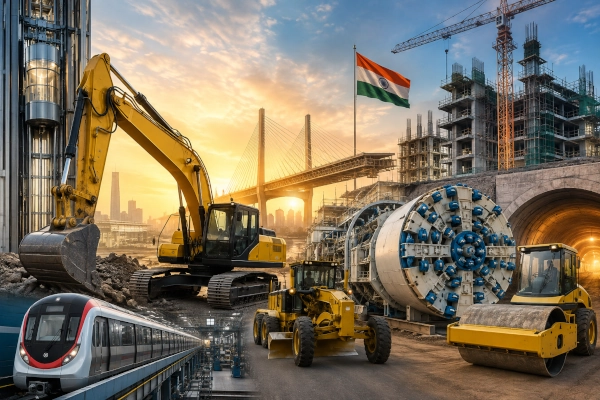
India is preparing a major incentive programme to build domestic manufacturing capacity for technologically advanced construction and infrastructure equipment, targeting machinery that the country currently imports in large quantities.
The proposed programme could provide around $1.2 billion in incentives over seven years and attract approximately $1.8 billion in new investment, according to Reuters, which cited two government sources. A final decision is expected soon, but the scheme has not yet received final approval or been formally notified.
The initiative would support Indian production of sophisticated equipment such as tunnel boring machines, high-rise elevators and specialised firefighting systems. These machines play an increasingly important role as India expands metros, highways, tunnels, airports and other large infrastructure projects.
Reducing Dependence on Imported Machinery
A central objective of the programme is to reduce India’s reliance on imported high-value construction machinery.
India remains dependent on foreign suppliers for several categories of advanced equipment, with China historically serving as an important source of tunnel boring and related machinery. The proposed scheme would introduce domestic value-addition requirements for equipment that is currently largely or entirely imported.
Tunnel boring machines are particularly important because India is simultaneously expanding metro networks, highway tunnels, hydropower projects and strategic roads through mountainous regions.
These machines are enormous engineering systems containing specialised cutting heads, hydraulic equipment, electric drives, guidance systems, conveyors and sophisticated control electronics. Establishing greater domestic capability therefore requires far more than simply assembling imported machinery.
It could create demand throughout India’s industrial ecosystem for precision engineering, heavy fabrication, electric motors, hydraulics, sensors, power electronics, control systems and advanced materials.
BEML, L&T and Indian Manufacturers Could Benefit
Reuters identified BEML, Larsen & Toubro and Johnson Lifts among companies that could potentially benefit from the proposed incentives.
BEML has already shown interest in developing indigenous tunnel boring machines, while Larsen & Toubro possesses extensive experience in heavy engineering and major infrastructure projects.
The policy could encourage these companies and other manufacturers to invest in technologies that previously lacked sufficient production volumes to justify large domestic manufacturing facilities.
Rather than supporting only final assembly, the proposed localisation requirements could also encourage manufacturers to source a greater share of critical components and subsystems from Indian suppliers.
Scheme Was Announced in Union Budget 2026-27
Finance Minister Nirmala Sitharaman announced a Scheme for Enhancement of Construction and Infrastructure Equipment (CIE) in the Union Budget 2026-27. The Budget described its objective as strengthening domestic manufacturing of high-value and technologically advanced equipment ranging from lifts and firefighting systems to tunnel boring machines used for metros and high-altitude roads.
A March 2026 parliamentary committee report subsequently described the proposed CIE scheme as having a ₹14,300 crore total financial outlay over seven years, with an initial ₹200 crore provision for FY27. It also highlighted India’s significant dependence on imported construction equipment.
The Reuters report of August 21 places the currently proposed incentive package at roughly $1.2 billion. The difference between that figure and the earlier ₹14,300 crore reference indicates that the final structure and financial components of the scheme should be treated as provisional until the government issues detailed guidelines.
A ₹1 Lakh Crore Domestic Market
India’s construction and infrastructure equipment market is already worth approximately ₹1 trillion, or around ₹1 lakh crore, according to Reuters, and demand is expected to expand as government and private investment flows into roads, metro systems, airports and urban infrastructure.
The Ministry of Heavy Industries has separately said the Indian construction equipment sector has the potential to grow substantially by the end of the decade as automation, AI-based fleet management, predictive maintenance and electric and hybrid machinery reshape the industry.
Developing indigenous machinery could therefore address two opportunities simultaneously: meeting India’s enormous domestic infrastructure requirement and establishing an Indian equipment industry capable of exporting to other rapidly developing economies.
Tunnel Boring Machines Highlight Strategic Dependence
Tunnel boring equipment demonstrates why localisation has become strategically important.
Reuters reported that Indian imports of tunnelling machinery from China fell from approximately $18 million in FY2022-23 to $3 million in FY2023-24, before declining to about $500,000 in FY2024-25 and $800,000 in FY2025-26.
China had also delayed customs clearance for some tunnel boring machine exports to India beginning in 2024, highlighting the vulnerability created when major infrastructure programmes rely heavily on equipment sourced from a limited number of overseas suppliers.
Developing domestic alternatives would give Indian infrastructure companies greater control over delivery schedules, maintenance, spare parts and future technological upgrades.
Moving Make in India Into Heavy Technology
India’s manufacturing localisation programmes have increasingly shifted from consumer products towards strategically important industrial technologies.
Construction machinery represents an important next step because the machines required to build infrastructure are themselves complex industrial products.
A successful localisation programme could therefore create capabilities that extend well beyond the construction sector. Technologies developed for tunnel boring machines, elevators and heavy infrastructure equipment can support mining, railways, defence engineering, energy projects and advanced manufacturing.
For now, the proposed $1.2-billion incentive package remains under finalisation. However, the underlying CIE programme has already been announced by the government, making the current discussions part of a wider effort to transform India from a major buyer of sophisticated construction machinery into an increasingly important manufacturer of it.
Reference:
Government of India — Union Budget 2026–27, Budget Speech — Ministry of Finance
https://www.indiabudget.gov.in/doc/budget_speech.pdf
Press Information Bureau — Parliamentary Committee Review of Scheme for Enhancement of Construction and Infrastructure Equipment (CIE) — Ministry of Heavy Industries
https://www.pib.gov.in/
Press Information Bureau — Indian Construction Equipment Sector and Advanced Manufacturing Initiatives — Ministry of Heavy Industries
https://www.pib.gov.in/
You may also like
-
Balaghat Chinnor Rice of Madhya Pradesh: The Fragrant Heritage Grain with GI Recognition
-
Indian Semiconductor Companies Propose New Manufacturing and Chip Design Investments in Madhya Pradesh
-
CSIR-CRRI Partners with Industry to Develop Advanced Indigenous Airport Runway and Pavement Materials
-
Paras Semiconductors Secures 43 Acres in Madhya Pradesh for Proposed ₹6,200 Crore Advanced Chip Packaging Facility
-
Petronet LNG Plans ₹1,200 Crore Joint Venture for Ten Compressed Biogas Plants Across India
