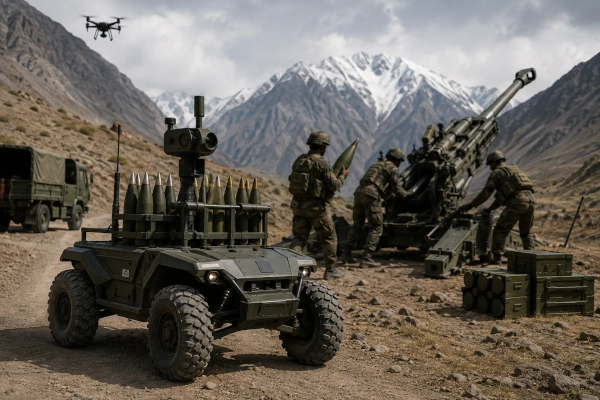
The Indian Army is moving to expand the use of unmanned ground vehicles in frontline support roles, with a new requirement emerging for a 4×4 UGV mobility platform linked to Field Artillery operations. The development reflects the Army’s growing focus on using unmanned systems to reduce the exposure of soldiers during ammunition resupply, equipment movement and other high-risk battlefield tasks.
Field artillery formations depend on a continuous supply of shells, propellant charges, fuzes, fuel and other stores. In modern combat, these logistics movements are increasingly vulnerable to reconnaissance drones, loitering munitions and counter-battery fire. A UGV could help carry ammunition and equipment through the final and most dangerous part of the supply route without placing soldiers inside a vehicle.
A four-wheel-drive unmanned platform offers a useful balance between payload capacity, cross-country mobility and mechanical simplicity. Depending on its final configuration, such a vehicle could operate from tracks, roads and rough terrain while carrying ammunition, communications equipment, engineering stores or other supplies to dispersed gun positions.
The Army has already shown wider interest in unmanned ground mobility. Procurement activity during 2026 has included multi-utility UGVs and platforms intended for deployment in difficult terrain, including the Leh region. These systems typically combine a mobility chassis, propulsion and power-management equipment, electro-optical sensors, communications links and a ground-control station.
Indian industry also possesses relevant indigenous technology. Kalyani Strategic Systems has developed the ECARS 4×4 unmanned ground vehicle, a multi-terrain platform designed for surveillance, logistics and other military roles. The vehicle has previously been displayed with a payload capacity of around 350 kg and a towing capacity of about 500 kg. However, there is no confirmation that ECARS has been selected for the latest artillery requirement.
For Field Artillery, ammunition transport is likely to be one of the most valuable applications. A 155 mm artillery shell can weigh around 40 to 50 kg depending on the type, which means even a relatively small ammunition load represents a substantial burden. Several UGVs operating between ammunition points and firing positions could reduce repeated crewed vehicle movements in areas exposed to enemy surveillance.
The concept also complements the Army’s growing emphasis on mobile and dispersed artillery. Modern guns increasingly rely on “shoot-and-scoot” tactics, firing rapidly before relocating to avoid counter-battery strikes. Unmanned logistics vehicles could help sustain this mobility by moving smaller ammunition loads between dispersed positions rather than relying only on larger, more predictable supply vehicles.
A modular 4×4 UGV could eventually support several other missions. Depending on the payload fitted, it could carry communications equipment, surveillance sensors, batteries, camouflage material or casualty-evacuation modules. Such flexibility would make the same basic platform useful across artillery, infantry and logistics formations.
The effectiveness of these vehicles will depend heavily on autonomy and communications. Battlefield UGVs must be capable of remote operation, waypoint navigation and obstacle avoidance while continuing to function in environments where satellite navigation or radio links may be disrupted by electronic warfare.
The emerging requirement therefore represents more than the acquisition of another robotic vehicle. It is part of a wider effort by the Indian Army to create a more distributed and survivable logistics network for future battlefields.
The program is scheduled to progress into a larger procurement. 4×4 UGVs could eventually become regular support assets for Indian artillery formations, moving ammunition and critical supplies while reducing the number of soldiers exposed to drone surveillance and counter-battery attack.
You may also like
-
Indian Semiconductor Companies Propose New Manufacturing and Chip Design Investments in Madhya Pradesh
-
CSIR-CRRI Partners with Industry to Develop Advanced Indigenous Airport Runway and Pavement Materials
-
Paras Semiconductors Secures 43 Acres in Madhya Pradesh for Proposed ₹6,200 Crore Advanced Chip Packaging Facility
-
Indian Army Special Forces Depart for Indonesia for Exercise Garuda Shakti 2026
-
India to Train 600 Nigerian Army Soldiers in Specialised Jungle and Mountain Warfare
