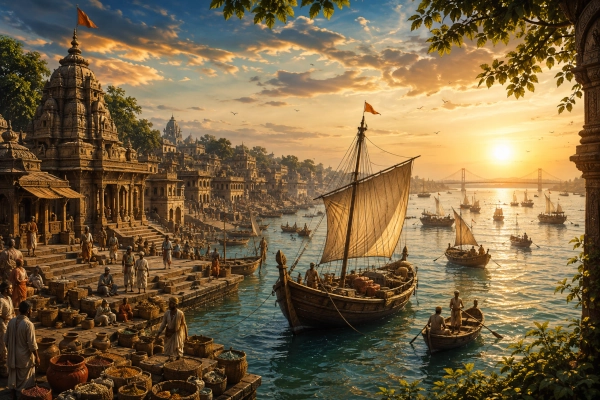
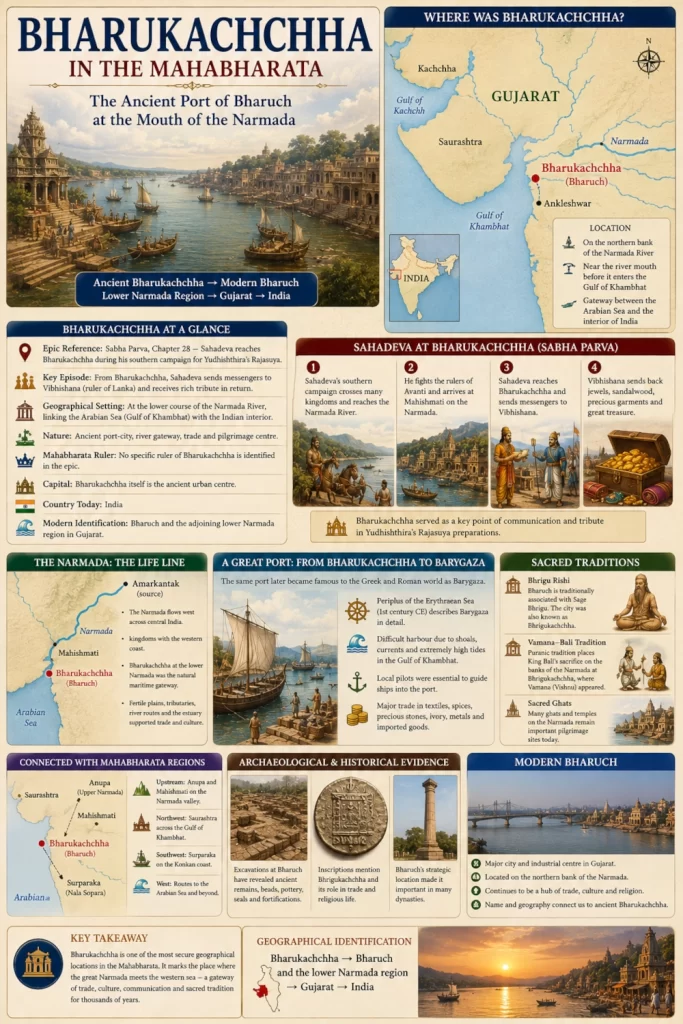
The ancient Bharukachchha, Bharukaccha or Bharukutch of the Mahabharata can be identified with remarkable confidence with modern Bharuch in Gujarat, situated on the lower course of the Narmada before the great river enters the Gulf of Khambhat. Unlike many places in epic geography whose modern locations remain disputed, Bharukachchha preserves both a strong continuity of name and an exceptionally clear geographical setting. The Government of Gujarat itself identifies the Bharukutch mentioned in the Sabha Parva of the Mahabharata with present-day Bharuch.
The Mahabharata gives Bharukachchha a particularly interesting place in the political geography surrounding Yudhishthira’s Rajasuya sacrifice. During Sahadeva’s southern campaign, the Pandava prince eventually reaches Bharukachchha. From there he sends messengers to Vibhishana, the celebrated ruler associated with Lanka, before returning with valuable tribute. The passage establishes Bharukachchha directly within the epic rather than depending upon a much later geographical tradition.
Bharukachchha was also situated at one of western India’s most important natural gateways. The Narmada flows westward across the subcontinent and reaches the sea through the Bharuch region, connecting the Arabian Sea and Gulf of Khambhat with routes extending deep into central India. Centuries after the Mahabharata tradition, the same city became famous to Greek and Roman merchants as Barygaza, one of the major international ports described in the Periplus of the Erythraean Sea.
Bharukachchha should therefore be understood primarily as an ancient port-city and lower Narmada region, rather than as a Mahabharata kingdom for which a ruler, dynasty and fixed political boundary can confidently be reconstructed. Its importance lies in the convergence of epic geography, sacred tradition, riverine movement and maritime trade at the point where the Narmada approaches India’s western sea.
Bharukachchha at a Glance
Ancient Bharukachchha corresponds to modern Bharuch and the adjoining lower Narmada region in Gujarat. The city stands on the Narmada east of the Gulf of Khambhat and historically controlled one of the most important routes linking the interior of western and central India with the Arabian Sea. The Mahabharata directly names Bharukachchha in the Sabha Parva during Sahadeva’s Rajasuya campaign.
No independent ruler of Bharukachchha is identified in the relevant Mahabharata passage, and the text does not describe a separate capital because Bharukachchha itself is the named urban location. In later historical periods the city became closely associated with the region of Lata, but that later political geography should not automatically be projected backward into the epic.
The geographical identification can therefore be stated as Bharukachchha → Bharuch and the lower Narmada → Gujarat → India.
Where Was Ancient Bharukachchha?
Bharuch lies on the northern bank of the Narmada River in southern Gujarat. Downstream, the river widens toward its estuary before entering the Gulf of Khambhat, while the Arabian Sea lies beyond the gulf. The Government of Gujarat describes the Narmada as the great shipping artery that gave Bharuch access to kingdoms and regions farther inland.
This geographical position explains much of Bharukachchha’s importance. The Narmada is one of the great west-flowing rivers of India, cutting across the interior rather than flowing toward the Bay of Bengal like most major northern rivers. A settlement near its lower course could therefore receive goods and travellers moving westward from central India and connect them with maritime routes.
Modern Bharuch provides the central anchor, but the wider geographical context should include Ankleshwar across the Narmada, the Narmada estuary, the Gulf of Khambhat and the approaches toward southern Gujarat. The ancient landscape was shaped as much by the river and tidal waters as by the city itself.
Bharukachchha Is Directly Named in the Mahabharata
The strongest evidence comes from Book II, the Sabha Parva, Chapter 28, which narrates Sahadeva’s expedition toward the south.
The chapter opens by stating that Sahadeva, honoured by Yudhishthira, departed with a large army toward the southern direction. His campaign carries him through numerous kingdoms and regions before reaching the western maritime world.
Verse 50 then explicitly says:
“bharukacchaṁ gato…”
The passage describes the son of Madri reaching Bharukaccha and sending messengers to Vibhishana. The chapter itself repeatedly identifies the campaigning Pandava as Sahadeva, and subsequent verses state that the mighty Sahadeva returned after receiving valuable tribute.
This direct occurrence of the place-name makes Bharukachchha one of the more secure geographical identifications in the Mahabharata.
Sahadeva’s Southern Campaign
The Bharukachchha episode belongs to the Pandavas’ preparations for Yudhishthira’s Rajasuya Yajna. Before Yudhishthira could claim imperial sovereignty, his brothers travelled in different directions to secure submission, tribute or recognition from rulers across Bharatavarsha.
Sahadeva was entrusted with the southern direction. The Sabha Parva describes him moving through Surasena and Matsya territory, continuing toward the Narmada, fighting the rulers of Avanti and Mahishmati and eventually extending his campaign across large parts of southern and western India.
Bharukachchha appears near the culmination of this extraordinary expedition. Its placement is significant because the city occupied a natural western gateway from which communication could extend both across the sea and along established commercial routes.
Sahadeva Reaches the Narmada
The Narmada appears earlier in the same campaign.
After receiving tribute and jewels from conquered rulers, Sahadeva is described as proceeding toward the Narmada River. He then confronts Vinda and Anuvinda of Avanti and continues to Mahishmati, one of the most celebrated cities associated with the Narmada valley.
The campaign therefore repeatedly interacts with the Narmada corridor before Bharukachchha itself appears.
This creates an important geographical pattern. Mahishmati represents the inland Narmada world, while Bharukachchha occupies the lower river near the western sea. The Mahabharata thus preserves two major points along the same natural corridor connecting central India with Gujarat.
Sahadeva at Bharukachchha
After the broad southern campaign described in the Sabha Parva, Sahadeva reaches Bharukachchha and sends envoys to Vibhishana, described as a descendant of Pulastya. The next verses state that Vibhishana accepted the communication favourably and sent back various treasures, including jewels, ornaments, sandalwood, aguru, costly garments and precious gems.
The episode is remarkable because Bharukachchha functions as a point of communication rather than simply a battlefield.
The text does not describe Sahadeva laying siege to the city or fighting a ruler of Bharukachchha. Instead, he reaches the location and uses it as the setting from which messengers are dispatched farther afield.
That role fits remarkably well with the later historical character of Bharuch as a major centre of long-distance communication and commerce, although the later evidence should not be used to assume that every feature of the classical port already existed in precisely the same form during the epic setting.
A Port at the End of a Great Inland Corridor
Bharukachchha’s geographical importance came from the union of river and sea.
The Narmada rises in central India and flows west through a long valley before reaching Gujarat. Routes following or intersecting this valley connected Bharuch with regions such as Anupa, Mahishmati, Malwa and the central Indian interior.
At its western end, Bharuch opened toward the Gulf of Khambhat and Arabian Sea.
The result was a natural transfer point. Goods travelling overland or along river-connected routes could be concentrated near Bharuch before entering maritime networks, while commodities arriving from overseas could move inland from the same location.
The Government of Gujarat describes the Narmada estuary as the geographical feature that gave Bharuch inland access to kingdoms and empires across the subcontinent.
The Lower Narmada Defines Bharukachchha
Bharukachchha should therefore not be understood solely as a dot representing one ancient city.
The surrounding lower Narmada landscape was fundamental to its existence. Fertile plains, tributary routes, river crossings, tidal waterways and the estuary created the geographical system upon which the settlement depended.
Modern Bharuch stands north of the river, while Ankleshwar lies across the Narmada to the south. Farther west, the river approaches the Gulf of Khambhat through a broad estuarine environment.
This riverine setting distinguishes Bharukachchha from neighbouring regions such as Saurashtra and Kachchha. Saurashtra was a peninsula projecting into the Arabian Sea, while Kachchha was dominated by the Rann, salt marshes and the Gulf of Kachchh. Bharukachchha belonged instead to the great river-mouth geography of southern Gujarat.
Bharukachchha and Bhrigukachchha
Ancient sources preserve several forms of the city’s name. Bharukaccha or Bharukachchha is the form occurring in the Mahabharata passage, while Bhrigukaccha or Bhrigukachchha became strongly associated with the tradition of the sage Bhrigu.
Historical archaeological scholarship records the Sanskrit forms Bharukachchha and Bhrigukachchha, while also noting the traditional association of the locality with Bhrigu.
Modern Bharuch continues to preserve this tradition. The district’s official cultural history describes a Bhrigu Rishi temple near the Narmada and records the belief that the city was once known as Bhrigukachchha because of the sage’s association with the place.
For a Mahabharata article, however, it is useful to retain the distinction: Bharukachchha is the form directly attested in the Sabha Parva, while Bhrigukachchha belongs to the closely related Sanskrit and sacred tradition surrounding Bhrigu.
The Tradition of Sage Bhrigu
Bhrigu is one of the great sages of ancient Sanskrit tradition and the ancestral figure associated with the Bhargavas, the lineage that later includes Jamadagni and Parashurama.
Bharuch has long claimed a particularly close relationship with Bhrigu. Local tradition places his residence or hermitage on the Narmada, while historical sources connect the name Bhrigukachchha with his presence in the region.
These traditions became important enough that Bharuch developed into a major sacred landscape as well as a commercial one.
The association is particularly appropriate within the broader geography of western India because another major Bhargava figure, Parashurama, is strongly connected in the Mahabharata with Surparaka farther south along the western coast.
The Narmada as a Sacred River
Bharukachchha’s importance was not only commercial. It stood on one of India’s most revered rivers.
The Narmada, also called Reva, occupies a prominent position in Sanskrit religious geography. The Mahabharata’s pilgrimage sections describe numerous sacred places along or connected with the river, showing that the Narmada valley formed an important tirtha landscape within the epic world.
By standing near the lower end of this sacred river system, Bharukachchha occupied a location where pilgrimage geography and maritime geography could intersect.
Later religious traditions around Bharuch became closely connected with the Narmada, Bhrigu and the Vamana-Bali narrative. The modern district administration still describes several ghats and shrines along the river as part of Bharuch’s sacred heritage.
Bharukachchha and the Vamana-Bali Tradition
Later Puranic tradition connects the lower Narmada and Bhrigukachchha with King Bali and Vamana, the dwarf incarnation of Vishnu.
The Bhagavata tradition describes Bali performing a sacrifice in the field called Bhrigukachchha on the northern bank of the Narmada when Vamana arrives before him. The episode is part of the famous story in which Vamana asks for three steps of land and then expands cosmically to encompass the worlds.
Modern Bharuch preserves this tradition through places associated with Vamana and Bali near the river.
This material belongs to Puranic sacred geography rather than the specific Mahabharata reference to Bharukachchha, but it shows how the location accumulated religious significance across different layers of Indian tradition.
Bharukachchha and Lata
The relationship between Bharukachchha and Lata requires careful chronological treatment.
In later ancient and early medieval history, Bharuch became one of the most important cities of Lata, the region corresponding broadly to southern Gujarat. Later texts and inscriptions repeatedly associate Bhrigukachchha with rulers controlling Lata.
The Mahabharata, however, directly names Bharukachchha without presenting it as the capital of a kingdom called Lata.
This is important because the regional name Lata becomes much clearer in post-epic historical sources. Bharukachchha itself has the stronger direct Mahabharata attestation.
For epic geography, Bharukachchha should therefore be mapped independently as the Bharuch-lower Narmada centre, while Lata can be treated as the later ancient regional identity encompassing much of southern Gujarat.
Bharukachchha and Anupa
Farther upstream along the Narmada lay the ancient region of Anupa, generally associated with the upper or middle Narmada valley around Mahishmati and adjoining central India.
The geographical relationship between Anupa and Bharukachchha is important because the Narmada forms a natural corridor linking them.
Anupa represents the inland river valley, while Bharukachchha represents its western maritime gateway. Goods, travellers and political influence could move through this corridor between central India and the Gulf of Khambhat.
The two locations should therefore appear on a Mahabharata map as parts of the same broad Narmada geographical system rather than isolated regions.
Bharukachchha and Saurashtra
To the west and north-west across the Gujarat landscape lay Saurashtra, the Kathiawar Peninsula.
Saurashtra and Bharukachchha are separately significant in Sahadeva’s wider campaign. The Sabha Parva associates Sahadeva with King Akriti of Saurashtra, while Bharukachchha appears later as the place from which the Pandava sends messengers to Vibhishana.
The two should not be merged geographically.
Saurashtra belongs to the peninsula beyond the Gulf of Khambhat, whereas Bharukachchha occupies the Narmada estuary on the eastern side of the gulf. Together they demonstrate how extensively the Mahabharata knew the western Gujarat coastline.
Bharukachchha and Surparaka
Farther south along the Arabian Sea coast lay Surparaka, identified with modern Nala Sopara in northern Konkan.
Both places became famous maritime centres. Bharukachchha controlled the Narmada gateway, while Surparaka served the northern Konkan and routes climbing through the Western Ghats toward the Deccan.
The Mahabharata directly knows both locations. Bharukachchha appears in the Sabha Parva during Sahadeva’s campaign, while Surparaka appears both in that campaign and in the sacred pilgrimage narratives associated with Yudhishthira and Parashurama.
The two ports therefore provide powerful geographical anchors for reconstructing the Mahabharata’s western seaboard.
Bharuch Becomes Barygaza to the Classical World
Centuries after the epic traditions preserved Bharukachchha, foreign merchants knew the same port as Barygaza.
The Periplus of the Erythraean Sea, a Greek-language maritime guide from the first century CE, describes Barygaza in considerable detail. It names the river approaching the port as Nammadus, clearly corresponding to the Narmada, and discusses the extraordinary difficulty of navigating into the harbour because of shoals, currents and powerful tides.
The geographical description leaves little doubt about the identification with Bharuch.
This later testimony is extraordinarily valuable because it allows us to see how the natural advantages and difficulties of the same lower Narmada landscape shaped international trade centuries after the Mahabharata’s reference to Bharukachchha.
A Difficult Harbour That Became a Great Port
Bharuch’s maritime success was not the result of possessing an easy harbour.
The Periplus describes the approach to Barygaza as extremely challenging. Ships entering the Gulf of Khambhat faced shoals, strong currents and dramatic tidal movements. The mouth of the Narmada could be difficult to locate from the sea, and local pilots were required to guide arriving vessels safely toward the port.
This gives a vivid picture of the ancient maritime environment.
Bharukachchha became important not because nature provided effortless navigation, but because its access to the Indian interior was valuable enough to justify overcoming the difficult estuary.
Its strategic position outweighed the dangers of the approach.
The Tides of the Gulf of Khambhat
The Gulf of Khambhat is famous for powerful tides, and ancient sailors already recognised this feature.
The Periplus describes the exceptionally large rise and fall of water around Barygaza and notes that places traversed by ships could later appear dry as the tide retreated. It also explains how the incoming tide could drive water strongly upstream against the river’s natural current.
This tidal environment shaped the relationship between Bharuch and the sea.
The ancient port therefore belonged to an estuarine world where river navigation and ocean navigation met under highly dynamic conditions.
Bharukachchha as an International Trading Centre
By the early centuries of the Common Era, Barygaza had become one of the great trading centres linking India with the western Indian Ocean.
The Periplus records maritime connections between Barygaza and ports in Arabia and the Persian Gulf and describes vessels travelling between the western Indian coast and distant commercial centres.
The Government of Gujarat similarly describes ancient Bharuch as a major sea port positioned at the terminus of important land-and-sea trade routes.
This later commercial prominence gives historical depth to the location chosen by the Mahabharata for Sahadeva’s contact with distant rulers. It does not prove that classical-era trade networks already existed unchanged in the epic age, but it demonstrates the enduring geographical logic of Bharukachchha as a place from which communication could radiate outward.
Goods Moved Through Bharukachchha
Ancient Bharuch connected the resources of India’s interior with the wider maritime world.
The Periplus describes cotton textiles and other products moving toward Barygaza from surrounding and inland regions, while foreign merchandise arrived through the port.
The Narmada corridor was particularly important because it opened toward central India and routes leading onward toward Malwa and the Deccan.
Bharukachchha should therefore be imagined not simply as ships anchored beside a coastal city, but as the western end of a much larger economic landscape composed of rivers, roads, caravan routes, agricultural districts and inland cities.
No Secure Mahabharata King of Bharukachchha
The Mahabharata does not identify a specific ruler as King of Bharukachchha in the passage describing Sahadeva’s arrival.
This is a significant difference from nearby Saurashtra, where King Akriti is named, or Mahishmati, where Sahadeva fights King Nila.
Bharukachchha appears instead as a location reached during the campaign.
A publication-ready geographical reconstruction should therefore avoid inventing a ruler merely to make the city’s profile resemble those of monarchic kingdoms.
The most accurate statement is that the Mahabharata directly names Bharukachchha, but no local ruler is securely identified in the relevant episode.
Was Bharukachchha a Kingdom?
Later Buddhist and Sanskrit sources sometimes use Bharukachchha in ways that suggest a larger territorial identity, and the city certainly became politically important under numerous historical dynasties.
The Mahabharata evidence, however, is better suited to describing Bharukachchha as a named city or locality within western India’s political landscape.
The distinction matters because ancient geographical names could refer variously to cities, districts, peoples and kingdoms depending on the period and source.
Bharukachchha’s greatest strength in this series is not that it can be reconstructed as a large kingdom with precise borders. It is that the actual urban location can be identified remarkably well.
A City Whose Name Survived for Millennia
The linguistic continuity from Bharukachchha to Bharuch is notable.
Historical forms include Bharukaccha, Bharukachchha, Bhrigukaccha, Bhrigukachchha, Barygaza and Broach, before the modern Gujarati form Bharuch became standard. The Bharuch district administration records several of these historical names and explicitly connects Bharukutch with the Mahabharata.
This survival gives modern readers an unusually direct link with ancient geography.
A traveller standing beside the Narmada at Bharuch today is not merely somewhere in the approximate region once described by the epic. The surviving name, river and geographical setting strongly indicate continuity with the Bharukachchha directly named in the Sabha Parva.
Ancient Bharukachchha and Modern Bharuch
Modern Bharuch has become a major industrial centre, and the lower Narmada landscape now contains highways, bridges, factories and expanding urban settlements that would have been unimaginable in the ancient world.
Yet the essential geography remains recognisable.
The Narmada still flows past the city toward the Gulf of Khambhat. Bharuch remains positioned on the northern bank, while Ankleshwar lies on the opposite side. The great estuary continues westward toward the Arabian Sea.
These geographical features provide the strongest bridge between ancient Bharukachchha and modern India.
The Legacy of Bharukachchha
Bharukachchha is one of the most valuable locations in the Mahabharata geographical record because it combines direct textual evidence with a highly convincing modern identification.
The Sabha Parva explicitly records Sahadeva reaching Bharukachchha during his southern campaign. From there he sends messengers to Vibhishana and subsequently receives valuable tribute before returning from his expedition.
The place can be identified with modern Bharuch because the ancient name survived, because Bharuch stands exactly where the lower Narmada reaches the western maritime world and because later Indian and classical sources repeatedly preserve the city’s importance.
Centuries after the epic tradition, the port became Barygaza to Greek and Roman merchants. The Periplus of the Erythraean Sea describes ships struggling against the enormous tides and shoals of the Narmada estuary while local pilots guided them toward a commercial centre connected with distant parts of the Indian Ocean.
Later sacred tradition remembered the same place as Bhrigukachchha, the land of sage Bhrigu, and associated the lower Narmada with additional narratives involving Vamana and Bali. Bharuch consequently became simultaneously a sacred city, river gateway and commercial port.
Its most accurate modern geographical identification is Bharukachchha → Bharuch and the lower Narmada region → Gujarat → India.
Within the Mahabharata, however, its importance goes beyond the survival of an ancient name. Bharukachchha marks the point where the great inland world of the Narmada meets India’s western sea. It stands at the intersection of Sahadeva’s imperial campaign, the sacred geography of the Narmada and a maritime corridor that would later make Bharuch one of the most famous ports of ancient India.
You may also like
-
Yavana in the Mahabharata: Greek Connections, Pandava Campaigns and the Warriors of Kurukshetra
-
India and Sri Lanka Launch SAMHiTA Manuscript Digitisation Project to Preserve Ancient Buddhist Heritage
-
ASI Uses Ground-Penetrating Radar to Investigate Ancient Buddhist Stupa at Ujjain After Nearly 90 Years
-
Pahlava: The Parthian World Beyond India’s Northwestern Frontiers in the Mahabharata
-
Namami Gange in 2026: 368 Projects Completed, 4,339 MLD Sewage Treatment Capacity Created as Ganga Rejuvenation Advances
