Among the many stories narrated by Bhishma to Yudhishthira in the Shanti Parva of the Mahabharata is a striking tale about a humble dog whose life changes through the compassion of a powerful sage. Whenever the frightened animal encounters a stronger predator, the sage protects it by transforming it into an even more powerful creature. The dog becomes a leopard, then a tiger, an elephant, a lion and finally the formidable Sharabha. Yet instead of becoming grateful for the extraordinary gifts it has received, the animal eventually becomes intoxicated with its own strength and begins plotting against the very sage who created its power.
The story is much more than a fable about animals. Bhishma tells it while teaching Yudhishthira about kingship, responsibility and the importance of judging character before granting authority. The tale asks a timeless question: what happens when someone receives great power without developing the wisdom, loyalty and self-control necessary to use it well?
The Sage Who Lived Among the Animals
In a forest far from human settlements lived a sage devoted to austerity and spiritual discipline. His conduct was so peaceful that even the wild animals of the forest approached his hermitage without hostility. Creatures that would normally fear one another could remain near the ascetic because his presence inspired an unusual atmosphere of tranquillity.
Among the animals that became attached to him was a dog. Unlike the powerful predators that occasionally visited the forest, the dog was weak and harmless. It remained close to the sage, depended upon his protection and shared the simple life of the hermitage. The animal lived on the humble food available around the ascetic rather than hunting other creatures.
The sage became fond of the dog because of its loyalty and constant companionship. Although the animal possessed no great strength, it had found safety beside a man whose spiritual power was far greater than the physical strength of any creature in the forest.
For a time, the dog lived peacefully. Then a predator appeared.
A Leopard Threatens the Dog
One day, a fierce leopard approached the hermitage and saw the dog. To the predator, the small animal appeared to be easy prey. Terrified for its life, the dog immediately ran to the sage and begged for protection.
The sage understood the dog’s fear. Rather than driving away the leopard or killing it, he used his ascetic power to transform the dog itself. In an instant, the weak animal became a powerful leopard, equipped with the strength, teeth and physical form necessary to defend itself.
The wild leopard saw another member of its own species standing before it and abandoned its intention to attack. The former dog was delighted. For the first time, it possessed the strength of one of the forest’s predators and no longer needed to fear the creature that had threatened it.
Yet its new security did not last.
The Leopard Becomes a Tiger
Some time later, a hungry tiger entered the forest and approached the transformed animal. The former dog, despite now possessing the body of a leopard, immediately recognised that it faced a creature more dangerous than itself.
Once again, fear overwhelmed it.
The animal rushed back to the sage and sought his protection. The compassionate ascetic responded just as he had before. Instead of allowing his companion to become prey for the tiger, he transformed the leopard into a tiger of tremendous strength.
When the wild tiger saw another powerful tiger standing near the hermitage, it no longer attacked.
The former dog had survived another danger, but something within it was beginning to change. As a dog, it had lived peacefully on the simple food associated with the hermitage. After receiving the body and instincts of a tiger, it began eating flesh and hunting other animals. Its increasing physical power gradually separated it from the harmless creature it had once been.
The sage, however, continued to protect it.
The Tiger Trembles Before an Elephant
One day, an enormous elephant approached the hermitage. The animal was powerful, mature and formidable, and the transformed tiger became frightened when it saw the huge creature advancing toward it.
Once again, the former dog turned to the sage.
The ascetic could easily have allowed events to follow their natural course, but his affection for the animal remained. He therefore transformed the tiger into a mighty elephant, giving it the massive body and strength of the creature it feared.
When the approaching elephant encountered another enormous elephant, it withdrew rather than beginning a dangerous confrontation.
The transformed animal now possessed even greater physical power. It wandered through lakes and lotus-covered waters and lived without fear of the predators that had once threatened it.
Yet the forest contained creatures stronger even than elephants.
The Elephant Becomes a Lion
After some time, a powerful lion appeared near the hermitage. Lions were capable of attacking large animals, including elephants, and the transformed dog once again felt its old fear return.
Despite having already received several miraculous forms, it did not attempt to confront the danger with the abilities it possessed. Instead, it returned to the sage and asked once more for protection.
The sage responded with the same generosity. The elephant disappeared, and in its place stood a mighty lion.
The wild lion saw the transformed animal and recognised a powerful rival. Rather than attack, it withdrew.
The former dog had now risen from one of the most vulnerable creatures in the forest to one of its most feared predators. Other animals began avoiding the area around the hermitage because of the lion living there.
Still, even the lion was not the strongest creature in Bhishma’s story.
The Fearsome Sharabha Appears
Eventually, a Sharabha entered the forest.
In this Mahabharata episode, the Sharabha is described as an extraordinarily powerful and fearsome creature, possessing eight legs and strength capable of terrifying other animals. It was presented as a beast capable of defeating even the lion.
The transformed lion immediately became frightened.
For the fifth time, the animal turned to the sage whose compassion had repeatedly saved its life. Once again, the ascetic granted what it wanted. Through his spiritual power, he transformed the lion into an even more powerful Sharabha.
The wild Sharabha that had approached the hermitage now found itself facing another creature stronger and fiercer than itself. It fled from the forest.
At last, the former dog had become one of the most powerful creatures imaginable. It no longer needed to fear the leopard, tiger, elephant or lion. Even another Sharabha had retreated before it.
The sage had given his companion everything it had ever sought.
That was when the real danger began.
Fear Gives Way to Power
When the animal had been a dog, its greatest concern had been survival. Each time a stronger creature appeared, it had run to the sage because it knew how helpless it was without him.
Now the situation had completely changed.
The transformed Sharabha was so powerful that other animals began abandoning the region. Creatures that had once visited the sage’s hermitage peacefully now stayed away because they feared the ferocious beast living beside him.
The former dog also abandoned its earlier peaceful habits. It hunted animals for food and increasingly lived according to the violent instincts associated with its powerful forms. The creature that had once survived quietly on fruits and roots now delighted in killing.
The transformation of its body was being accompanied by a transformation of its behaviour.
Yet something even more dangerous was developing within its mind.
The Animal Begins to Fear Its Benefactor
The Sharabha eventually began thinking about the source of its power.
It knew that it had not become mighty through its own achievement. Every transformation had occurred because of the sage. The same ascetic who had turned a dog into a Sharabha could presumably grant similar strength to another creature.
The animal began to reason that other deer, birds and animals also lived under the sage’s protection. What would happen if the ascetic became compassionate toward one of them and transformed that creature into another Sharabha? What if he created something even stronger?
The possibility disturbed the animal.
Its desire was no longer merely to survive. It wanted to remain unrivalled.
The Mahabharata describes the transformed creature deciding that the safest way to preserve its position would be to kill the sage before he could give comparable strength to anyone else.
This is the decisive moment of the story. The being responsible for every advantage the animal possessed had become, in its distorted thinking, an obstacle that needed to be removed.
Gratitude Turns into Betrayal
The transformation reveals how completely the former dog’s character had deteriorated. The sage had never harmed it. On the contrary, he had protected it repeatedly from death. Every increase in its strength had been granted through affection and compassion.
The dog owed its survival to the sage.
The leopard owed its existence to the sage.
The tiger, elephant, lion and finally the Sharabha owed their forms to exactly the same benefactor.
Yet once the animal believed itself sufficiently powerful, gratitude disappeared. It no longer looked at the sage and remembered the frightened dog that had once begged at his feet. Instead, it saw someone capable of creating a rival.
The gifts themselves had not created wisdom. Greater strength had merely magnified the flaws already present within the creature.
The Sage Discovers the Plot
The animal believed that its plan remained hidden, but the sage possessed spiritual insight and could understand the intentions developing within its mind.
He knew that the Sharabha intended to kill him.
The ascetic did not respond with fear. The enormous beast standing before him possessed terrifying physical strength, but that strength existed only because the sage himself had bestowed it.
He therefore reminded the animal of its history. It had begun as an ordinary dog. Through his compassion it had become a leopard, then a tiger, then an elephant, then a lion and finally a Sharabha. None of these forms had been achieved through the animal’s own power.
The sage had granted each transformation because he cared for the creature and wanted to protect its life.
Now that same creature intended to repay compassion with murder.
The Sharabha Becomes a Dog Again
The sage therefore withdrew what he had given.
The mighty Sharabha disappeared, and the animal returned to its original form as a dog.
Within a moment, the enormous strength that had inspired terror throughout the forest was gone. The animal that had imagined itself powerful enough to eliminate its own benefactor once again possessed the humble body with which the story had begun.
The Mahabharata’s transformation sequence is explicit: the sage reminds the animal that it had gone from dog to leopard, leopard to tiger, tiger to elephant, elephant to lion and lion to Sharabha before being returned to its original condition.
The loss of power was not caused by a stronger predator defeating the animal in battle. It came because the creature had failed the moral responsibility that accompanied the extraordinary power entrusted to it.
The Dog Is Driven from the Hermitage
The consequences did not end with the loss of its supernatural form. The restored dog had also destroyed the relationship that had once protected it.
The sage had originally welcomed the animal because of its attachment and dependence. He had repeatedly used extraordinary powers to save it from dangers that might otherwise have killed it.
By planning to murder its benefactor, the dog had made that trust impossible.
After returning the animal to its original form, the sage expelled it from the hermitage. The dog that had once enjoyed the protection of a great ascetic lost both its power and the place of safety from which that power had come. The Sanskrit continuation of the episode describes it as returning to its former miserable condition and being sent away from the hermitage.
Its final loss was therefore greater than simply becoming physically weak again.
It had lost trust.
Bhishma Tells the Story to Yudhishthira
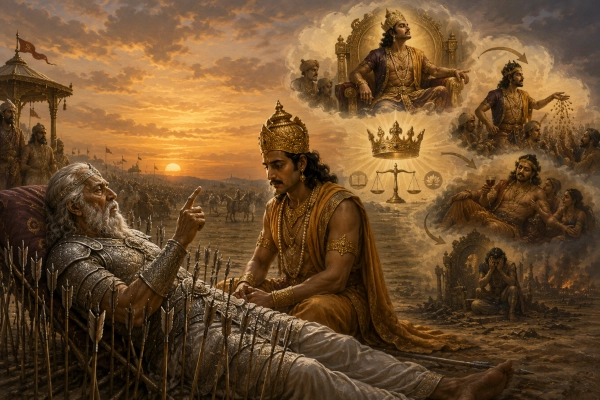
The story appears in the Shanti Parva, during Bhishma’s extensive teachings to Yudhishthira after the Kurukshetra War. Lying upon his bed of arrows, Bhishma instructs the new king about government, morality, administration and the qualities required of rulers and their officials.
The tale of the transformed dog forms part of this discussion about choosing people for positions of responsibility.
Bhishma explains that a ruler should carefully examine the character, conduct, abilities and self-control of those to whom authority is entrusted. Someone may be granted a powerful position, but the office itself cannot create integrity in a person who lacks it.
The lesson becomes political as well as moral. A king who gives authority without judging whether the recipient possesses the qualities necessary to exercise it responsibly may eventually create a danger to his own kingdom.
Power Cannot Create Character
The sage can change the dog’s body, but he cannot automatically change its character.
This distinction lies at the centre of the story.
Every transformation gives the dog greater external capability. As a leopard it becomes stronger than the dog it once was. As a tiger it becomes stronger still. The elephant, lion and Sharabha each represent another enormous increase in physical power.
Yet nothing comparable happens within the animal’s moral nature.
The dog receives strength without developing gratitude. It receives security without developing generosity. It receives authority over weaker creatures without developing restraint.
Eventually, increased power simply gives its worst instincts greater scope.
The Mahabharata therefore separates what someone is capable of doing from whether that person possesses the character to use those capabilities wisely.
The Problem Was Not the Sage’s Compassion
The story does not present compassion itself as a mistake. At every stage, the sage acts because another creature seeks his protection. Saving a frightened animal from being killed is portrayed as a natural expression of the ascetic’s benevolence.
The problem emerges when protection turns repeatedly into greater and greater empowerment without a corresponding transformation in the recipient’s character.
The dog learns an unfortunate lesson from each rescue. Whenever something frightens it, greater power will be given to eliminate the fear. Eventually it becomes so powerful that it begins thinking not about protection but domination.
The same gift that originally saved the creature ultimately exposes what lies within it.
From Vulnerability to Arrogance
When the dog is weak, it understands dependence. It knows that the sage is stronger and that its own survival rests upon his compassion.
As its power increases, that awareness slowly disappears.
The Sharabha eventually behaves as though its strength belongs entirely to itself. It forgets that the person it plans to attack is responsible for everything that makes the attack possible.
This movement from vulnerability to arrogance gives the story much of its psychological power. People often remember those who helped them while they remain dependent, but power can change the way they understand their own history.
Success may encourage a person to reinterpret gifts as achievements and assistance as evidence of personal superiority.
The transformed dog becomes the Mahabharata’s dramatic example of this failure.
Ingratitude Becomes Self-Destructive
The animal’s plan is also irrational.
If the sage has enough power to transform a dog into a Sharabha, then attacking such a sage should immediately appear dangerous. Yet arrogance has become so great that the creature can no longer understand the source of its own position.
Its betrayal therefore destroys precisely what it is trying to preserve.
The Sharabha wants to eliminate the sage so that nobody else can receive similar power. Instead, the attempt causes it to lose its own power completely.
Ingratitude becomes self-destructive.
The animal is not defeated because another beast proves stronger. It is defeated because it destroys the relationship that made its strength possible.
The Importance of Choosing People for Responsibility
Bhishma’s political application of the story is particularly important because Yudhishthira is no longer merely a warrior or prince. After Kurukshetra, he must govern an enormous kingdom.
A king cannot personally administer every village, treasury, army, fortress and court. He must delegate authority to ministers, commanders and officials.
Such appointments therefore require judgement.
Bhishma tells Yudhishthira that people should be entrusted with responsibilities appropriate to their abilities and qualifications. Courage may be necessary for one office, wisdom for another, honesty for the treasury and specialised knowledge for still another.
Granting authority simply because someone is close to the ruler is dangerous if that person lacks the character or competence required by the position. Bhishma explicitly links the story of the dog with this principle of appointing people to roles for which they are suited.
Authority Magnifies What Already Exists
A deeper interpretation of the story is that power does not necessarily change character as much as it reveals and magnifies it.
When the dog is weak, its ability to harm others is limited. Once transformed into a great predator, the same creature acquires the ability to impose its will upon the forest.
As a Sharabha, it becomes so dominant that other animals flee.
The power therefore exposes tendencies that weakness had previously kept under control. The creature that once appeared harmless becomes dangerous when circumstances give it the means to act upon its impulses.
The tale consequently warns rulers that examining behaviour only when a person is powerless may not reveal how that individual will behave once authority is granted.
Fear Does Not Disappear with Greater Power
Another striking feature of the story is that every transformation begins with fear.
The dog fears the leopard, so it becomes a leopard. The leopard fears the tiger, so it becomes a tiger. The tiger fears the elephant, the elephant fears the lion, and the lion fears the Sharabha.
Each increase in strength appears to solve the problem.
Yet fear returns.
This suggests that power alone cannot produce inner security. There is always the possibility of another rival, another danger or another individual possessing comparable strength.
Even after becoming a Sharabha, the creature remains afraid. There is no stronger predator immediately threatening it, so its fear turns toward the possibility that the sage might create one.
The enemy now exists only in its imagination.
Its attempt to achieve perfect security through greater power therefore ends by making it suspicious of its greatest friend.
The Sage Possesses a Different Kind of Power
The contrast between the dog and the sage is also significant.
The animal’s understanding of power is entirely physical. To be safe, it believes that it must become stronger than whatever threatens it.
The sage possesses another kind of strength. His power arises from austerity, knowledge and control over himself. He does not need claws, tusks or enormous physical size to dominate the situation.
At the end of the story, the gigantic Sharabha is physically terrifying, while the sage remains outwardly unchanged.
Yet the sage retains true control because he understands both himself and the creature before him.
The Mahabharata repeatedly presents self-mastery as a higher form of strength than simply possessing the ability to overpower others. The transformed dog acquires enormous strength but never masters its fear, appetite or ambition.
Gratitude Is a Form of Memory
The animal’s betrayal also involves a failure of memory.
To remain grateful, the Sharabha would have needed to remember the frightened dog it once was. It would have needed to remember running toward the sage when the leopard appeared and receiving protection when it possessed no ability to save itself.
Instead, power causes the creature to forget its own weakness.
The story therefore presents gratitude as more than politeness toward a benefactor. Gratitude requires remembering how one’s present circumstances came into existence.
The Sharabha’s moral collapse begins when it starts thinking only about what it possesses now and forgets everything that made its present strength possible.
The Final Return to the Original Form
There is a deliberate symmetry to the ending.
The story begins with an ordinary dog living peacefully near a sage. It rises through increasingly powerful forms until it becomes a creature capable of terrifying an entire forest.
Then, in a single moment, everything disappears.
The Sharabha becomes a dog again.
The transformation reminds both the animal and the listener that borrowed power can be withdrawn as easily as it was given. Rank, authority, wealth and influence may appear permanent while they are being enjoyed, yet circumstances can change rapidly when the foundations supporting them disappear.
The former dog discovers this truth only after betraying the person upon whom those foundations depended.
The Lesson of the Transformed Dog
The story of the dog transformed into powerful animals is one of the Mahabharata’s memorable teachings about power, gratitude and character. The compassionate sage gives the frightened animal every protection it requests, transforming it successively into a leopard, tiger, elephant, lion and finally a formidable Sharabha. Each transformation removes an immediate danger, but none creates the wisdom necessary to handle the new power responsibly.
Eventually, the animal becomes so powerful that it begins to regard its own benefactor as a threat. It plans to kill the sage who saved it because it fears that the same man might empower another creature. The sage reads its intention, reminds it of everything it has received and returns it to the humble form from which it began.
Bhishma uses the story to teach Yudhishthira that authority should be entrusted only after character and suitability have been carefully examined. The ability to grant someone a powerful position does not guarantee that the recipient will possess the gratitude, restraint and judgement necessary to use that position well.
The lesson extends far beyond kingship. Greater power does not automatically make a person greater. Without wisdom, gratitude and self-control, increased strength can simply magnify fear, pride and ambition.
The dog believed that becoming stronger than every creature in the forest would finally make it secure. Instead, its growing power caused it to fear even the sage who loved and protected it. By turning against the source of its own strength, it ultimately lost everything.
The Mahabharata thus leaves a simple but powerful warning: power can change circumstances, but only character determines what a person will do with it.
You may also like
-
Youth Empowerment Vision Takes Shape in Uttarakhand With Free Coaching for 11,000 Students
-
The Three Fishes: The Mahabharata’s Lesson on Foresight, Presence of Mind and Delay
-
The Golden Mongoose at the Ashvamedha: The Humble Gift That Outweighed Yudhishthira’s Great Sacrifice
-
Yudhishthira and the Faithful Dog: The Final Test of Dharma on the Road to Heaven
-
Indian Indology and Sanskrit Programmes Build Growing Academic Presence in Poland
